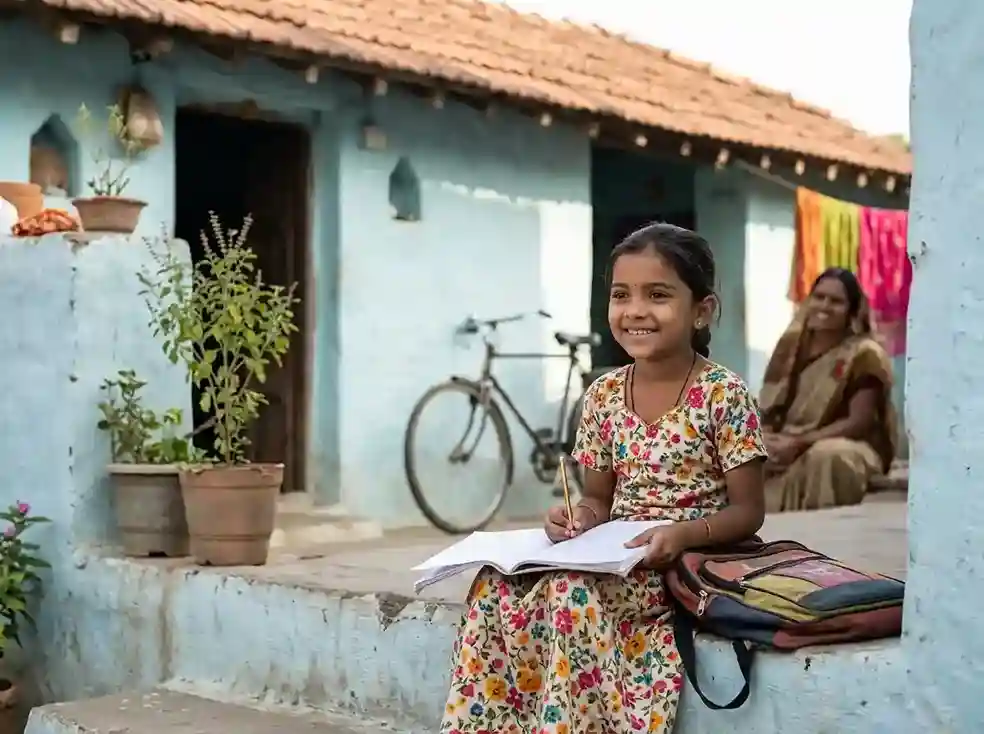
A state government scheme that gives Rs. 1,10,000 to families raising daughters. Money comes in three payments | at Class 1, Class 9, and age 18. This guide covers every detail families need in 2026-27.
Vahli Dikri Yojana is a Gujarat state government scheme. It gives Rs. 1,10,000 in financial support to families with one or two daughters. Payments happen at three milestones in a girl's life. The scheme aims to improve the girl-child birth rate, cut school dropout rates, and remove financial barriers to higher education.
"Vahli Dikri" means "dear daughter" in Gujarati. The name reflects the scheme's core message | that daughters deserve the same celebration and investment as sons.
Before the scheme launched, Gujarat recorded only 883 girls for every 1,000 boys. Many families in low-income groups pulled daughters out of school early. The Gujarat government designed this scheme to change both problems at once.
The Department of Women and Child Development (WCD Gujarat) runs the scheme. Payments go directly into the bank account of the mother or female guardian. No middleman is involved.
Similar girl-child welfare schemes exist in other states | Rajasthan has the Raj Shree Yojana, Madhya Pradesh runs Ladli Laxmi Yojana, and Haryana has the Ladli Scheme. Vahli Dikri Yojana is Gujarat's version, designed for the state's specific demographic needs.
Gujarat Chief Minister Vijay Rupani formally launched the scheme on 2 August 2019 in Rajkot. He chose that date because it was his 63rd birthday. The launch happened at a Seva Setu Mega Camp organized jointly by the district administration and Rajkot Municipal Corporation at Dharmendra College Ground.
At the launch, the Gujarat government announced a budget allocation of Rs. 133 crore for the scheme in the 2019-20 state budget. Finance Minister Nitin Patel had first announced the scheme in the budget session earlier that year.
Rupani personally handed over assistance under various schemes to 63 beneficiaries to mark the day. Women and Child Welfare Minister Ganpatbhai Vasava thanked the Chief Minister on behalf of all girls in the state.
The government screened a documentary on Vahali Dikri Yojana and released a book on the occasion. The scheme was positioned as a direct response to the state's skewed child sex ratio and high school dropout rate among girls.
Key fact for competitive exams: Gujarat CM Vijay Rupani launched Vahli Dikri Yojana on 2 August 2019 in Rajkot with a Rs. 133 crore budget allocation.
Before 2019, Gujarat had three well-documented problems with girl-child welfare:
Only 883 girls were born for every 1,000 boys. National and state data showed consistent undercounting and undervaluing of girl children in several districts.
Around 30% of girls dropped out before reaching Class 10. Over 57% left school before entering higher secondary. Financial pressure was the main reason cited by families.
Low-income families often treated daughters as a financial liability. Dowry expectations added to the burden. Direct cash transfers aimed to reverse that thinking.
The scheme pays Rs. 1,10,000 per eligible girl child. Payments happen at three specific milestones. Here is exactly how the money flows:
The first payment of Rs. 4,000 is made when the girl takes admission in Class 1. This money supports the family during the early schooling years. It covers basic stationery, uniform, and school fee costs.
The second payment of Rs. 6,000 is released when the girl passes Class 8 and takes admission in Class 9. This is the most critical dropout risk period. Many girls leave school before reaching this stage. The payment incentivizes families to keep daughters enrolled through secondary education.
The largest payment of Rs. 1,00,000 is made when the girl reaches 18 years of age. She must either be pursuing higher education or approaching marriage. This amount is intended to fund college fees, vocational training, or marriage expenses.
| Stage | Trigger Event | Amount Paid | Purpose |
|---|---|---|---|
| 1 | Admission to Class 1 | Rs. 4,000 | Early schooling support |
| 2 | Admission to Class 9 | Rs. 6,000 | Retention in secondary school |
| 3 | Age 18 | higher education or marriage | Rs. 1,00,000 | Higher education or marriage |
| Total | Rs. 1,10,000 | Per eligible girl child | |
Important: All payments go directly to the bank account of the mother or female guardian. The money is not paid in cash. An active bank account is required before applying.
The Gujarat government set specific conditions for eligibility. Read these carefully before applying. Missing one condition means the application will be rejected.
The annual household income must not exceed Rs. 2 lakh from all sources. This includes wages, agricultural income, business income, and any other earnings. The income certificate must be issued by a competent authority such as a Mamlatdar or Taluka Development Officer.
If a family has a third or fourth daughter, those daughters do not qualify. The benefit is restricted to the first two live girl children per family.
Girls belonging to Scheduled Castes (SC), Scheduled Tribes (ST), and Other Backward Classes (OBC) who meet the income limit are also eligible. Caste certificate must be attached if applicable.
Gather these documents before visiting the application office. Incomplete submissions cause delays. Keep photocopies of all documents.
Take all original documents and two sets of self-attested photocopies. The office may need originals for verification before returning them.
The primary application route is offline | through your local Anganwadi centre, Gram Panchayat office, or District WCD Office. An online portal for some districts is also available via the Gujarat Government citizen services site.
Go to your nearest Anganwadi Kendra, Gram Panchayat, or the District Office of the Women and Child Development Department. All three can provide you the official form.
Ask for the Vahli Dikri Yojana application form. The form is free. Do not pay anyone for it. The form is also available at the Gujarat government scholarship portal.
Fill all required fields | child's name, date of birth, parents' details, income details, and bank account number. Write clearly. Corrections or overwriting can cause rejection.
Attach self-attested photocopies of all the documents listed above. Check the list twice before submitting. Missing even one document delays the process significantly.
Submit the completed form with attachments at the same office where you collected it. Ask for an acknowledgement receipt. Keep it safe | you will need it to track your application.
The concerned official will verify the form and documents. Once approved, the selected girl child's name is published in the beneficiary list. Payments begin after verification.
Some districts allow online submission through the Gujarat government's citizen services portal. Steps are similar:
Go to the District Women and Child Development Department portal or the Gujarat citizen services site. Look for the Vahli Dikri Yojana link.
Create a login with your mobile number. Fill in child and parent details. Upload scanned copies of all documents in the required format and size.
Submit the application and save the confirmation number. Use this number to track application status online. Download and print the confirmation page for your records.
Note: Online availability varies by district. If you cannot find the online option, visit the nearest Anganwadi or District WCD Office. That will always work.
If you face any difficulty applying, contact the District Office of Women and Child Development in your district. They are the official authority for this scheme.
Find Your District OfficeHere is what makes this scheme different from a one-time grant:
Every payment goes directly into the mother's bank account. There is no cash disbursement. This reduces leakage and ensures the money reaches the family.
Payments are tied to education milestones. This structure rewards families for keeping daughters in school | not just for enrolling them.
The scheme is 100% funded by the Gujarat state government. No co-payment or contribution from the family is required at any stage.
Each eligible family can claim benefits for up to two girl children. Both girls must individually meet the eligibility conditions.
The documents required are standard and available to most rural families | Aadhaar, income certificate, birth certificate, and bank passbook.
The scheme does not require the girl to score specific marks. Enrollment and attendance in the next class level is sufficient to claim the payment.
The Gujarat government designed the scheme around five specific outcomes:
| # | Objective | Target Problem |
|---|---|---|
| 1 | Improve the girl-child sex ratio in Gujarat | Sex ratio stood at 883 girls per 1,000 boys at launch |
| 2 | Reduce female school dropout rates | 30% of girls dropped out before Class 10 |
| 3 | Encourage higher education for girls | 57% of girls left school before higher secondary |
| 4 | Reduce female foeticide and infanticide | Economic pressure on families with daughters |
| 5 | Improve socio-economic status of girls | Financial dependence and limited opportunities |
The Rs. 6,000 payment at Class 9 admission is specifically designed for the highest-risk dropout point. Research from Gujarat's education data shows that most girls leave school between Class 8 and Class 10. By attaching a cash incentive to that specific transition, the scheme gives families a direct financial reason to keep daughters enrolled.
The Rs. 1,00,000 payment at age 18 serves a dual purpose. It provides a meaningful lump sum for higher education fees. It also reduces pressure for early marriage by making turning 18 financially beneficial rather than a trigger for premature marriage.
The central government's Beti Bachao Beti Padhao scheme runs alongside state schemes like Vahli Dikri Yojana. National data shows the sex ratio at birth improved from 918 in 2014-15 to 930 in 2023-24, reflecting cumulative impact of multiple schemes across states.
Many states run their own versions. Here is how Gujarat's scheme compares with four key state schemes:
| Scheme Name | State | Total Benefit | Key Feature |
|---|---|---|---|
| Vahli Dikri Yojana | Gujarat | Rs. 1,10,000 | 3 stage payments, up to 2 girls |
| Raj Shree Yojana | Rajasthan | Rs. 50,000 | 6 stage payments from birth |
| Ladli Laxmi Yojana | Madhya Pradesh | Rs. 1,18,000 | NSC-based deposits over 5 years |
| Majhi Kanya Bhagyashree | Maharashtra | Rs. 50,000 | Deposit in bank at age 18 |
| Ladli Scheme | Haryana | Rs. 5,000/yr | Annual payment up to Class 10 |
Gujarat's scheme stands out for the size of the final payment (Rs. 1 lakh at age 18) and for applying to families across all castes | not just specific communities.
Beware of fraud: No agent or middleman is needed to apply for this scheme. The form is free. If anyone asks for money to fill or submit your form, report them to the District WCD Office immediately.
| Scheme Name | Vahli Dikri Yojana (Vahali Dikri Yojana) |
| Launched By | Gujarat CM Vijay Rupani |
| Launch Date | 2 August 2019, Rajkot |
| Administered By | Dept. of Women and Child Development, Gujarat |
| Total Benefit | Rs. 1,10,000 per eligible girl child |
| Payment Stages | Stage 1: Rs. 4,000 (Class 1) | Stage 2: Rs. 6,000 (Class 9) | Stage 3: Rs. 1,00,000 (age 18) |
| Eligibility | Girl born after 2/8/2019, first or second daughter, Gujarat resident, family income below Rs. 2 lakh |
| Budget Allocation | Rs. 133 crore (2019-20 budget) |
| Payment Method | Direct Bank Transfer (DBT) to mother's account |
| Application Mode | Offline (Anganwadi / District WCD Office) and Online (select districts) |
Explore all Gujarat government scholarship schemes available for your daughter, from primary school through college.
View All Gujarat Scholarships