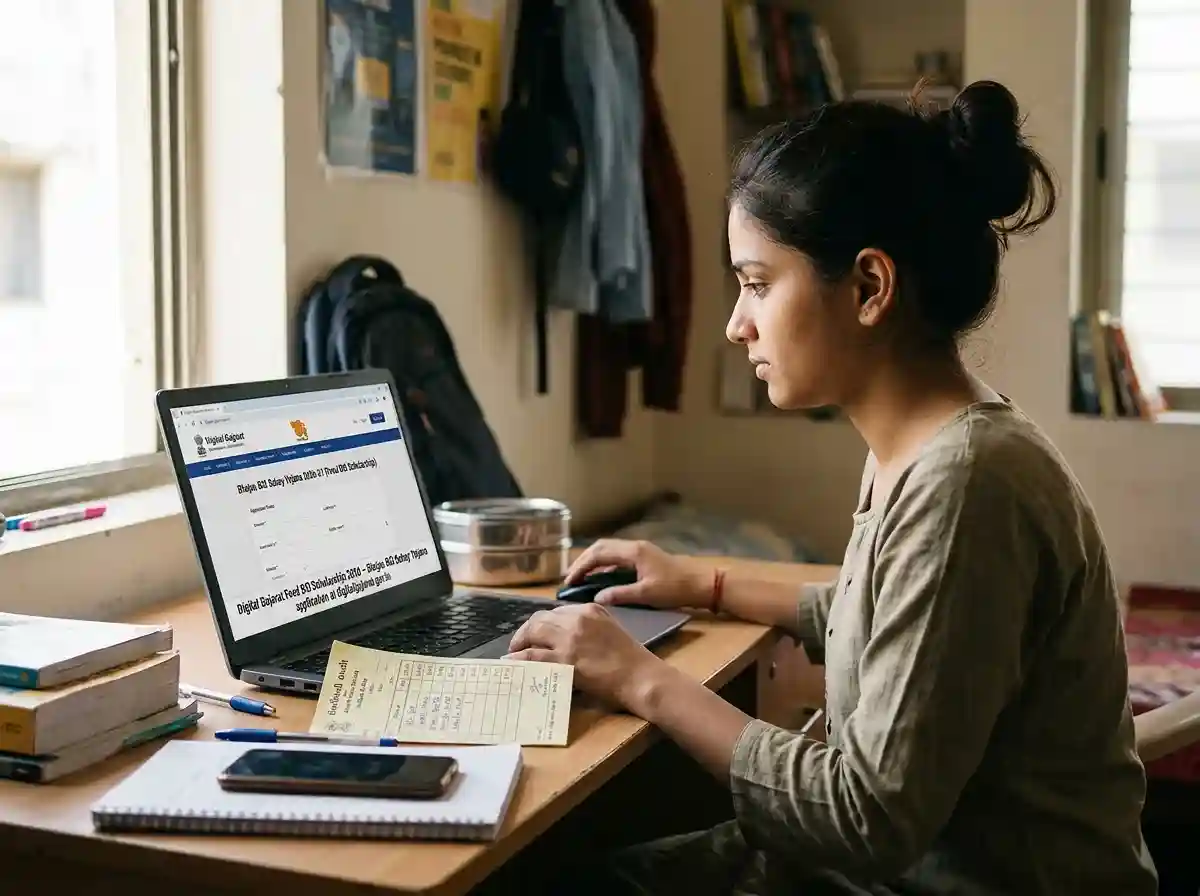
The Digital Gujarat Food Bill Scholarship covers hostel meal costs for SC, SEBC, and ST students. Applications open annually at digitalgujarat.gov.in.
What Is the Digital Gujarat Food Bill Scholarship?
Many students leave their home districts to study engineering or medicine. They get admission in a city college, move into a hostel, and then face a reality their family did not fully account for: the cost of daily meals.
Hostel food is not free. For a family earning less than Rs. 2.5 lakh a year, it adds up fast. Tuition fees, travel, books | and then a food bill on top of that. Many students cut corners on nutrition just to stay enrolled.
The Digital Gujarat Food Bill Scholarship exists to fix that specific problem. It is a meal cost assistance programme run by the Government of Gujarat under the Digital Gujarat Scholarship portal. The scheme covers food expenses for eligible students living in college-attached hostels. It is also called the Bhojan Bill Sahay Yojana in Gujarati.
This is not a general scholarship. It does not pay tuition or exam fees. Its only purpose is food bill assistance. That focus makes it a strong add-on to the Post Matric Scholarship, which handles most other costs.
Four separate schemes fall under this umbrella. Each scheme targets a different student category. They share the same purpose but have different eligibility rules and amounts.
All Four Food Bill Scholarship Schemes | Gujarat 2026
Each scheme has a different scheme code, category, and income limit. Check which one applies to you before applying.
Food Bill Assistance for SC Students
For Scheduled Caste students in any post-matric course. Must live in an affiliated college hostel. Family income limit: Rs. 6 lakh per year. Additional benefit on top of Post Matric Scholarship.
Food Bill Assistance for Medical/Engineering Students (SEBC)
For SEBC students enrolled in medical or engineering programmes at government or unaided institutions. Family income limit: Rs. 2.5 lakh. Must live in college-attached hostel.
Food Bill Assistance in College Attached Hostels (ST)
For Scheduled Tribe students in any regular course at a recognised institution. Family income limit: Rs. 2.5 lakh. Student must reside in an affiliated college hostel.
MYSY Food Assistance Component
Part of the Mukhyamantri Yuva Swavalamban Yojana for students from non-reserved categories. The food assistance component is Rs. 12,000 per year for hostel residents alongside tuition and fee support.
Scheme Comparison at a Glance
The table below shows all four schemes side by side. Use it to identify which scheme matches your situation.
| Scheme | Category | Course | Amount/Year | Income Limit |
|---|---|---|---|---|
| BCK-78 | SC | Any post-matric | Rs. 15,000 | Rs. 6 lakh |
| BCK-79 | SEBC | Medical / Engineering only | Rs. 12,000 | Rs. 2.5 lakh |
| VKY-157 | ST | Any regular course | Rs. 12,000 | Rs. 2.5 lakh |
| MYSY | General / EWS | Higher education (hostel) | Rs. 12,000 | Rs. 6 lakh (family) |
Eligibility Criteria for Food Bill Scholarship Gujarat
Eligibility varies slightly by scheme, but all four share a common base. Read the criteria for your category carefully before starting the application.
Common Requirements (All Schemes)
- Permanent resident (domicile) of Gujarat state
- Currently enrolled in a recognised college or university in Gujarat
- Living in a hostel affiliated with the same institution
- Must not be receiving the same food assistance from any other government source
- Bank account must be linked to Aadhaar and operational for DBT
BCK-78 | SC Students
- Must belong to Scheduled Caste (SC) community
- Must be studying in a post-matric course (Class 11 and above)
- Total family income from all sources must be below Rs. 6 lakh per year
- Can claim this benefit in addition to the Post Matric Scholarship
BCK-79 | SEBC Students (Medical or Engineering)
- Must belong to Socially and Educationally Backward Class (SEBC)
- Must be enrolled in a medical or engineering programme
- Institution must be government or government-aided / unaided recognised college
- Total family income must be below Rs. 2.5 lakh per year
VKY-157 | ST Students (College Hostels)
- Must belong to Scheduled Tribe (ST) community
- Must be enrolled in any regular full-time course
- Institution must be recognised by the government
- Total family income must be below Rs. 2.5 lakh per year
Documents Required for Food Bill Scholarship
Scan all documents clearly before you open the portal. Blurry uploads cause rejection. Keep each file under 200 KB.
Aadhaar Card
For identity verification and DBT payment linkage
Caste Certificate
SC / SEBC / ST as applicable | issued by Mamlatdar
Income Certificate
Family income from all sources | issued by Mamlatdar or Tehsildar
Bank Passbook
Must be Aadhaar-linked and active for DBT
College Admission Proof
Admission letter or fee receipt showing current enrolment
Hostel Allotment Letter
Proof of residence in an affiliated college hostel
Previous Marksheet
Marks from the qualifying examination for current course
Passport-size Photo
Recent photo with white background | mandatory for portal profile
Domicile Certificate
Proof that you are a permanent resident of Gujarat
How to Apply for Food Bill Scholarship at digitalgujarat.gov.in
The entire process is online. You do not need to visit any office. Read through all the steps before you start, so you do not leave the form midway.
Register or Log In
Go to digitalgujarat.gov.in. Click Register if you are new. Enter your mobile number, email, and a password. Verify with the OTP. If you already have an account, log in directly.
Complete Your Profile
Click "My Profile." Fill all required fields | name, address, category, date of birth. Upload a passport-size photo. Click "Update Profile" and verify with OTP. An incomplete profile blocks the application.
Go to Scholarship Services
Click the "Service" tab on the top menu. Select "Scholarship Services." You will see a list of schemes. Select the scheme for your category | SC, SEBC, or ST | and the current financial year.
Select the Correct Food Bill Scheme
Find the food bill scheme from the scheme list. For SC students, look for BCK-78. For SEBC medical/engineering students, look for BCK-79. For ST students, look for VKY-157. Click on your scheme and then click "Apply."
Fill the Application Form
Enter your personal details, current course, institution name, hostel allotment details, and bank account information. Double-check everything before moving forward. Errors in bank details delay or block payment.
Upload All Required Documents
Upload each document in the correct field. Files must be clear, under 200 KB, and in PDF or JPG format. Check each uploaded file after upload to confirm it is readable. Blurry files cause rejection.
Save as Draft and Review
Click "Save as Draft." Review every section from the beginning. Check that your name in the form matches your Aadhaar exactly. Small mismatches cause the college to reject the application before it reaches the government.
Submit and Note Your Application Number
Tick the declaration checkbox. Click "Submit." The portal gives you an application reference number. Write it down or screenshot it. You need this number to check your application status later.
What Happens After You Submit
Submitting the form is step one. After that, the application goes through a multi-level review before payment reaches your account.
College-level verification: Your institution's scholarship coordinator reviews your application first. They check whether you are genuinely enrolled and living in the hostel. If they find a discrepancy, they send the application back with a query.
Government review: After the college approves, the Department of Social Justice and Empowerment processes the application. Officials verify documents and check for duplicate claims from the same student.
DBT payment: Once approved, funds transfer via Direct Benefit Transfer (DBT) to your Aadhaar-linked bank account. You receive a credit alert on your registered mobile number.
The whole process | from submission to payment | typically takes 30 to 90 days after the application window closes, depending on the volume of applications in your district.
Common Reasons Your Application Gets Rejected
Most rejections are preventable. These are the most frequent reasons:
- Not living in an affiliated hostel. Day scholars do not qualify. Applications from private paying-guest accommodation are also rejected.
- Name mismatch between Aadhaar and application form. Even a slight spelling difference triggers a flag.
- Wrong scheme selected. A student selecting BCK-79 without being in a medical or engineering programme will face rejection.
- Duplicate application from the same student. If you submit more than one application for the same scheme | even from different devices | all applications get rejected automatically.
- Expired income certificate. An income certificate from a previous academic year is not accepted.
- Bank account not linked to Aadhaar. The DBT system requires an active Aadhaar-seeded bank account. Payments fail if the account is dormant or not seeded.
- Wrong or incomplete IFSC code. Double-check your bank account number and IFSC. A single digit error means your payment bounces.
- Not responding to college queries. If the college sends a correction query and you miss it, the application gets auto-rejected after the deadline.
Can You Combine Food Bill Scholarship With Other Schemes?
Yes | and you should, if you qualify.
The Food Bill Scholarship is designed as a supplementary benefit. SC students who receive the BCK-6.1 Post Matric Scholarship can also claim BCK-78 food bill assistance on top of it. These are two separate schemes with separate budgets.
Similarly, SEBC students receiving the post-matric scholarship can also apply for BCK-79 separately, as long as they are in medical or engineering and living in a hostel.
What you cannot do is claim the food bill benefit from two different schemes at the same time. For example, an SC student cannot claim both BCK-78 and VKY-157. Choose the one relevant to your category and stick to it.
Renewal | What to Do in the Next Academic Year
The Food Bill Scholarship is not a one-time payment. It is an annual scheme. You must apply | or renew | every academic year to continue receiving the benefit.
Renewal is not automatic. If you do not re-apply during the application window for the new academic year, you lose that year's payment. There is no backdated compensation.
For renewal, you need:
- Your previous year's application number
- Updated income certificate for the current year
- Current year's hostel allotment letter
- Current year's college enrolment or fee receipt
- Updated bank passbook (if account details changed)
The portal usually distinguishes between "Fresh Application" and "Renewal Application." Select the correct type. Renewal applications typically process faster because background verification data already exists in the system.
Application Dates | Digital Gujarat Food Bill Scholarship 2026
The Food Bill Scholarship follows the same academic calendar as the broader Digital Gujarat Scholarship programme.
For Academic Year 2026–27:
- Application window expected to open: June–August 2026
- Last date to apply: 31 October 2026 (extendable in some categories)
- Renewal window: opens alongside the fresh application window
Frequently Asked Questions
The Digital Gujarat Food Bill Scholarship, also called Bhojan Bill Sahay Yojana, is a meal cost assistance programme run by the Government of Gujarat. It pays for food expenses of students living in college-attached hostels. The benefit runs for 10 months per academic year. It covers SC, SEBC, and ST students through four separate schemes on the Digital Gujarat portal.
SC students under BCK-78 get Rs. 1,500 per month | Rs. 15,000 per year. SEBC students under BCK-79 get Rs. 1,200 per month | Rs. 12,000 per year. ST students under VKY-157 also get Rs. 1,200 per month | Rs. 12,000 per year. MYSY beneficiaries get Rs. 12,000 as a flat food component per year. All payments go to your Aadhaar-linked bank account via DBT.
No. The Food Bill Scholarship is only for students who live in a college-affiliated hostel. Day scholars are not eligible under any of the four schemes. If you are staying in a private room or paying-guest accommodation outside the campus, you also do not qualify | even if you eat at the college canteen.
Yes. The Food Bill Assistance is a separate, supplementary benefit. SC students receiving BCK-6.1 Post Matric Scholarship can also apply for BCK-78 food bill assistance. The two schemes are funded separately. You must apply for each scheme individually on the portal. You cannot claim the same food benefit from two different schemes at the same time.
For SC students (BCK-78), the family income limit is Rs. 6 lakh per year from all sources. For SEBC students (BCK-79) and ST students (VKY-157), the family income must be below Rs. 2.5 lakh per year. For the MYSY food component, the family income limit is Rs. 6 lakh per year. Income is calculated from all family members' earnings combined.
The BCK-79 scheme for SEBC students covers medical and engineering courses only. It does not apply to arts, commerce, science, or other streams. SEBC students in non-medical and non-engineering courses should check whether any other relevant Digital Gujarat scheme applies to their situation.
You cannot edit an application after submission. Wait for the college coordinator to review your application. If they find an error, they will send a query. Respond to that query with the correct information or document. If the application is rejected, you must apply fresh in the next available window. The DG helpline at 1800-233-5500 can guide you on correction procedures.
Log in to your account at digitalgujarat.gov.in. Click "My Services" or "Track Application Status." Enter your application number if prompted. You will see the current stage | Submitted, Under College Verification, Under Government Review, Approved, or Rejected. If payment has been approved, you will receive an SMS on your registered mobile number.