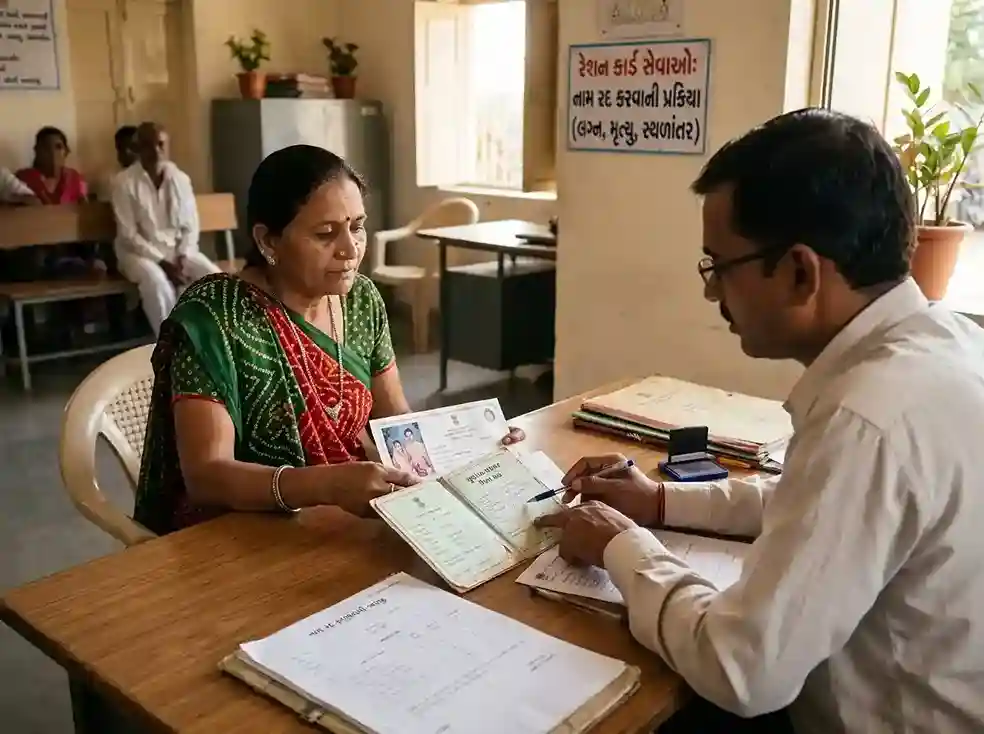
What Is Ration Card Name Removal
A ration card lists every member of a household. It decides how much subsidised food grain that family gets each month under the Public Distribution System (PDS). When a member's situation changes, that name must be removed from the card.
Keeping an inactive or departed member on the card is not just a paperwork issue. Ration entitlement is calculated per person. An outdated card means your family's allocation still shows that person, which can attract scrutiny during verification drives. In some cases, it can lead to card suspension.
There are three situations that call for name removal. Each one has its own process and its own set of documents. This guide covers all three in full detail.
- Death certificate (Municipal / GP)
- Ration card copy
- Aadhaar of HoH
- If HoH died: Change of HoH form
- Marriage certificate
- Proof of name on new/spouse's card
- Ration card copy
- Aadhaar of HoH
- Self-declaration affidavit
- Original ration card
- Aadhaar of all members
- Surrender certificate (issued after)
Scenario 1 — Death of a Member
When to use this process
Use this when a person listed on the ration card has died. This includes the head of household and any dependent family member. The name must be removed so the card reflects the correct number of living members in the household.
If the deceased was a regular member (not the head), the process is straightforward. If the deceased was the head of household, you also need to file a Change of Head of Household application at the same time.
Documents Required — Death of Member
Special Situations — Death
If the death certificate has a name spelling different from the ration card, get a correction done on one of the two documents before applying. A mismatch is the most common cause of rejection in death-related removal cases.
If the deceased was the sole member of a ration card, the card itself must be surrendered rather than just a name removed. Approach your Mamlatdar office directly in this case and file for full card cancellation with the death certificate.
If the death happened years ago and was never reported, you can still file. There is no time limit on filing name removal for deceased members. Older cases may require a sworn affidavit stating when the death occurred and explaining the delay.
Scenario 2 — Marriage and Migration
When to use this process
Use this when a family member has got married and moved to their spouse's household, or when someone has permanently migrated to another city or state and needs a new ration card at their new location.
The key principle here is that a person cannot be on two ration cards at the same time. Before adding a name to a new card, it must be removed from the old one. This is why the process has two steps: removal at the origin and addition at the destination.
Documents Required — Marriage of a Daughter or Son
Documents Required — Permanent Migration to Another State
When the Person Has Already Left and Their Name Was Never Removed
This is a common situation. A daughter married years ago, but her name was never taken off the family's ration card. To remove it now, you follow the same process. Attach the marriage certificate and, if available, a copy of the ration card at the new address. If no new ration card exists, a notarised affidavit stating the date of marriage and new address is usually accepted.
Scenario 3 — Voluntary Surrender
When to use this process
Voluntary surrender means a member or the entire household chooses to give up their ration card or their membership in it. This happens when a family's income rises above the PDS eligibility limit, when a person wants to stop receiving subsidised rations by choice, or when a household splits into two separate units.
The government also encourages financially stable families to voluntarily surrender their PDS benefits so that the ration can reach genuinely needy households. A surrender certificate is issued as proof. This certificate is required if you later want to apply for a new ration card at a different location.
Documents Required — Voluntary Surrender
Difference Between Surrender and Cancellation
These two terms sound the same but they are not. Surrender means you voluntarily give up the card and receive a certificate. You retain the right to apply for a new card in the future if circumstances change. Cancellation is permanent — it is usually done by the government due to fraud, duplicate entries, or death of all members. A cancelled card cannot be reinstated.
Always file for surrender, not cancellation, if you are moving or your situation may change later.
Household Split — When a Member Wants Their Own Card
If an adult member wants to set up a separate household and get their own ration card, they must first be removed from the existing card. This is technically a voluntary removal on behalf of that member. After removal, they can apply for a new ration card using their new address proof, Aadhaar, and a declaration that they now run a separate kitchen.
Both the old card holder and the new applicant must show separate residential addresses. A NOC from the current head of household is mandatory in most Gujarat districts.
Documents at a Glance — All Three Scenarios
This table summarises what each scenario requires. Use it as a quick-check before you start your application.
| Document | Death | Marriage / Migration | Voluntary Surrender |
|---|---|---|---|
| Death Certificate | Required | Not needed | Not needed |
| Marriage Certificate | Not needed | Required | Not needed |
| Existing Ration Card (copy) | Required | Required | Original required |
| Aadhaar of Applicant / HoH | Required | Required | Required (all members) |
| Proof of new ration card / address | Not needed | Often required | Not needed |
| Self-Declaration Affidavit | Sometimes | Sometimes | Required |
| Surrender Certificate (issued after) | Not applicable | For migration out of state | Issued after processing |
| Change of HoH Form (Form B) | If HoH died | Not needed | Not needed |
How to Apply Online — Step by Step
All ration card member deletion services in Gujarat are available at digitalgujarat.gov.in. There is no need to visit an office if your documents are ready and you have a working internet connection.
Log in to Digital Gujarat Portal
Go to digitalgujarat.gov.in. Click Citizen Login. Enter your registered mobile number or Aadhaar linked to your account. Verify with OTP. New users need to register first using Aadhaar and mobile.
Go to Citizen Services → Ration Card
From the home dashboard, click the Services tab. Select Citizen Services. Scroll to the Ration Card section. Click on Removal of Name from Ration Card.
Enter ration card number and select member
Enter your ration card number. The portal will display all listed members. Select the name you want to remove. Confirm the ration card number matches your card exactly — even a one-digit error will pull up the wrong record.
Select reason for removal
Choose from the dropdown: Death, Marriage, Separate Household / Migration, or Voluntary Surrender. The system then shows you the specific document upload fields for that reason. Different reasons show different fields.
Upload supporting documents
Upload each required document. Files must be in PDF or JPG format. Each file must be under 200 KB. Scan clearly — blurry uploads cause delays. Label your files before uploading so you can track which is which.
Review and final submit
Check every field before clicking Submit. Verify the member's name, reason, and documents. Once submitted, you cannot edit the application. You will get an application reference number — note it down or screenshot it.
Track your application status
Log in at any time and go to Track Application. Enter your reference number to see the current status — Submitted, Under Verification, Approved, or Rejected with reason. Processing takes 15 to 30 working days.
How to Apply Offline — Mamlatdar and Jan Seva Kendra
Not everyone has internet access or comfort with online forms. The offline route works just as well. Processing time is the same.
Visit your Taluka Mamlatdar office or Jan Seva Kendra
Go to the nearest office during working hours. Carry originals and photocopies of all required documents. Some Jan Seva Kendras can scan your documents if you bring only the originals.
Collect the Member Deletion Form
Ask the counter staff for the Ration Card Member Deletion Form. The form is free. Do not accept a form with pre-filled incorrect information.
Fill the form carefully
Enter the ration card number, the name of the member to be removed, and the reason. Write clearly in block letters. Attach all required documents. If removing a deceased person, attach the death certificate. If marriage, attach the marriage certificate.
Submit and collect receipt
Submit the completed form with documents at the counter. Insist on a stamped acknowledgement receipt. It carries your application number and submission date. You need it to track your case and to escalate if there is a delay.
Verification and collection of revised card
The office verifies your documents, which may include a home visit by a Civil Supplies Inspector. After approval, the revised ration card is issued. Collect it from the office or download the updated digital copy from digitalgujarat.gov.in.
Common Mistakes That Cause Rejection
Rejection wastes time. Here are the mistakes that appear most often — and how to avoid them.
Name Mismatch Between Certificate and Ration Card
If the death certificate says "Ramesh Patel" but the ration card says "R. Patel", the portal flags a mismatch. Get the name corrected in one document before applying. A notarised affidavit explaining the variation also works in some districts.
Hospital Discharge Summary Instead of Death Certificate
A hospital discharge or death summary is not a legal death certificate. The death must be registered with the Municipal Corporation or Gram Panchayat, and the official certificate issued from there. This takes 1 to 7 days after registration.
Wrong Reason Selected in the Portal
Selecting "Marriage" when the actual reason is "Separate Household" pulls up different document fields. An uploaded death certificate against a marriage reason will fail verification. Match the reason exactly to your situation.
Missing Proof of New Ration Card for Migration Cases
For marriage and migration, the most common rejection is not providing evidence that the person has been added to their new ration card. Get a copy of the new card or a fresh application acknowledgement from the new location before filing removal.
Aadhaar Not Linked to Ration Card
Since 2023, most states require Aadhaar linkage for any amendment. If the member's Aadhaar is not seeded on the ration card, the deletion request will be stuck. First visit your Fair Price Shop (FPS) or Jan Seva Kendra to get Aadhaar seeded. Then file the removal.
Not Following Up After Institute Verification Fails
The Mamlatdar office must forward your application to the district after verifying it. If they park it without action, your application just sits there. Follow up at the office 10 days after submission. Ask for the forwarding status by name. If no action in 30 days, file a grievance at the State Food Commission established under Section 16 of the NFSA, 2013.
What Happens After the Name Is Removed
Once your application is approved, the member's name is deleted from the state PDS database. Your ration card is updated. The food grain allocation for that household decreases by the amount assigned to the removed member, starting from the next monthly cycle.
You can download the updated ration card from digitalgujarat.gov.in under your account dashboard. If you had a paper card, collect the revised one from your Mamlatdar office.
If the household used the Antyodaya Anna Yojana (AAY) or Priority Household (PHH) category, the category remains the same for remaining members. The card type does not change just because one member was removed, unless the total number of members drops below the minimum required for that category — which is rare.
PHH households get 5 kg per person per month. AAY households get a fixed 35 kg per family regardless of member count. So for AAY cards, removing one member does not reduce the monthly allocation. For PHH cards, it does reduce the allocation proportionally.
What to Do If Your Application Is Rejected
Every rejection comes with a reason. Read the reason carefully. Most rejections fall into one of three buckets: wrong document, name mismatch, or verification failure.
Correct the specific issue raised and reapply. You can reapply online at digitalgujarat.gov.in using the same portal. Start a fresh application — do not try to edit a rejected one.
If the same application is rejected twice without a clear or valid reason, escalate. File a grievance at your district Civil Supplies Officer (DSO) with your two rejection acknowledgements as supporting evidence. If that does not resolve it in 30 days, approach the District Grievance Redressal Officer under NFSA 2013.
Related Ration Card Services in Gujarat
Ration card updates go hand in hand. After a name removal, you may need one of these services as a next step.
Add Member to Ration Card
New birth, marriage, dependent relative
Death Certificate Gujarat
Required for name removal after death
Change of Address on Ration Card
Update address after migration
New Ration Card Application
Apply for fresh card after surrender
Frequently Asked Questions
You need the official death certificate issued by the Municipal Corporation or Gram Panchayat, a copy of the existing ration card, and the Aadhaar card of the head of household filing the application. If the deceased was the head of household, you must also file a Change of Head of Household form (Form B) at the same time.
Submit the marriage certificate, a copy of your existing ration card, proof that the daughter's name has been added to the spouse's ration card (or a fresh application acknowledgement), and the head of household's Aadhaar. Apply at digitalgujarat.gov.in under Citizen Services → Ration Card → Removal of Name, selecting Marriage as the reason.
Voluntary surrender means you choose to give up your ration card membership — usually because your income has increased above the PDS eligibility limit, or because you are permanently moving to another state. You submit a self-declaration affidavit, the original ration card, and Aadhaar cards of all members. After processing, you receive a Surrender Certificate which you need to apply for a new ration card at your new location.
Processing typically takes 15 to 30 working days after you submit and the application is verified at the district level. You can track the status at digitalgujarat.gov.in using your application reference number. If you applied offline, call the Digital Gujarat helpline at 1800-233-5500 with your receipt number.
Yes. Visit your nearest Taluka Mamlatdar office or Jan Seva Kendra (JSK). Collect the Member Deletion form, fill it with the correct reason, attach all required documents, and submit at the counter. Always get a stamped acknowledgement receipt. Processing time is the same as online — 15 to 30 working days.
No. The ration card is not cancelled when the head of household dies. File a Change of Head of Household application (Form B in most states) along with the death certificate and the Aadhaar of the new head. The card transfers to the next adult member. File this together with the name removal request to avoid any gap in ration supply.
Yes, for temporary work or short stays. Under the One Nation One Ration Card (ONORC) scheme active since 2020, your Gujarat ration card works at any Fair Price Shop across India. But for permanent relocation, you should surrender the Gujarat card at the Mamlatdar office, get the Surrender Certificate, and apply for a new ration card in your destination state.
First, check your application status at digitalgujarat.gov.in using your reference number. If it shows Approved but the card has not updated, download the revised e-ration card from the portal — it should show the change. If it shows Pending for more than 30 working days, visit the Mamlatdar office with your acknowledgement receipt and ask for the forwarding status. If that does not work, file a complaint with the District Grievance Redressal Officer under NFSA 2013.