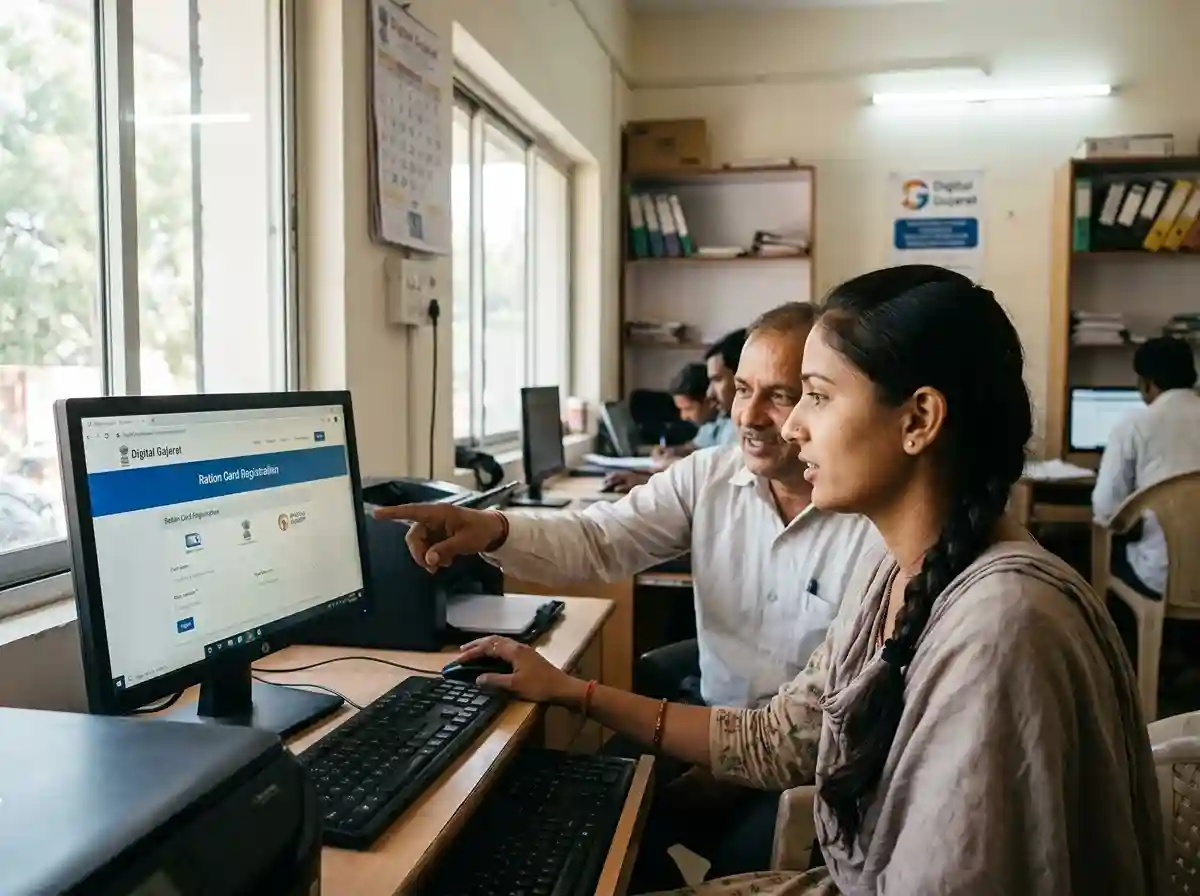
What Is a Ration Card in Gujarat?
A ration card is an official document issued by the Gujarat government's Department of Food and Civil Supplies. It lets eligible families buy wheat, rice, and other food grains at subsidised prices from government-run fair price shops (FPS).
Beyond food access, it also works as a valid identity and address proof across India. You can use it to apply for government schemes, income certificates, PAN cards, domicile certificates, and more.
Gujarat manages ration card services through two main systems. The Digital Gujarat portal handles online applications and updates. The IPDS (Integrated Public Distribution System) manages actual grain distribution at the shop level.
Types of Ration Cards in Gujarat
Gujarat issues ration cards under the National Food Security Act (NFSA) and the older Targeted Public Distribution System (TPDS). The card type depends on your household income and economic status.
AAY cards go to the most vulnerable households | landless labourers, marginal farmers, widows, and people with disabilities who have no regular income. PHH cards cover low-income families who fall under the NFSA but are not in the AAY category.
Eligibility Criteria
You must meet all of the following conditions before you apply for a Gujarat ration card.
| Condition | Requirement |
|---|---|
| Residency | Must be a permanent resident of Gujarat |
| Age of head of family | 18 years or above |
| Minimum family size | At least 2 members |
| Rural income (subsidised card) | Annual family income below ₹1.2 lakh |
| Urban income (subsidised card) | Annual family income below ₹1.5 lakh |
| Existing ration card | Must not already hold a ration card in Gujarat or any other state |
| Government employment | Family members should not hold regular government jobs (for PHH/AAY) |
| Vehicle ownership | Should not own a 4-wheeler vehicle (for PHH/AAY) |
A newly married couple living separately from parents can apply for a new independent ration card. They need to provide their marriage certificate and a separate residence proof.
Documents Required for Ration Card Registration
Keep these documents ready before you start filling the online form. Uploading them in one go saves time and avoids rejections.
| Document | Purpose | Accepted Format |
|---|---|---|
| Aadhaar Card | Identity and biometric verification | PDF / JPG |
| Proof of Gujarat Residence | Confirms permanent address in the state | Utility bill, voter ID, rent agreement |
| Income Certificate | Determines which card category you qualify for | Issued by Mamlatdar Office |
| Bank Passbook | Required for DBT and subsidy linkage | First page with account details |
| Passport-size Photograph | Applicant and family members | JPG, recent photo |
| Voter ID / Election Card | Alternate identity proof | PDF / JPG |
| Proof of Date of Birth | Birth certificate or school leaving certificate | PDF / JPG |
Newly married applicants also need their marriage certificate. Those applying for a separate card after splitting from a joint family need proof of separate residence.
How to Apply for a Ration Card Online in Gujarat
The entire process runs on the official Digital Gujarat portal at digitalgujarat.gov.in. It takes about 20–30 minutes if your documents are ready. Follow these steps carefully.
-
1Open the Digital Gujarat Portal
Go to digitalgujarat.gov.in. Click the "Services" tab on the top navigation bar.
-
2Register as a New Citizen or Log In
If you are new, click "New Registration (Citizen)" and create an account using your mobile number or email. Existing users log in directly with their credentials.
-
3Select Citizen Services
After login, click the "Revenue" menu from the homepage. Select "Application for New Ration Card" from the dropdown list.
-
4Read Guidelines and Click Apply Online
Go through the official guidelines on the next screen. Then click the "Apply Online" button to start the application form.
-
5Enter Your Profile Details
Fill in your personal details | name, address, date of birth, and mobile number. Click "Update Profile" to save, then press "Next".
-
6Fill in Family and Applicant Details
Add every family member's name, Aadhaar number, age, and relationship to the head of household. Double-check all spellings before proceeding.
-
7Upload Documents
Upload each document in the required format and size. The portal accepts JPG and PDF files. Blurry or expired documents cause rejection.
-
8Submit and Save Acknowledgement
Review all details. Click "Submit". Save or print the acknowledgement slip. It has a reference number you will need to track your application.
How to Apply Offline at the Taluka Mamlatdar Office
Not comfortable applying online? You can do it the traditional way by visiting your nearest Taluka Mamlatdar Office or Jan Seva Kendra.
-
1Visit the Office
Go to your nearest Taluka Mamlatdar Office or Jan Seva Kendra. Bring all original documents and photocopies.
-
2Collect the Application Form
Ask the staff for the ration card application form, referred to as Appendix-1 or the 64 Application Form under Gujarat PDS rules.
-
3Fill and Attach Documents
Fill the form carefully in block letters. Attach photocopies of all required documents. A staff member can help if needed.
-
4Submit and Get Receipt
Submit the form and collect your receipt. The officer will conduct a verification visit. The ration card is then sent to your home address.
Jan Seva Kendras are available at both district and taluka levels across Gujarat. They handle ration card generation and all changes to existing cards.
Application Fees for Gujarat Ration Card
The fee is small and depends on the category of card you apply for.
| Card Type | Category | Fee |
|---|---|---|
| Antyodaya Anna Yojana (AAY) | Poorest households | Free |
| BPL (Below Poverty Line) | Low income | ₹5 |
| APL-1 (Above Poverty Line) | Moderate income | ₹10 |
| APL-2 (Above Poverty Line) | Higher income | ₹20 |
Payment can be made online through the Digital Gujarat portal during submission. Offline applicants pay at the Mamlatdar Office counter.
How to Check Your Ration Card Application Status
After applying, you can track progress online without visiting any office.
-
1Go to the IPDS Gujarat Website
Visit the official IPDS portal managed by the Food and Civil Supplies Department of Gujarat.
-
2Select Year, Month, and Enter Captcha
Choose the relevant month and year. Enter the captcha code shown on screen and click "Go".
-
3Select Your District and Taluka
Click on your district, then your taluka, and then your town or village.
-
4Find Your Name
Click the number shown under your ration card category. The beneficiary list will display your application and approval status.
You can also track status directly from the Digital Gujarat portal by logging into your account and checking the "Track Application" section using your acknowledgement number.
Once approved, you can download your e-ration card from the official Food and Civil Supplies Department website at dcs-dof.gujarat.gov.in.
Benefits and Monthly Food Grain Entitlement
A Gujarat ration card does much more than just give you food grains. Here is a clear breakdown of what you receive.
Monthly Food Entitlement
| Card Type | Wheat | Rice | Total |
|---|---|---|---|
| Per person (PHH) | 4 kg | 1 kg | 5 kg per person |
| Per family (AAY) | Varies | Varies | 35 kg per family |
Other Benefits
Ration card holders in Gujarat also get access to these services through the Public Distribution System:
- Subsidised cooking oil, iodised salt, and pulses at fair price shops
- Free grains under PMGKAY | no payment required at the ration shop
- Identity and address proof for other government services
- Proof required for income certificate, PAN card, domicile certificate, and driver's licence applications
- Access to state welfare schemes and subsidies
- Portability | use your card at any fair price shop in India under ONORC
One Nation One Ration Card (ONORC) | Use Your Card Anywhere in India
Gujarat is fully integrated with the ONORC scheme. This means your Gujarat ration card works at any fair price shop across India.
If you travel to another state for work | say from Gujarat to Maharashtra or Rajasthan | you do not lose your food entitlement. You can collect your monthly food grains at the nearest fair price shop in your current location.
The system uses biometric authentication through ePoS (electronic Point of Sale) machines. Your Aadhaar number links your ration card to the national database. The shop verifies your identity with a fingerprint scan and releases your monthly allocation.
How to Use ONORC
- Your Gujarat ration card must be Aadhaar-seeded (linked) to use ONORC
- Visit any fair price shop in the new state
- Provide your ration card number or Aadhaar number
- Complete biometric verification
- Collect your allotted food grains
Name, Address, and Member Changes in Your Ration Card
Life changes | marriages, births, deaths, relocations. Your ration card should reflect your current family situation. Gujarat lets you make all these changes online.
Changes You Can Make Online
| Change Type | When to Use | Documents Needed |
|---|---|---|
| Add a new member | Birth of a child or new marriage | Birth certificate / Marriage certificate |
| Remove a member | Death or member leaving the household | Death certificate / Proof of separate residence |
| Name correction | Spelling errors or name change after marriage | Aadhaar, Gazette notification if applicable |
| Address change | Moving within Gujarat | New address proof, NOC from old FPS |
| Separate ration card | Married child living independently | Marriage certificate, separate residence proof |
| Duplicate card | Lost or damaged ration card | FIR or loss declaration |
For barcoded ration cards, you do not need to change the entire card when you move. Only the shopkeeper name and address need updating. Contact your local District Supply Office for this.
How to Apply for Changes Online
Log into the Digital Gujarat portal. Go to "Services" and search for "Ration Card Services." Select the type of change you need, fill the form, upload supporting documents, and submit. Track the change request using your acknowledgement number.
Ready to Apply for Your Ration Card?
Visit the official Digital Gujarat portal. The entire application takes less than 30 minutes if your documents are ready.
Apply Now on Digital GujaratHelpline Numbers and Contact Information
Contact these numbers if you face any issues with your application, distribution, or ration card services.
| Service | Contact Number |
|---|---|
| Food and Civil Supplies Helpline (Toll-Free) | 1800-233-5500 |
| Alternate Helpline (Toll-Free) | 1800-233-0222 |
| National Food Helpline | 14445 |
| Emergency / Grievance | 1967 |
| Direct Office (Gandhinagar) | 079-2325 1170 |
You can also walk into any Jan Seva Kendra at the district or taluka level. Staff there can assist with new applications, corrections, and status tracking in both Gujarati and English.
Frequently Asked Questions
Sources and References
- Digital Gujarat Official Portal | digitalgujarat.gov.in
- Department of Food and Civil Supplies Gujarat | dcs-dof.gujarat.gov.in
- National Food Security Act, 2013 | Ministry of Consumer Affairs
- My Ration Gujarat | UMANG App / web.umang.gov.in
- National Government Services Portal | services.india.gov.in
- Mahesana District Collectorate | mahesana.nic.in
- Vadodara District Administration | vadodara.nic.in
Last reviewed: June 2026. Information is subject to change. Always verify current details on official government portals before applying.