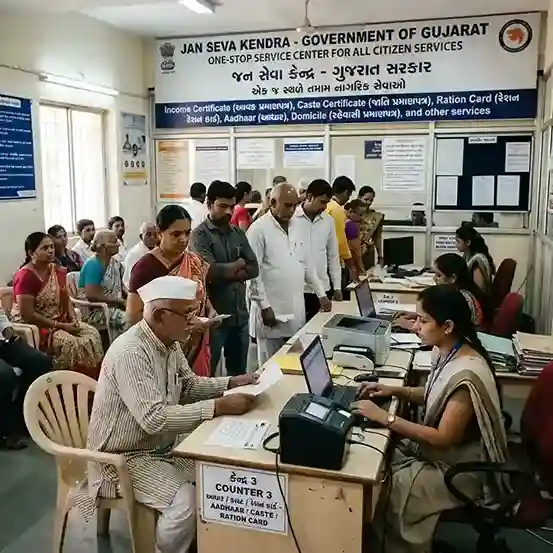
Jan Seva Kendra (meaning "people's service centre") is a one-stop citizen service outlet. In Gujarat, it is the government-operated single-window at every Taluka Mamlatdar office, offering over 102 services through digitalgujarat.gov.in — income certificates, caste certificates, ration card changes, and more. Nationally, the term also covers CSC (Common Service Centre) outlets operated by trained Village Level Entrepreneurs (VLEs) under the Digital India programme, and Sahaj Jan Seva Kendra outlets at the gram panchayat level. Find your nearest one at locator.csc.gov.in.
What Is Jan Seva Kendra
Jan Seva Kendra translates directly to "People's Service Centre." It is a physical location where citizens get access to government and digital services without visiting multiple offices. The concept is the same whether you are in Gujarat, UP, Delhi, or Rajasthan — but the operating model and services differ slightly by state.
At its core, a Jan Seva Kendra does three things. It gives citizens access to government services electronically. It acts as a last-mile connector between the government and people who are not comfortable using computers or the internet on their own. And it creates livelihood for the operator who runs it.
The term covers two distinct types of centres that often get confused:
- Government-operated Jan Seva Kendra (Gujarat model): A single-window service counter at every Taluka Mamlatdar office and Collectorate. Run by trained government staff or contracted operators. Provides 102+ revenue and welfare services through the Digital Gujarat platform. Free or very low-cost for citizens. Available in all 33 districts and 250+ talukas of Gujarat.
- CSC / Privately-operated Jan Seva Kendra (national model): A centre run by a Village Level Entrepreneur (VLE) who is registered under the CSC e-Governance Services India Limited — a government company under the Ministry of Electronics and IT. Offers government services for a small fee. Over 5 lakh such centres operate across India. Citizens pay a service charge per transaction.
Jan Seva Kendra in Gujarat — How It Works
Gujarat runs one of India's most structured Jan Seva Kendra networks. Every district has a Collectorate-level Jan Seva Kendra. Every taluka has a Mamlatdar-level Jan Seva Kendra. Together, they form a network of over 250 single-window service outlets across the state.
The Gujarat Jan Seva Kendra is described on the official district websites as "the outcome of the strategic union of technology and positive governance." Citizens visit the centre, hand over their documents, and an operator fills and submits the application online through digitalgujarat.gov.in. The citizen receives an acknowledgement slip and, once processed, either collects the certificate at the centre or downloads it digitally.
Gujarat districts with Jan Seva Kendra online portals
Every Gujarat district has a dedicated page listing Jan Seva Kendra services. You can find them at:
| District | Jan Seva Kendra Portal URL | Key Services at JSK |
|---|---|---|
| Surat | surat.gujarat.gov.in/jan-seva-kendra | 102 services — certificates, ration card, land |
| Ahmedabad | ahmedabad.nic.in | Income, domicile, caste, ration card |
| Gandhinagar | gandhinagar.gujarat.gov.in/jan-seva-kendra | 102 services — all categories |
| Vadodara | vadodara.nic.in | Domicile, income, ration card, arms license |
| Rajkot | rajkot.nic.in | Caste certificate, income, domicile, ration |
| Jamnagar | jamnagar.nic.in | Full certificate suite, widow, senior citizen |
| Bhuj / Kutch | kutch.nic.in | Certificates, ration card, panchayat services |
| Nikol / Ahmedabad Urban | ahmedabad.nic.in | Urban certificate and ration card services |
Jan Seva Kendra Services List — Complete Overview
The services at Jan Seva Kendra fall into several categories. What is available depends on whether you are at a Gujarat government Jan Seva Kendra (Mamlatdar) or a CSC-type private Jan Seva Kendra.
Revenue Certificates (Gujarat JSK)
- Income Certificate
- Domicile / Residence Certificate
- Caste Certificate (SC/ST/OBC/SEBC)
- Non-Creamy Layer Certificate
- Senior Citizen Certificate
- Widow Certificate
- Character Certificate
- Religious Minority Certificate
- Farmer Certificate
- EWS Certificate
Ration Card Services (Gujarat JSK)
- New Ration Card Application
- Add Member to Ration Card
- Remove Member from Ration Card
- Ration Card Category Change
- Duplicate Ration Card
- Address Change on Ration Card
- Ration Card Surrender
Aadhaar Services (CSC / JSK)
- New Aadhaar Enrolment
- Aadhaar Name/Address Update
- Aadhaar Mobile Number Update
- Aadhaar Biometric Update
- Aadhaar-Bank Linking (NPCI)
- Aadhaar Card Download / Print
- Jeevan Pramaan (Life Certificate)
Banking & Financial Services (CSC)
- AePS — Aadhaar-enabled Payments
- Bank Account Opening (BC Model)
- Money Transfer / IMPS / NEFT
- Insurance (PM Suraksha / Jeevan Jyoti)
- NPS — Pension Registration
- PM Kisan Registration
- Mudra Loan Application
Tax & Legal Services (CSC)
- PAN Card Application & Update
- GST Registration & Returns
- Income Tax Return Filing
- MSME / Udyam Registration
- Digital Signature Certificate
- FSSAI Food Licence Application
- Driving Licence Services
Government Scheme Applications (CSC)
- PM Awas Yojana (Urban/Rural)
- PM Kisan Samman Nidhi
- NREGA Job Card
- Scholarship Applications
- E-District Services
- Birth/Death Certificate
- Marriage Registration
How to Open a Jan Seva Kendra — Registration Process
Anyone who meets the basic requirements can open a CSC-type Jan Seva Kendra. The process runs through the CSC e-Governance Services India Limited registration portal.
Who can apply
- Minimum age: 18 years
- Minimum education: Class 10 pass from any recognized board
- Must have basic computer knowledge
- Must be able to read and write in the local language and basic English
- Must have suitable space: at least 100 to 150 square feet
- No gender, caste, or religion restriction
Equipment needed
- Two computers or laptops
- Printer and scanner
- Stable internet connection (broadband or 4G)
- Webcam for Aadhaar-related services
- Biometric device (fingerprint scanner) for AePS and Aadhaar
- UPS for power backup
Step-by-step registration at register.csc.gov.in
-
1
Get a TEC (Telecentre Entrepreneur Course) Certificate
This is the mandatory first step. Visit cscentrepreneur.in. Register, pay the course fee of approximately ₹1,479, and complete the online modules. Once you pass, you get a TEC Certificate Number. Without this, the CSC registration portal will not let you proceed.
-
2
Visit digitalseva.csc.gov.in or register.csc.gov.in
Go to the official CSC registration portal. Click Apply, then select New VLE Registration. Enter your TEC Certificate Number when prompted. The portal validates it against the TEC database.
-
3
Verify your Aadhaar
Enter your 12-digit Aadhaar number. Choose OTP verification (on your Aadhaar-registered mobile), fingerprint, or IRIS. Complete the verification. This links your identity to the CSC application permanently.
-
4
Fill in personal and centre details
Enter your name, address, email, mobile number, educational qualification, and proposed centre address. Provide the GPS coordinates of your centre location if prompted. This helps the District Manager verify the physical location.
-
5
Upload required documents
Upload clear scanned copies of: Aadhaar card (front and back), educational certificate (10th marksheet or above), address proof (if different from Aadhaar), your recent photograph, and a cancelled cheque or bank passbook first page for payment settlement.
-
6
Submit and wait for District Manager review
Submit the form. Your application goes to the CSC District Manager (CDM) for your area. They may visit your proposed centre location for verification. Approval timelines vary from a few days to 4 weeks depending on the district.
-
7
Receive CSC ID and start operations
After approval, you get your CSC ID and login credentials for the Digital Seva Portal. Display your CSC ID, rate list, and the Digital India logo at your centre as required. Log in at digitalseva.csc.gov.in and start offering services to citizens.
Documents Required for Jan Seva Kendra Registration
- 1TEC Certificate NumberFrom cscentrepreneur.in — mandatory first step. Keep your certificate number handy during registration.
- 2Aadhaar CardFor Aadhaar-based identity verification. Your mobile number must be registered with Aadhaar for OTP verification.
- 3Educational CertificateClass 10 marksheet or certificate from a recognized board. Higher education documents are accepted too.
- 4Address ProofIf your current address differs from the Aadhaar address. Utility bill, rent agreement, or voter ID.
- 5Bank Account DetailsCancelled cheque or passbook first page. CSC commissions are deposited to this account. The account must be in your name.
- 6Passport-size PhotographRecent, clear photo against white background. Under 100 KB JPG.
- 7Police Character Verification CertificateMandatory from May 2026. Obtain from your local police station before applying.
Sahaj Jan Seva Kendra — What It Is and How to Register
Sahaj Jan Seva Kendra is a separate network operated by Sahaj e-Village Limited, which has a government agreement to deliver G2C (Government-to-Citizen) services at the gram panchayat level. It is not the same as CSC, though both offer similar services.
Sahaj focuses primarily on rural areas and aims to reach villages that CSC outlets may not cover. The Sahaj portal at portal.digitalgujaratscholarships.com offers mobile recharges, bill payments, DTH services, e-district services, banking correspondents, and more. Operators log in with a Sahaj ID and password.
Key services available at Sahaj Jan Seva Kendra
- Sahaj Mitra Pay — electricity bills, mobile recharges, internet bills, DTH
- E-District services — state certificate applications
- Banking correspondent — account services, money transfer
- Save Mitra Education — video lectures, computer courses
- PAN card, Aadhaar services, ration card applications
- Insurance and pension services
How to register for Sahaj Jan Seva Kendra
-
1
Visit retail.sahaj.co.in
Go to the Sahaj portal. Click the Sign Up or Registration button on the home page.
-
2
Fill the registration form
Enter your name, address, mobile number, email ID, and proposed centre location. Submit the form.
-
3
Upload documents
Upload your Aadhaar card, PAN card, and educational certificate. If Sahaj requires a GST number and banking details, keep those ready too.
-
4
Receive Sahaj ID and login
After approval, log in at retail.sahaj.co.in with your Sahaj ID and password. For first-time login, enter your banking and GST details if you have them, or skip and continue.
CSC vs Sahaj vs Gujarat Mamlatdar Jan Seva Kendra — Key Differences
| Feature | CSC (Common Service Centre) | Sahaj Jan Seva Kendra | Gujarat Mamlatdar JSK |
|---|---|---|---|
| Operated by | VLE registered under CSC e-Governance Services India Ltd | Operator registered under Sahaj e-Village Ltd | Government staff or contracted operator |
| Portal | digitalseva.csc.gov.in | portal.digitalgujaratscholarships.com | digitalgujarat.gov.in, sso.gujarat.gov.in |
| Registration portal | register.csc.gov.in | portal.digitalgujaratscholarships.com (sign up) | Not open to public — government-run |
| Number of centres | 5 lakh+ nationwide | 1 lakh+ in rural India | 250+ in Gujarat (one per taluka) |
| Services offered | 200+ government and private services | 100–200 services | 102 government certificate and welfare services |
| Cost to citizen | Small service charge per transaction | Small service charge per transaction | Only government fee — no operator charge |
| Aadhaar services | Full — enrolment, update, biometrics | Limited Aadhaar services | Aadhaar-seeding for DBT schemes |
| Banking services | Full BC model — AePS, transfers, insurance | Banking correspondent services | Not available |
| Focus area | Rural and semi-urban India | Rural gram panchayat level | All talukas across Gujarat |
How to Find the Nearest Jan Seva Kendra
The method to find the nearest Jan Seva Kendra depends on which type you are looking for.
Find nearest CSC-type Jan Seva Kendra (nationwide)
Use the official CSC Locator at locator.csc.gov.in. Select your state, district, and block or village. The portal shows all active CSC centres in your area with their address and contact number. You can also search by pincode.
Find nearest Jan Seva Kendra in Gujarat (Mamlatdar)
The Gujarat Mamlatdar-level Jan Seva Kendra is at your Taluka Mamlatdar office. Every taluka has one. Visit your district's official website (e.g., surat.gujarat.gov.in, gandhinagar.gujarat.gov.in) and look under "Jan Seva Kendra" or "E-Citizen" for the exact address and contact number of your taluka's centre.
Find nearest Sahaj Jan Seva Kendra
Contact the Sahaj helpline at 1800-419-0250 or check the Sahaj portal for a branch locator. Alternatively, ask at your gram panchayat office — Sahaj centres typically operate at or near gram panchayat buildings in rural areas.
City-wise Jan Seva Kendra locations in Gujarat
| City / Area | Jan Seva Kendra Location | Contact / Portal |
|---|---|---|
| Ahmedabad | Mamlatdar Office, Near RTO, Ashram Road; also at Nikol, Daskroi, Bavla, Dholka talukas | 07927551681 · ahmedabad.nic.in |
| Surat (incl. Athwalines) | District Collectorate, Surat; Olpad, Mandvi, Choryasi, Bardoli talukas | surat.gujarat.gov.in |
| Gandhinagar | District Collectorate, Gandhinagar; Dehgam, Kalol, Mansa talukas | gandhinagar.gujarat.gov.in |
| Vadodara | District Collectorate, Vadodara; Savli, Padra, Karjan, Sinor talukas | vadodara.nic.in |
| Rajkot | District Collectorate, Rajkot; Gondal, Jetpur, Upleta talukas | rajkot.nic.in |
| Jamnagar | District Collectorate, Jamnagar; Dhrol, Jodiya, Lalpur talukas | jamnagar.nic.in |
| Bhuj | District Collectorate, Bhuj; Anjar, Gandhidham, Mundra talukas | kutch.nic.in |
Jan Seva Kendra Rate List — What Services Cost
The Jan Seva Kendra rate list differs between government centres (Gujarat Mamlatdar model) and private CSC centres. Every centre is required to display its rate list clearly at the counter.
Gujarat government Jan Seva Kendra (Mamlatdar) — fee structure
The fee at a Gujarat government Jan Seva Kendra is the official government fee for the service. There is no extra operator charge. Common fees:
| Service | Government Fee (approx.) | Processing Time |
|---|---|---|
| Income Certificate | ₹20 — ₹50 | 3–7 working days |
| Domicile / Residence Certificate | ₹20 — ₹50 | 3–7 working days |
| Caste Certificate (SC/ST/OBC/SEBC) | ₹20 — ₹50 | 5–15 working days |
| Senior Citizen Certificate | ₹20 | 3–5 working days |
| Widow Certificate | ₹20 | 3–7 working days |
| Character Certificate | ₹20 — ₹50 | 7–15 working days |
| New Ration Card Application | ₹0 — ₹30 | 15–30 working days |
| Non-Creamy Layer Certificate | ₹20 — ₹50 | 7–15 working days |
CSC / private Jan Seva Kendra — typical service charges
CSC operators charge a service fee on top of any government fee. These rates are not fixed centrally and vary by location and operator. Typical charges:
- Aadhaar update or mobile linking: ₹50 — ₹100
- PAN card application: ₹100 — ₹200
- Bill payment (electricity, mobile): ₹10 — ₹30 per transaction
- AePS cash withdrawal: ₹20 — ₹50 per transaction
- Passport application assistance: ₹200 — ₹500
- Certificate applications (state): ₹50 — ₹150
- ITR filing: ₹200 — ₹500
Jan Seva Kendra Login — All Portals
There are three different login portals depending on which type of Jan Seva Kendra you operate or need to access.
| Type | Login Portal URL | Who Uses It |
|---|---|---|
| CSC / Digital Seva Kendra | digitalseva.csc.gov.in | Registered VLEs to deliver services |
| Sahaj Jan Seva Kendra | retail.sahaj.co.in | Sahaj operators to deliver G2C services |
| Gujarat Government JSK | sso.gujarat.gov.in → digitalgujarat.gov.in | Mamlatdar office operators in Gujarat |
| Citizens tracking applications | digitalgujarat.gov.in | Citizens checking status of applications |
For CSC VLE login, go to digitalseva.csc.gov.in, enter your CSC ID (which looks like a 12-digit number) and password. If you have forgotten your password, click Forgot Password and enter your registered mobile number for OTP reset.
For Gujarat SSO login (used by Mamlatdar-level operators), go to sso.gujarat.gov.in, enter your employee or operator username and password, and then navigate to the relevant service on the Digital Gujarat dashboard.
How Much Can You Earn from a Jan Seva Kendra
A Jan Seva Kendra is not just a service point — it is also a livelihood. VLEs earn commissions on every service they deliver. The income depends on location, footfall, and the mix of services offered.
In urban areas like Ahmedabad, Surat, and Delhi where footfall is high, a VLE can earn ₹500 — ₹2,000 per day. In smaller towns, the typical range is ₹200 — ₹800 per day. In rural talukas with low population density, earnings may be ₹100 — ₹500 per day during peak seasons.
The highest-margin services at a CSC are:
- AePS transactions (Aadhaar-enabled payments) — earn ₹5 — ₹20 per transaction, volume can be high
- Insurance policy sales — one-time commissions of ₹100 — ₹500 per policy
- GST registration and return filing — ₹500 — ₹2,000 per client
- ITR filing — ₹200 — ₹500 per return
- Driving licence and passport assistance — ₹200 — ₹500 per applicant
Related Gujarat Government Guides
Frequently Asked Questions
Jan Seva Kendra (meaning "people's service centre") is a one-stop citizen service outlet. In Gujarat, it is the government-operated single-window at every Taluka Mamlatdar office, offering over 102 services through digitalgujarat.gov.in including income certificates, caste certificates, ration card changes, domicile certificates, and more. Nationally, the term also covers CSC (Common Service Centre) outlets run by registered Village Level Entrepreneurs under the Digital India programme, and Sahaj Jan Seva Kendra outlets at the gram panchayat level.
To find a CSC-type Jan Seva Kendra near you, visit locator.csc.gov.in, select your state, district, and block, and the portal lists all active centres. In Gujarat, the Mamlatdar-level Jan Seva Kendra is at your Taluka Mamlatdar office — there is one in every taluka. Visit your district's official government website (e.g., surat.gujarat.gov.in) and look under Jan Seva Kendra or E-Citizen for the exact address.
Gujarat Jan Seva Kendra at Mamlatdar offices provides income certificate, domicile certificate, caste certificate (SC/ST/OBC/SEBC), non-creamy layer certificate, senior citizen certificate, widow certificate, character certificate, religious minority certificate, farmer certificate, EWS certificate, ration card applications and updates, and various land and panchayat services — all through digitalgujarat.gov.in. CSC-type Jan Seva Kendras additionally offer Aadhaar services, banking (AePS), PAN card, GST registration, ITR filing, insurance, driving licence services, and 200+ other services.
First complete the TEC (Telecentre Entrepreneur Course) at cscentrepreneur.in for approximately ₹1,479. Then go to register.csc.gov.in or digitalseva.csc.gov.in, click New VLE Registration, verify your Aadhaar, upload your documents (Aadhaar, educational certificate, photo, cancelled cheque, police character certificate), and submit. The CSC District Manager reviews and approves your application. After approval, you receive a CSC ID to start delivering services.
CSC (Common Service Centre) operates under CSC e-Governance Services India Limited, a government company. It has 5 lakh+ centres nationwide and is the primary national network. Sahaj Jan Seva Kendra is operated by Sahaj e-Village Limited, a private company with a government agreement, focused on gram panchayat level rural outreach. CSC login is at digitalseva.csc.gov.in and Sahaj login is at retail.sahaj.co.in. Both offer similar G2C services, but CSC has a wider service portfolio including banking, insurance, and more.
CSC Jan Seva Kendra operators log in at digitalseva.csc.gov.in with their CSC ID and password. Sahaj Jan Seva Kendra operators log in at retail.sahaj.co.in. In Gujarat, government Jan Seva Kendra operators at Mamlatdar offices log in via sso.gujarat.gov.in which connects to digitalgujarat.gov.in. Citizens tracking their applications log in at digitalgujarat.gov.in under the Citizen Services section.
At Gujarat government Jan Seva Kendra (Mamlatdar office), the fee is the official government fee for the certificate or service — typically ₹20 to ₹100. There is no operator service charge at these centres. At CSC-type private Jan Seva Kendras, service charges are additional — typically ₹50 to ₹200 for certificate applications, ₹10 to ₹30 for bill payments, and more for complex services like GST or ITR. Every centre must display its rate list. Ask to see it before getting any service done.
A Jan Seva Kendra operator (VLE) earns between ₹100 and ₹1,000 per day depending on location and services offered. In high-footfall urban areas, earnings can exceed ₹2,000 per day. In rural talukas, income is ₹100 to ₹500 per day on average. The highest margins come from AePS banking transactions, insurance sales, GST registration, and ITR filing. Starting with bill payments and Aadhaar services is the easiest way to build initial footfall.
Yes. Most Gujarat certificate services available at Jan Seva Kendra are also available directly at digitalgujarat.gov.in. Log in with your SSO Gujarat account, go to Citizen Services, choose the certificate you need, fill the form, upload documents, and submit. Jan Seva Kendra is the assisted option for people who do not have internet access or need help with the online process.