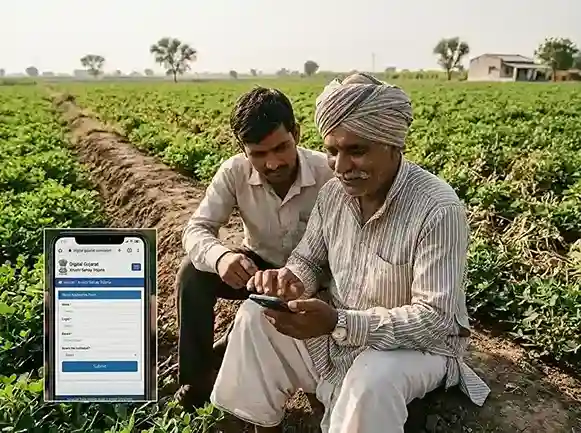
Krushi Sahay Digital Gujarat refers to the Mukhyamantri Kisan Sahay Yojana and Krushi Rahat Package — Gujarat state crop loss relief schemes managed through krp.gujarat.gov.in and the Digital Gujarat portal. Farmers who lose 33% or more crops due to heavy rain, drought, or unseasonal rain during Kharif season get ₹20,000–₹25,000 per hectare (up to 4 hectares) directly in their bank account. No premium is charged. Apply through your Gram Panchayat VCE or online at krp.gujarat.gov.in.
What Is Krushi Sahay Yojana on Digital Gujarat
Gujarat farmers face a hard reality. Rain arrives too early, too late, or not at all. When it does, it can wash away an entire season's work in a matter of days. The Krushi Sahay Yojana — officially named Mukhyamantri Kisan Sahay Yojana (MMKSY) — was launched on 10 August 2020 to address exactly this problem.
The scheme gives farmers direct cash compensation when natural calamities destroy their crops. It covers the Kharif season — the June-to-November farming cycle that accounts for most of Gujarat's agricultural output. There is no insurance premium. Farmers do not sign up in advance and pay monthly charges. The government decides who qualifies based on official crop damage surveys after a calamity occurs.
The Krushi Rahat Package (KRP) is the implementation arm of this scheme for event-specific relief. When a district-level or statewide crop damage is declared, the government opens a KRP window and farmers apply through the dedicated portal at krp.gujarat.gov.in or through the Digital Gujarat system.
Both names — Krushi Sahay Yojana and Krushi Rahat Package — refer to the same underlying relief mechanism. Locally, farmers and government staff use both terms interchangeably.
Which department runs this scheme
The Revenue Department of Gujarat leads the overall scheme. The Agriculture, Farmers Welfare and Co-operation Department manages field operations and crop damage assessments. The Collector's office in each district coordinates the damage surveys and prepares the initial beneficiary list. After approval, funds flow through the State Disaster Response Fund (SDRF) and are transferred via DBT to farmers' Aadhaar-linked bank accounts.
Who Is Eligible for Krushi Sahay Yojana
The eligibility criteria are clear. If you meet all of these, you can receive compensation.
- You must be a resident of Gujarat. Migrant or seasonal farmers from other states do not qualify.
- You must hold an 8-A land record (Athaak Nondh) in your name. This is the Gujarat revenue record that shows you as the legal cultivator or owner of agricultural land.
- Your crops must have suffered 33% or more loss during the Kharif season. The Revenue Department's survey team verifies this percentage on-ground.
- The crop loss must be due to a notified natural calamity — specifically heavy rainfall (varsad), drought (dakal), or unseasonal rain (mavtha). The Collector must officially notify the affected talukas before individual applications are accepted.
- Tribal farmers registered in the Revenue Department records are eligible on the same terms.
- There is no income limit for this scheme. Rich or poor, any 8-A holder farmer who suffered qualifying crop loss can apply.
Which crops are covered
The scheme covers all major Kharif crops grown in Gujarat, including cotton, groundnut, castor, bajra, maize, tur, moong, rice, sugarcane, and most vegetable crops. The crop must have been sown and growing at the time of the calamity. Crops that had already been harvested before the calamity are not eligible for compensation.
Land limit for compensation
The scheme covers a maximum of 4 hectares (approximately 10 acres) per farmer. Large landholders with more than 4 hectares can still apply, but compensation is calculated only for 4 hectares. The 4-hectare cap applies per farmer, not per survey number.
How Much Compensation Do You Get
The compensation rate depends on the percentage of crop loss. The government survey team assesses your fields and certifies the damage level. There are two compensation tiers.
| Crop Loss Percentage | Compensation per Hectare | Maximum (4 Hectares) | Payment Method |
|---|---|---|---|
| 33% to 60% crop loss | ₹20,000 per hectare | ₹80,000 | Direct to Aadhaar-linked bank via DBT |
| More than 60% crop loss | ₹25,000 per hectare | ₹1,00,000 | Direct to Aadhaar-linked bank via DBT |
The compensation is a direct grant — not a loan, not an advance that needs repayment. Once the money reaches your bank account, it is yours to use for the next sowing season, for buying seeds, paying off loans, or any other agricultural purpose.
How the damage percentage is decided
The process starts with the District Collector. When a district receives abnormal rainfall or declared drought, the Collector prepares a list of affected talukas and villages. Within 7 days, this list goes to the Revenue Department. A survey team is then deployed to the affected areas within 15 days to inspect fields, count damaged plants, and record the percentage of loss. This survey data becomes the official basis for the beneficiary list.
The survey covers standing crops in the field at the time of damage. A farmer cannot self-report a higher damage percentage. The government survey team's assessment is final unless you formally dispute it through the Revenue Department.
Documents Required for Krushi Sahay Application
Having these ready before you go to the E-Gram Centre or open the KRP portal saves time and prevents rejection.
-
17/12 Land Extract (Satbara Utara)Latest copy from e-Dhara. Must show the survey number, land area, and your name as cultivator or owner. An outdated 7/12 without the current season's crop entry can cause delays.
-
28-A Land Record (Athaak Nondh)Shows your legal right to cultivate the land. This is the primary eligibility document. Farmers without 8-A cannot apply.
-
3Aadhaar CardFor identity verification and Aadhaar-linked DBT transfer. Name on Aadhaar must match land records. Get any discrepancy corrected before applying.
-
4Bank Passbook (First Page)Account must be in your name and seeded with Aadhaar for NPCI DBT. Compensation is transferred only to the Aadhaar-mapped account. A dormant or joint account will cause payment failure.
-
5Talati Certificate / Crop Sowing CertificateIssued by the Gram Panchayat Talati Mantri. Confirms which crops were sown, on which survey number, and on what date. This is sometimes called a Pik Nondh or sowing record.
-
6PMFBY Policy Details (if enrolled)If you already have a Pradhan Mantri Fasal Bima Yojana policy for the same season, attach the policy number. This is not a barrier to applying for Krushi Sahay — both can coexist.
-
7Mobile Number Linked to AadhaarNeeded for OTP verification during online application and for SMS alerts when compensation is transferred to your account.
How to Apply for Krushi Sahay — Online and Offline
Applications open only after the government officially declares affected talukas. Do not apply before the official notification — early or pre-emptive applications are rejected. Watch for government press releases or ask your Gram Panchayat when the window opens for your taluka.
KRP Portal — krp.gujarat.gov.in
The dedicated Krushi Rahat Package portal. Opens when the government declares a crop damage event. Login via SSO Gujarat.
- Direct link: krp.gujarat.gov.in
- SSO login needed
- VCE multi-user access available
Digital Gujarat — digitalgujarat.gov.in
Check application status and track payments under Citizen Services. Some Krushi Sahay applications are accessible here.
- digitalgujarat.gov.in
- Log in → My Services → Krushi Sahay
i-Khedut — ikhedut.gujarat.gov.in
The state's main agricultural services portal. Lists all farmer welfare schemes and allows status checks.
- ikhedut.gujarat.gov.in
- Check scheme application status
E-Gram Centre / Gram Panchayat VCE
Most farmers apply through the Village Computer Entrepreneur at the local Gram Panchayat. The VCE fills the form with the farmer's details.
- No internet needed from the farmer's side
- VCE has official multi-user login
- Best option for first-time applicants
Step-by-step — applying online at krp.gujarat.gov.in
-
1
Check if your taluka is notified
Go to krp.gujarat.gov.in or digitalgujarat.gov.in. Confirm your district and taluka appear in the official affected areas list. If your area is not listed, applications for that area are not yet open.
-
2
Log in via SSO Gujarat
Go to sso.gujarat.gov.in. Log in with your Gujarat SSO username and password. If you do not have an account, register using your Aadhaar number and mobile OTP. After login, the system redirects to the KRP portal.
-
3
Select Krushi Sahay / Crop Loss Relief application
On the KRP dashboard, click New Application or Krushi Sahay Application. Enter the current year's crop damage event from the dropdown (the government names each event separately).
-
4
Enter land and crop details
Enter your 7/12 survey number, land area in hectares, crop name, sowing date, and estimated damage percentage. The system may auto-fill some data from the e-Dhara land records database if your 7/12 is linked. Verify all auto-filled data carefully before proceeding.
-
5
Upload required documents
Upload your 7/12 extract, 8-A record, Aadhaar, and bank passbook. Each file must be in PDF or JPG format and under 200 KB. Use a scanning app for clean, legible images. Blurry or cropped documents are rejected during verification.
-
6
Review, submit, and save your application number
Check every detail before clicking Submit. Once submitted, the application goes to the Gram Panchayat level for VCE forwarding. Note your application reference number. You need it for all future status checks.
-
7
Follow up with your VCE or Talati
After you submit, the application must move from Gram Panchayat level to Taluka level to District level for approval. Visit your Gram Panchayat office 7–10 days after submitting and confirm the VCE has forwarded it to the next level. Many applications stall here if not followed up.
How to Check Krushi Sahay Beneficiary List and Payment Status
After applying, you want to know two things: is your name on the approved beneficiary list, and has the money reached your account.
Method 1 — Check online at krp.gujarat.gov.in
Log in at krp.gujarat.gov.in using your SSO credentials. Go to Application Status or Know Your Application. Enter your application number or Aadhaar number to see the current status.
Method 2 — Check via Digital Gujarat portal
Log in at digitalgujarat.gov.in. Go to My Applications or Citizen Services → Krushi Sahay. Locate your Krushi Sahay application entry. The status shows as Pending, Approved, or Rejected with a reason if rejected.
Method 3 — Visit your Gram Panchayat VCE
Most farmers use this method. Visit the Gram Panchayat office with your application number or Aadhaar. The VCE has a real-time dashboard and can tell you exactly where your application stands and whether it has been forwarded to the next level.
Method 4 — Check the district-wise beneficiary list PDF
After final approval by the Collector's office, a district-wise beneficiary list is published. You can find it on your district's government website or ask your village Sarpanch or Talati Mantri. A physical copy is often posted on the Gram Panchayat notice board. If your name appears on this list, payment will arrive within a few working days.
Checking payment via PFMS
Once Approved, the DBT transfer goes through PFMS (Public Financial Management System). You can verify the payment at pfms.nic.in using the Know Your Payments feature — enter your bank name and account number. See our full PFMS payment guide for step-by-step instructions.
The Survey and Approval Process — How the Government Decides
Understanding the government's process helps you know when to apply, when to expect results, and who to approach if something goes wrong.
The process starts at the top with a weather trigger. When heavy rainfall, drought, or unseasonal rain hits a district, the Collector assesses the situation and prepares a list of affected talukas within 7 days. This list goes to the Revenue Department in Gandhinagar.
Next, a special survey team is deployed to the affected talukas. They inspect fields within 15 days. The survey records which crops are damaged, on which survey numbers, and to what percentage. Survey results are then compiled district-wide.
After the survey, the government prepares two beneficiary lists: one for farmers with 33–60% damage (₹20,000/hectare rate) and one for farmers with more than 60% damage (₹25,000/hectare rate). These lists are submitted to the Finance Department for fund allocation. Once funds are released, payments go through DBT within a defined window.
The entire cycle from calamity declaration to payment can take 4 to 8 weeks, depending on the scale of the event and department workload.
Common Problems and How to Fix Them
Name not on beneficiary list despite being eligible
This happens when the government survey missed your fields, or when your 7/12 record was not updated with the current season's crop. Visit your Talati Mantri, request that your fields be resurveyed, and update your 7/12 with the crop sowing data. Then reapply when the next window opens or raise a formal representation to the Mamlatdar office.
Application rejected due to missing 8-A record
If the land is in your family's name but not yet transferred to you, work with the Mamlatdar office to update the mutation (hakkpatra) in the revenue records first. An application in the wrong name will always be rejected. Land record corrections take time, so do not wait for a calamity to discover your records are outdated.
Payment delayed beyond 30 days after Approved status
Check your NPCI seeding at your bank. If seeding is fine, visit the Taluka Mamlatdar office with your approval letter and application number. Ask for the payment batch reference. If still unresolved, contact the District Agriculture Office or call the Digital Gujarat helpdesk at 1800-233-5500.
VCE not forwarding the application
Some VCEs delay forwarding applications due to workload or technical issues. If your application status stays at Pending for more than 10 days, visit the Gram Panchayat in person. If the VCE is unresponsive, escalate to the Taluka Development Officer (TDO) or the Mamlatdar office directly.
Krushi Sahay Yojana vs PMFBY — Key Differences
| Feature | Krushi Sahay Yojana | PMFBY (PM Fasal Bima) |
|---|---|---|
| Premium from farmer | Zero — no payment required | 2% of sum insured (Kharif) |
| Who administers | Gujarat Revenue Department | Insurance companies via Agriculture Ministry |
| Trigger for payout | Government-declared calamity + Revenue survey | Crop loss verified by insurance company |
| Maximum compensation | ₹1 lakh (4 hectares at top rate) | Sum insured based on crop and area (can be higher) |
| Advance registration needed | No — apply after calamity | Yes — must enroll before sowing season |
| Can you get both | Yes — both can pay for the same season | Yes — both can pay for the same season |
| Season covered | Kharif only | Kharif and Rabi |
| Portal | krp.gujarat.gov.in, digitalgujarat.gov.in | pmfby.gov.in |
A farmer can receive both Krushi Sahay Yojana compensation and PMFBY insurance claims for the same season. They are not mutually exclusive. If you are not currently enrolled in PMFBY, consider enrolling through your bank or Common Service Centre before the sowing season begins.
Where to Get Help — Official Contacts
| Contact | Details | Use When |
|---|---|---|
| Digital Gujarat Helpdesk | 1800-233-5500 (toll-free) Mon–Fri, 10:30 AM–6:10 PM | Portal login issues, application not submitting, status tracking help |
| Gram Panchayat VCE | Visit your Gram Panchayat | Filling application, forwarding help, local status check |
| Taluka Mamlatdar Office | Your taluka headquarters | Application stuck, escalation after VCE fails to act |
| District Agriculture Office | Your district headquarters | Survey disputes, payment delays after approval |
| i-Khedut Portal | ikhedut.gujarat.gov.in | Check scheme information, application status verification |
| KRP Portal | krp.gujarat.gov.in | Online application, status check, login |
Related Gujarat Government Services
Frequently Asked Questions
Krushi Sahay on Digital Gujarat refers to the Mukhyamantri Kisan Sahay Yojana and Krushi Rahat Package — Gujarat state government crop loss relief schemes. Farmers who lose 33% or more of their Kharif crops due to natural calamities receive direct financial compensation of ₹20,000–₹25,000 per hectare, for up to 4 hectares, with no premium required. Applications are submitted at krp.gujarat.gov.in or through the Gram Panchayat VCE.
Farmers receive ₹20,000 per hectare for crop loss between 33% and 60%, and ₹25,000 per hectare for crop loss exceeding 60%. The maximum covered area is 4 hectares per farmer. So the maximum possible compensation is ₹1,00,000 (four hectares at the higher rate). The money is transferred directly to your Aadhaar-linked bank account via DBT — no cash, no intermediary.
Applications are submitted at krp.gujarat.gov.in (the dedicated Krishi Rahat Package portal) or through the Digital Gujarat portal. You log in via SSO Gujarat, select the current crop damage event, enter your land and crop details, and upload your 7/12, 8-A, Aadhaar, and bank passbook. Most farmers apply with help from the Village Computer Entrepreneur (VCE) at their Gram Panchayat, who has official multi-user access to the system.
Check online at krp.gujarat.gov.in or digitalgujarat.gov.in under My Applications. You can also visit your Gram Panchayat VCE with your application number or Aadhaar — the VCE has real-time status access. The final district-wise beneficiary list is published on district government websites and posted on Gram Panchayat notice boards. For payment verification, use pfms.nic.in Know Your Payments with your bank account number.
Any Gujarat resident farmer who: (1) holds an 8-A land record, (2) suffered 33% or more Kharif crop loss due to a notified natural calamity in their taluka, and (3) has an Aadhaar-linked bank account. There is no income limit. Tribal farmers registered in Revenue Department records are also eligible. Farmers on land with no 8-A record in their name, or in non-notified talukas, cannot apply for that event.
You need: (1) 7/12 land extract (Satbara Utara), (2) 8-A land record, (3) Aadhaar card, (4) bank passbook first page (Aadhaar-seeded account), (5) Talati certificate of crop sowing, and (6) PMFBY policy number if enrolled. All documents must match your Aadhaar name. Name discrepancies between land records and Aadhaar are the most common cause of rejection.
Yes. Krushi Sahay Yojana and PMFBY (Pradhan Mantri Fasal Bima Yojana) are separate schemes funded by different sources. Receiving compensation under one does not disqualify you from the other. Krushi Sahay is a direct state government grant requiring no premium. PMFBY is a premium-based insurance scheme you must enroll in before the sowing season. Both can pay out for the same crop damage event.
After Approved status, payment takes 7–15 working days via DBT. If it has been more than 15 working days, check your NPCI Aadhaar seeding at your bank branch. The payment goes to whatever account is currently seeded in the NPCI DBT mapper using your Aadhaar — not necessarily the account number on your application form. If the seeding is to an old or inactive account, the payment will fail silently. Update NPCI seeding at your bank and contact the Digital Gujarat helpdesk at 1800-233-5500.