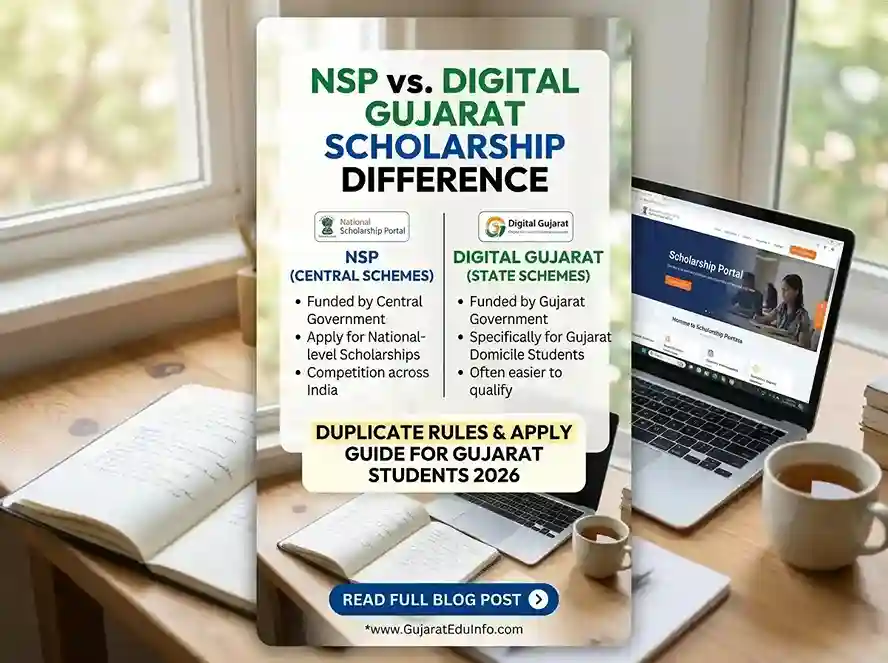
NSP (scholarships.gov.in) holds central government schemes — funded by ministries in Delhi. Digital Gujarat (digitalgujarat.gov.in) holds Gujarat state schemes — funded by Gandhinagar. You can apply on both, but you can only receive one government scholarship at a time. ST students must complete a One-Time Registration (OTR) on NSP before applying on Digital Gujarat for post-matric schemes. Minority students should check NSP first — central minority schemes there pay more than state stipends.
Two Portals, Two Governments, One Student
Every Gujarat student eligible for a scholarship faces this confusion at least once: should I apply on NSP or Digital Gujarat? The answer depends on your category, your course, and which government funds the scheme you need.
India has two parallel scholarship systems. The Central Government runs schemes through the National Scholarship Portal (NSP) at scholarships.gov.in. It was launched in 2015 under the Digital India initiative and now lists over 100 scholarship schemes from 15+ central ministries. The Government of Gujarat runs state schemes through digitalgujarat.gov.in, which hosts 33+ schemes across multiple departments including Social Welfare, Tribal Development, Education, and Minority.
These two portals are not competitors. They complement each other. A student who qualifies for a central scheme should apply on NSP. A student who qualifies for a state scheme applies on Digital Gujarat. The problem is that many students only know about one of the two — and miss money they are entitled to.
| Feature | NSP — scholarships.gov.in | Digital Gujarat — digitalgujarat.gov.in |
|---|---|---|
| Run by | Government of India (NIC / MeitY) | Government of Gujarat (GIL) |
| Funds come from | Central government ministries | Gujarat state government |
| Number of schemes | 100+ central + some state schemes | 33+ Gujarat-only schemes |
| Who can apply | Any student in India (scheme-wise eligibility) | Gujarat domicile students only |
| Payment system | PFMS → DBT → Aadhaar-linked bank | IFMS → DBT → Aadhaar-linked bank |
| Income limits | Varies: ₹1 lakh to ₹4.5 lakh depending on scheme | Varies: ₹2.5 lakh to ₹6 lakh depending on scheme |
| Merit requirement | Some schemes require 50%+ marks; NMMS and CSS are merit-based | MYSY requires 80th percentile; most other schemes are income-based |
| OTR required | OTR generated here (mandatory for ST post-matric) | OTR from NSP needed before ST post-matric application |
| Minority schemes | High-value central minority schemes (Pre-Matric + Post-Matric) | State-specific minority stipends (smaller amounts) |
Which Portal Has Which Schemes — Category by Category
The most practical question is: which portal should you open first based on your category? Here is the answer for every major category of Gujarat students.
| Student Category | Portal to Use | Key Scheme | Income Limit |
|---|---|---|---|
| SC — Pre-Matric (Std 1–10) | NSP | Pre-Matric Scholarship for SC Students (Ministry of Social Justice) | ₹2.5 lakh/year |
| SC — Post-Matric (Cl. 11+) | Both | NSP: Central Post-Matric SC scheme. Digital Gujarat: State Post-Matric SC scheme (check which covers your course better) | ₹2.5 lakh/year |
| ST — Pre-Matric | NSP | Pre-Matric Scholarship for ST Students (Ministry of Tribal Affairs) | ₹2.5 lakh/year |
| ST — Post-Matric | Digital Gujarat + NSP OTR | Umbrella Scheme for ST Post-Matric. OTR on NSP is mandatory before Digital Gujarat application. | ₹2.5 lakh/year |
| OBC / SEBC | Digital Gujarat | Pre/Post-Matric Scholarship for OBC/SEBC (Gujarat state scheme) | ₹2.5 lakh/year |
| Minority (Muslim, Christian, Sikh, Buddhist, Jain, Parsi) | NSP first | Pre-Matric & Post-Matric Minority Scholarship (Ministry of Minority Affairs). Higher amount than state stipend. | ₹1 lakh (Pre-Matric) / ₹2 lakh (Post-Matric) |
| Minority — Professional courses | NSP | Merit-cum-Means Scholarship for Minorities — Medical, Engineering, Pharmacy | ₹2.5 lakh/year |
| EWS (General category, low income) | Digital Gujarat | EWS scholarship on Digital Gujarat. No equivalent central scheme for general EWS at pre/post-matric level. | ₹1.5–2 lakh/year |
| Class 9–12, government school, any category | NSP | NMMS (National Means-cum-Merit Scholarship) — ₹12,000/year. Merit + income based. | ₹3.5 lakh/year |
| Top 20 percentile Class 12, college student | NSP | Central Sector Scheme of Scholarships (CSS) — ₹10,000–20,000/year for degree students | ₹4.5 lakh/year |
| OBC/EBC/DNT — Class 9–12 | NSP | PM YASASVI — ₹25,000/year (day scholar) or ₹75,000/year (residential) | ₹2.5 lakh/year |
| MYSY — Merit-based, any category | Digital Gujarat | MYSY Scholarship — up to ₹2 lakh/year. 80th percentile in Class 10/12 required. | ₹6 lakh/year |
| Students with disabilities | NSP | Pre-Matric and Post-Matric Scholarship for Persons with Disabilities (DEPwD) | ₹2.5 lakh/year |
Can You Apply to Both NSP and Digital Gujarat?
Yes — you can submit applications on both portals. Nothing technically stops you from creating accounts and filling forms on both. But applying and receiving are two different things.
The actual rule is: you can only receive money from one government scholarship at a time. This is the "one benefit" rule, enforced across all central and state DBT scholarship payments through Aadhaar-based deduplication at the PFMS and NPCI level.
Both portals require you to declare that you are not receiving another government scholarship. Submitting that declaration falsely on both portals and receiving dual payments is fraud under DBT guidelines. The system catches it through Aadhaar cross-matching.
When applying to both makes sense
There is a legitimate reason to apply on both portals at the same time: to compare which scholarship covers more for your specific course, then decide which to keep before the final payment cycle. Some students apply on NSP and Digital Gujarat simultaneously, then — once they see which one has been approved first — they cancel or do not complete the other. This is not fraudulent as long as you do not receive dual payments.
When applying to both does NOT make sense
If you are already receiving a Digital Gujarat state scholarship in the current year, do not apply for an NSP scheme that covers the same benefits in the same year. The deduplication system at PFMS will flag it. The NSP payment will be blocked or reversed, and your state scholarship may be reviewed. You waste time and risk your active scholarship.
- SC student, pre-matric or post-matric
- ST student, pre-matric
- Minority student (any level)
- Class 9–12 in a government school (NMMS)
- Top 20 percentile Class 12, going to college (CSS)
- OBC/EBC/DNT student (PM YASASVI)
- Student with a disability
- ST student, post-matric (after NSP OTR)
- OBC/SEBC student, any level
- EWS general category student
- MYSY-eligible (80th percentile+)
- NTDT student
- Gujarat student not covered by any central scheme
- SC post-matric — compare central vs state amount
- Minority student — NSP for main scheme, Digital Gujarat for supplementary state stipend if it does not overlap
- Unsure which portal has a higher benefit for your specific course group
The Duplicate Scholarship Avoidance Rule — How It Works
The "one scholarship at a time" rule is not just a policy statement. It is technically enforced. Here is how.
Every DBT scholarship payment in India passes through PFMS (Public Financial Management System). PFMS uses your Aadhaar number as the primary identifier, not your name or account number. Before releasing a payment, PFMS cross-checks your Aadhaar against a central deduplication database. If another scheme has already made a payment to the same Aadhaar in the same academic year for the same category of benefit, the second payment is flagged and blocked.
NPCI (National Payments Corporation of India) adds a second layer through the Aadhaar Payment Bridge System (APBS). Payments route to your Aadhaar-seeded bank account. If two payments from two different schemes for the same purpose reach the bridge simultaneously, NPCI's deduplication logic applies and only one passes through.
The declaration clause on both portals
Both NSP and Digital Gujarat applications include a self-declaration where you confirm you are not availing a duplicate scholarship. On NSP, this is part of the application form. On Digital Gujarat, it appears before final submission. Signing this declaration falsely while receiving both is a misrepresentation under the terms of the scheme, and recovery of excess payment is initiated when detected.
Private scholarships are exempt from this rule
The "one government scholarship" rule applies only to government-funded schemes — central and state. You can receive a government scholarship and a private/corporate scholarship at the same time. For example, receiving the central post-matric scholarship through NSP and also receiving a Reliance Foundation scholarship are not in conflict. Only two government scholarships covering the same purpose cannot be stacked.
What about top-up schemes?
Some state schemes are designed specifically as top-ups for central schemes. VKY-157 (food bill assistance for ST hostellers on Digital Gujarat) is one example — it is an add-on to the central Umbrella Scheme, not a replacement. The state explicitly designed it to complement, not duplicate. These top-up schemes are exempt from the duplication rule. Check the scheme's official notification to confirm whether it is a top-up or a standalone scheme before applying.
The OTR Rule for ST Students — Why Both Portals Are Mandatory
ST (Scheduled Tribe) students who apply for Post-Matric Scholarships through Digital Gujarat face a mandatory two-portal requirement. This is not optional.
The Ministry of Tribal Affairs (MoTA) requires all ST students applying for post-matric scholarships to complete a One-Time Registration (OTR) on the NSP portal before applying on any state portal. Digital Gujarat does not have its own OTR system — it depends on NSP's OTR to create a verified identity record for ST students.
The OTR is not an application for a central scholarship. It is simply a registration step that generates an OTR ID. The student then takes that OTR ID and uses it when applying for the post-matric scheme on Digital Gujarat. Without a valid OTR ID from NSP, the Digital Gujarat application will fail at verification.
What happens if you skip OTR
If you submit a Digital Gujarat post-matric application without completing NSP OTR first, the application will either be rejected at the institute verification stage or get stuck at the district level. There is no way to retroactively add OTR to a submitted application. You would need to restart the application from scratch. Always complete OTR before starting the Digital Gujarat form.
NSP Apply Guide for Gujarat Students — Step by Step
NSP has a different registration and application process than Digital Gujarat. Here is the full process for a Gujarat student applying on NSP for the first time in 2026.
-
1
Go to scholarships.gov.in — verify the URL
Open scholarships.gov.in in Chrome or Firefox. Always check the URL ends in .gov.in. Do not use any third-party site to register on NSP. The official portal is the only valid point of entry.
-
2
Click "New Registration" and select the academic year
On the homepage, click New Registration. Select the current academic year — 2026–27. Read the instructions carefully. Tick the declaration box. Click Continue.
-
3
Enter your Aadhaar number and verify with OTP
NSP uses Aadhaar-based registration. Enter your 12-digit Aadhaar number. You will receive an OTP on your Aadhaar-registered mobile. Enter it. If your mobile is not registered with Aadhaar, visit your nearest Aadhaar Seva Kendra first and update it before registering on NSP.
-
4
Fill your personal, academic, and bank details
Enter your name (exactly as on Aadhaar — any mismatch causes rejection), date of birth, gender, category (SC/ST/OBC/Minority/General/PwD), father's income, current institution, course name, year of study, and bank account details. Your account must be in your own name and Aadhaar-seeded for NPCI DBT.
-
5
Select your state as Gujarat and choose a scheme
Under the scheme selection section, choose State of Domicile: Gujarat. NSP will show you all central schemes available for your category and level. Select the one relevant to you. If multiple schemes appear, read the eligibility carefully and select the one where you meet all conditions. Do not apply for a scheme where you do not fully qualify — it wastes your application cycle and delays your correct application.
-
6
Upload required documents
Upload: Aadhaar card, income certificate (from Mamlatdar or competent authority), caste certificate (for reserved category), last year's marksheet, current year fee receipt or bonafide certificate, and bank passbook first page. All files in PDF or JPG, each under 200 KB. Blurry or incomplete uploads are the most common rejection reason.
-
7
Complete Aadhaar face authentication (mandatory from 2025)
NSP now requires Aadhaar-based face authentication for new registrations. Open the NSP app or use the face auth module on the portal. Scan your face with a front camera. This takes less than one minute but requires a steady camera and good lighting. Without face auth, the application cannot be submitted.
-
8
Final submit and note your Application ID
Review every field before clicking Final Submit. After submission, NSP generates an Application ID. Save it or screenshot it. This is your reference for tracking, renewing, and for generating the OTR ID if you are an ST student who also needs to apply on Digital Gujarat.
-
9
Institute verification — follow up with your school or college
After submission, your institution must verify your application on NSP within the institute verification window (typically 15 days after student submission closes). Go to your school or college and remind the scholarship coordinator that your NSP application needs verification. Many applications fail at this step because students do not follow up. Check your application status at scholarships.gov.in regularly. If institute verification is not done in time, your application is invalidated and you have to reapply next year.
NSP Application Deadlines for 2026–27
NSP applications for the 2026–27 academic year typically open in June–July 2026 and close between October and November 2026. Institute verification usually closes 2–4 weeks after student submission. Check the current academic year's official notification at scholarships.gov.in — deadlines shift each year and vary by scheme.
Payment Differences — NSP vs Digital Gujarat
Both portals pay through DBT directly to your Aadhaar-linked bank account. But the back-end systems and timelines differ.
NSP: Payments flow through PFMS (Public Financial Management System). You can track payments at pfms.nic.in using the Know Your Payments feature. See our PFMS payment status guide for the full tracking process. NSP disbursements typically happen between January and March after the application year.
Digital Gujarat: Payments flow through IFMS (Integrated Financial Management System) — Gujarat's state treasury system — before routing to your bank via DBT. You track payments at digitalgujarat.gov.in under My Services. Gujarat state payments sometimes arrive earlier than central scheme payments, depending on the department's budget release.
For both portals, your bank account must be in your own name, active, and Aadhaar-seeded with NPCI for DBT. A dormant account, wrong IFSC, or missing NPCI seeding will cause payment failure regardless of which portal approved your application. See our NPCI seed check guide for how to verify and fix this.
Quick Decision Guide — Which Portal Should You Open First
If you are still unsure which portal to prioritize, use this simple rule:
- If you are SC or ST — check NSP for the central pre-matric scheme first. For post-matric, SC students compare central vs state benefit; ST students must complete OTR on NSP before applying on Digital Gujarat.
- If you are Minority — open NSP first. The Ministry of Minority Affairs schemes pay more than state stipends for the same eligibility.
- If you are OBC/SEBC — open Digital Gujarat first. The central OBC post-matric scheme is available on NSP, but Gujarat's state scheme through Digital Gujarat is stronger for most courses and income brackets.
- If you are General / EWS — open Digital Gujarat. There is no central general category pre-matric or post-matric scheme on NSP (except merit-based CSS and NMMS for specific criteria).
- If you are in Class 9–12 in a government school — check NMMS on NSP regardless of category.
- If you scored in the top 20 percentile in Class 12 — check CSS on NSP.
- If you scored 80th percentile or above in Class 10 or 12 — check MYSY on Digital Gujarat. It pays up to ₹2 lakh and the income limit is ₹6 lakh — far higher than most other schemes.
Renewal — NSP vs Digital Gujarat
Renewal works differently on each portal.
NSP renewal: Log in to scholarships.gov.in with your existing credentials. Go to your dashboard and select Renewal Application. The system pulls your previous year's details. Update your current marks, course year, fee receipt, and income certificate. Submit. Your institution must re-verify every year. Do not start a fresh application if you are renewing — fresh applications for existing beneficiaries are rejected.
Digital Gujarat renewal: Log in at digitalgujarat.gov.in, go to Scholarship Services, and select Renewal Application. Upload updated documents — new marksheet, new fee receipt, attendance certificate. Lock the application before the deadline. Renewal applications do not require all documents from scratch, but the marksheet and fee receipt must be for the current year.
Both portals have different renewal deadlines from fresh application deadlines. NSP renewal typically closes in November. Digital Gujarat renewal windows open around August and close in October for most schemes. Set separate reminders for both if you hold scholarships on both portals.
Related Scholarship Guides
Frequently Asked Questions
NSP (scholarships.gov.in) hosts central government scholarships funded by ministries in Delhi — covering SC, ST, OBC, Minority, Disability, and merit-based students nationwide. Digital Gujarat (digitalgujarat.gov.in) hosts Gujarat state scholarships funded by the Government of Gujarat — only available to students with Gujarat domicile. Both serve Gujarat students, but the funding source, benefit amounts, income limits, and application portals are different. A student may qualify for schemes on both portals depending on their category.
Yes, you can apply on both portals. But you can only receive money from one government scholarship at a time. If you apply for the same type of scholarship (e.g., post-matric for SC) on both portals, the Aadhaar-based deduplication system at PFMS will allow only one payment through. You should choose which scholarship offers better benefits for your course and focus on that. ST students must complete an NSP One-Time Registration (OTR) before applying on Digital Gujarat for post-matric — this is mandatory, not optional.
All central NSP schemes are available to Gujarat students who meet eligibility. Key ones include: Pre-Matric and Post-Matric SC Scholarship (Ministry of Social Justice), Pre-Matric and Post-Matric ST Scholarship (Ministry of Tribal Affairs), Pre-Matric and Post-Matric Minority Scholarship (Ministry of Minority Affairs), Merit-cum-Means Scholarship for Minorities, NMMS for Class 9–12 government school students (₹12,000/year), Central Sector Scholarship for top college students (₹10,000–20,000/year), and PM YASASVI for OBC/EBC/DNT students.
The Ministry of Tribal Affairs (MoTA) mandates One-Time Registration (OTR) on NSP for all ST students before they can apply for post-matric scholarships on any state portal, including Digital Gujarat. The OTR creates a verified central identity record for the student. When you apply on Digital Gujarat, the portal asks for your NSP OTR ID to link your application to this central record. Without OTR, your Digital Gujarat application will fail at institute or district verification. Complete OTR at scholarships.gov.in first, receive your OTR ID, then proceed to Digital Gujarat.
NSP first. The Ministry of Minority Affairs central schemes on NSP pay significantly more than the state minority stipends on Digital Gujarat. For post-matric minority scholarships, NSP covers full course fees plus a maintenance allowance. For pre-matric minority, NSP has a strict income limit of ₹1 lakh but covers most government school students from minority communities. Apply on NSP for the central scheme. If you do not qualify for the central scheme due to income or other criteria, then check Digital Gujarat for the state-level minority stipend.
The PFMS deduplication system will typically block the second payment. If both payments were released before deduplication caught the overlap, the excess amount will be recovered by the disbursing agency in the next payment cycle. Your scholarship status for the following year may be reviewed. If you realize you have applied to two overlapping schemes, cancel or abandon the one you do not want before the final payment is released. Contact the concerned nodal officer or helpdesk to withdraw the duplicate application.
The issuing authority and format can be the same — a Mamlatdar-issued income certificate works for both portals in Gujarat. However, income limits differ by scheme. NSP minority pre-matric requires income below ₹1 lakh. NSP post-matric SC/ST requires below ₹2.5 lakh. Digital Gujarat's MYSY allows up to ₹6 lakh. Always check the current year's income limit for the specific scheme you are applying for — not the portal's general limit. One income certificate can be used across both portals as long as it is from the current financial year and issued by the Mamlatdar.
NSP payments flow through PFMS. After your application is approved on NSP and your institution verifies it, track the payment at pfms.nic.in using the Know Your Payments feature — enter your bank name and account number. You can also track the application-specific status by entering your NSP Application ID in the Track DBT Details section on PFMS. For a full guide on what each PFMS status means and what to do if the payment does not arrive, see our PFMS payment status guide.