Why You Need This
The EWS Certificate (Income and Assets Certificate for Economically Weaker Sections) gives General category students and candidates who do not belong to SC/ST/OBC/SEBC access to a 10% reservation in higher educational institutions and central government jobs under the 103rd Constitutional Amendment (2019). Also required for the EBC/EWS scholarship on the Digital Gujarat portal. If your family does not qualify for SC/ST/OBC reservations but has income ≤ ₹8 lakh and limited assets, this certificate unlocks those benefits.
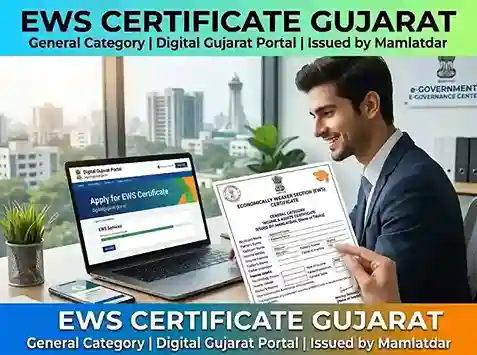
What is an EWS Certificate in Gujarat?
The EWS Certificate Gujarat — officially called the Income and Assets Certificate for Economically Weaker Section — is a government-issued document that certifies a person belongs to the Economically Weaker Section (EWS) of the General (unreserved) category. It is not a caste certificate; it is an income-and-assets-based certificate that verifies financial status.
The certificate was introduced under the 103rd Constitutional Amendment Act, 2019, which inserted Articles 15(6) and 16(6) into the Constitution of India, enabling a 10% reservation for EWS persons in government jobs and higher educational institutions. The Gujarat Government implemented EWS reservation on 14 January 2019 — the first state to do so. It is issued by the Mamlatdar (Taluka Magistrate) or other designated revenue officers in Gujarat.
EWS Certificate Eligibility in Gujarat 2026
To qualify for the EWS Certificate in Gujarat, all four conditions below must be met simultaneously. Failing even one condition means you are not eligible.
1. Category Requirement
The applicant must belong to the General / Unreserved category. Persons belonging to SC, ST, OBC (Other Backward Classes), or SEBC (Socially and Educationally Backward Classes) in Gujarat are not eligible for EWS reservation, as they have separate constitutional provisions.
2. Income Criteria (EWS Income Limit in Gujarat)
The annual family income from all sources must be less than or equal to ₹8 lakh per financial year. "All sources" includes:
- Salary / wages (from all earning family members)
- Agricultural income
- Business / trade / professional income
- Rental income from property
- Interest income, pension, and any other earnings
The income of the applicant, parents, spouse (if married), and minor siblings is all counted together. This is the EWS income limit in Gujarat — ₹8 lakh per year across all sources combined.
3. Property / Asset Criteria (EWS Property Limit)
Even if income is below ₹8 lakh, you must also pass the asset test. The family should not own any of the following:
- Agricultural land: 5 acres or more
- Residential flat (urban): 1,000 sq. ft. or more in any city
- Residential plot in notified municipality: 100 sq. yards or more
- Residential plot in non-notified area: 200 sq. yards or more
Ownership of any one of the above disqualifies the applicant, regardless of income. Property held by any family member (parents, spouse, minor children) is included in this calculation. This is the EWS property limit defined in the Office Memorandum issued by the Government of India (January 2019).
4. Residency
The applicant must be a Gujarat resident. The EWS Certificate is issued by the respective state government, and Gujarat-issued EWS certificates are valid for Gujarat state quota reservations and central government reservations when the applicant is domiciled in Gujarat.
Documents Required for EWS Certificate in Gujarat
This is the most searched section — many applicants search for "EWS certificate documents required in Gujarati" and "digital Gujarat EWS certificate required documents income certificate ITR." Here is the complete, verified document checklist:
Aadhaar Card
Identity and address proof. Must match all form fields exactly.
Income Certificate
Current financial year income certificate from Mamlatdar or Taluka officer. Mandatory.
ITR / Form 16
Income Tax Return of last financial year (if filed). Accepted as income proof alongside income certificate.
Passport-size Photo
Recent colour photograph (white background preferred).
Domicile / Residence Proof
Ration card, electricity bill, voter ID, or any government-issued address proof.
Self-Declaration / Affidavit
Sworn statement declaring family income and assets. Notarised in some jurisdictions.
PAN Card
If available. Helps cross-verify income details.
7/12 Satbara (Land Record)
Required if the family owns agricultural land, to verify total land area is under 5 acres.
Many applicants ask: "Is income certificate mandatory for EWS certificate in Gujarat?" — Yes. An income certificate issued by the Mamlatdar for the current financial year is mandatory for the EWS application on Digital Gujarat. ITR is accepted as supporting income proof but does not replace the government-issued income certificate.
Some Mamlatdar offices may also ask for:
- Caste/community declaration (to confirm General category)
- Salary slip (for employed applicants)
- Property documents or house ownership certificate
- School or college leaving certificate (for student applicants)
How to Apply EWS Certificate Online in Gujarat | Step-by-Step
Applying for the EWS Certificate online at the Digital Gujarat Portal is free and straightforward. Here is the complete step-by-step process for 2026:
- 1
Log in to the Digital Gujarat Portal
Visit www.digitalgujarat.gov.in and log in with your username and password. New users must register first (5 minutes, free). You need a valid mobile number linked to your Aadhaar for OTP verification.
- 2
Go to Citizen Services → Revenue Certificates
After login, click on Citizen Services from the top menu. Then select Revenue Department certificates. Scroll to find "Income and Assets Certificate for EWS" (also listed as EWS Certificate / EWS Income Certificate).
- 3
Fill the Application Form
Complete all mandatory fields: full name (as in Aadhaar), father's/husband's name, date of birth, Aadhaar number, address, taluka, district, annual family income, and asset declaration. Double-check every field — any mismatch with your Aadhaar will cause rejection.
- 4
Upload Required Documents
Upload scanned copies of all required documents in PDF or JPG format. Each file must be under 200 KB. The most critical upload is the income certificate — ensure it is current (issued within this financial year) and clearly legible. Also upload your ITR if available.
- 5
Submit and Note Application Reference Number
After reviewing all entries, click Submit. You will receive an Application Reference Number (ARN) via SMS and on screen. Save this number — you need it to track status and download the certificate.
- 6
Mamlatdar Verification
Your application is forwarded to the local Mamlatdar office for verification. An officer may visit your residence or contact you for additional verification. This typically takes 7–14 working days.
- 7
Download EWS Certificate
Once approved, log in to the portal → My Services → Approved Applications → Download Certificate. The certificate is digitally signed and legally valid. It is also automatically saved to your DigiLocker account.
How to Apply EWS Certificate Offline (at Mamlatdar Office)
If you prefer to apply offline or are facing issues with the online portal, you can apply directly at your local Mamlatdar office. Steps for offline application:
- Collect the EWS certificate application form from the Mamlatdar office (Form — Income and Assets Certificate)
- Fill in all details carefully in block letters
- Attach self-attested copies of all required documents
- Submit the application to the counter officer and receive an acknowledgment receipt
- Collect the issued certificate within 7–14 working days (or earlier if specified)
How to Check EWS Certificate Application Status
After submitting your application, you can track your EWS certificate status online at any time:
- Log in to digitalgujarat.gov.in
- Click My Services from the dashboard
- Find your EWS certificate application in the list
- The Status column shows: Submitted → Under Review → Pending Verification → Approved / Rejected
- If rejected, the rejection reason is shown — correct the issue and reapply
You can also check status using your Application Reference Number (ARN) on the portal's status-check page without logging in. Alternatively, contact the helpline at 1800-233-5500 with your ARN for a status update.
How to Download EWS Certificate Gujarat
Once your EWS certificate is approved, downloading it is simple:
- Log in to digitalgujarat.gov.in
- Go to My Services → Approved Certificates
- Locate the EWS / Income and Assets Certificate in the list
- Click Download — the PDF will download with a digital signature and QR code
The downloaded certificate includes: applicant's name, father's/spouse's name, address, income declaration, asset declaration, date of issue, validity period, issuing officer (Mamlatdar) details, digital signature, and a QR code for verification. You can also access your EWS certificate download via DigiLocker — link your DigiLocker with your Digital Gujarat account to find it under Gujarat Government → Revenue Department documents.
EWS Certificate Validity in Gujarat — How Long Is It Valid?
The EWS Certificate Gujarat validity is one financial year (April 1 to March 31). This means:
- A certificate issued in June 2025 is valid until 31 March 2026
- A certificate issued in August 2026 is valid until 31 March 2027
- Certificates issued close to year-end (February–March) may be valid for only a few weeks
It is highly recommended to apply for a fresh EWS certificate at the beginning of the financial year (April–May) to maximize its validity. For college admissions and competitive examinations, institutions generally require an EWS certificate valid for the current academic/application year.
Some central government examinations (UPSC, SSC, banking) may accept an EWS certificate issued in the previous financial year for applications submitted in the same year — always check the specific notification for that exam.
How to Renew EWS Certificate in Gujarat (EWS Renew Online)
The EWS Certificate must be renewed every year. There is no "renewal" in the traditional sense — you apply fresh each financial year as a new application. Here is how to renew your EWS certificate:
- Log in to Digital Gujarat portal at the start of the new financial year
- Apply for a new Income and Assets Certificate for EWS (same process as first application)
- Upload fresh documents for the new financial year — especially a new income certificate for the current year
- Your previous certificate cannot be "extended" — a new application must be submitted
Documents required for EWS renew (EWS certificate renewal documents in Gujarati / English):
- Updated income certificate for the new financial year (mandatory)
- Updated ITR if income/assets have changed
- Aadhaar card (same)
- Address proof (same, unless you have moved)
- Fresh self-declaration affidavit
EWS Caste List in Gujarat — Which Castes Are Eligible?
A common question is: "EWS caste list in Gujarat PDF download" or "which castes are covered under EWS in Gujarat?" The answer is important to understand clearly:
EWS is NOT a caste-based reservation. There is no specific "EWS caste list." The EWS reservation is available to persons who belong to the General (Unreserved) category — meaning any person who is not included in SC, ST, OBC, or SEBC lists in Gujarat. The eligibility is based on income and assets, not caste.
Broadly, the following communities fall in the General category in Gujarat and may be eligible for EWS (subject to income/asset conditions):
- Brahmin, Patel/Patidar (those not covered under SEBC), Rajput, Lohana, Bania/Vaishya, Jain, Sindhi, Kayastha, and other communities not listed in SC/ST/OBC/SEBC schedules
- Residents who belong to no reserved category as per Gujarat's current caste lists
If you are unsure whether your caste falls under any reserved category (SC/ST/OBC/SEBC) in Gujarat, check the official list at sje.gujarat.gov.in (Social Justice and Empowerment Department, Gujarat). The PDF of reserved category lists can be downloaded from there. If your community is not on any reserved category list, you are in the General category and may apply for EWS.
EWS Certificate for College Admission in Gujarat
The EWS certificate is essential for claiming the 10% EWS reservation quota during college admissions in Gujarat — including MBBS, engineering (ACPC), pharmacy, law, arts, commerce, and science courses in government and government-aided colleges. Here is how the EWS quota works for admissions:
- 10% seats are reserved in all centrally funded institutions and Gujarat state government institutions for EWS candidates
- The EWS certificate must be valid for the admission year (current financial year)
- For ACPC (Admission Committee for Professional Courses) admissions in Gujarat, the EWS certificate must be submitted during online registration
- For NEET-UG/PG admissions (medical seats), an EWS certificate issued by competent authority (Mamlatdar or above) is mandatory
- For central institutions (IITs, NITs, IIMs, central universities), the certificate must be issued by a state-level officer — Mamlatdar-issued Gujarat EWS certificates are accepted
Many students ask: "EWS certificate for college admission — which authority should issue it?" For all Gujarat admissions, the Mamlatdar-issued certificate from the Digital Gujarat portal is accepted. For central institutions, some may require a Collector-level or SDM-level certificate — check the specific institution's admission prospectus.
Benefits of EWS Certificate in Gujarat
Holding a valid EWS certificate in Gujarat unlocks multiple benefits across education, employment, and scholarship:
- 10% reservation in government jobs: All central and Gujarat state government job advertisements include 10% EWS quota. Competitive exams (GPSC, GSSSB, UPSC, SSC, Banking, Railways) all have EWS seats.
- 10% reservation in higher education: Engineering, medical, pharmacy, law, and management seats in government colleges have EWS quota.
- EBC/EWS Scholarship on Digital Gujarat: Students with a valid EWS certificate can apply for the EBC/EWS scholarship — financial assistance covering tuition fee, maintenance allowance, and other educational expenses. Apply at EBC/EWS Scholarship guide.
- Fee concession: Many government colleges offer fee waivers or reductions for EWS students.
- Hostel reservation: Government hostels in Gujarat reserve seats for EWS students.
- Age relaxation: Some state government services provide age relaxation to EWS candidates.
- MYSY Scholarship: EWS students who score high marks in board exams may also be eligible for the MYSY scholarship (Mukhyamantri Yuva Swavalamban Yojana).
EWS Certificate by City — Ahmedabad, Rajkot, Surat, Vadodara
The process for obtaining an EWS certificate is the same across all districts and cities in Gujarat — all applications go through the central Digital Gujarat portal. However, the issuing Mamlatdar office differs by your location:
- EWS Certificate Ahmedabad: Apply online at digitalgujarat.gov.in. Offline application at your local Mamlatdar office (Ahmedabad city is under multiple talukas: Daskroi, Sanand, Detroj-Rampura, etc.). For Ahmedabad city residents, the taluka is Ahmedabad City — check your ration card / Aadhaar for the correct taluka name. EWS Ahmedabad online form is the same as state-level.
- EWS Certificate Rajkot: Rajkot district applicants select "Rajkot" as the district during online application. Talukas include Rajkot, Lodhika, Gondal, Jetpur, etc. For Rajkot city, select Rajkot taluka.
- EWS Certificate Surat: Surat applicants select Surat district. Talukas include Surat City, Choryasi, Palsana, Bardoli, etc.
- EWS Certificate Vadodara: Vadodara (Baroda) applicants select Vadodara district. City taluka is Vadodara.
The online process is identical for all cities — only the district/taluka selection differs. The certificate is processed by the Mamlatdar of the applicant's home taluka.
EWS Certificate from Mamlatdar Office — Offline Process
For applicants who prefer the offline route or face technical difficulties on the portal, here is what to expect at the Mamlatdar office:
- Obtain the Income and Assets Certificate application form from the Mamlatdar office front desk (usually free of cost)
- Fill in all fields in Gujarati or English (both are accepted)
- Attach self-attested photocopies: Aadhaar, income certificate, residence proof, photo
- Submit at the designated counter and receive a dated receipt / acknowledgment
- The Mamlatdar officer may schedule a home verification visit in some cases
- Collect the issued certificate within 7–14 working days
- Alternatively, it will be available for download on the Digital Gujarat portal once issued
Find your nearest Mamlatdar office: All Mamlatdar Offices Gujarat — District & Taluka Wise.
EWS Certificate Fees in Gujarat
The EWS Certificate application is free of cost on the Digital Gujarat Portal. There are no government fees charged for applying online. Some notes:
- Online application: ₹0 (completely free)
- Agent assistance: If you use a CSC (Common Service Centre) or VLE (Village Level Entrepreneur) to file your application, they may charge a nominal service fee (typically ₹30–₹100). This is their service charge, not a government fee.
- Notarisation of affidavit: If a notarised self-declaration is required, notary charges may apply (₹50–₹200 depending on location)
- Income certificate: Getting the income certificate first may involve a small government fee at the Mamlatdar level in some talukas
Central EWS Certificate vs Gujarat State EWS Certificate
There is sometimes confusion about "central EWS certificate Gujarat" vs state-level certificates:
- Gujarat State EWS Certificate: Issued by the Mamlatdar/SDM under Gujarat Government rules. Valid for Gujarat state-level jobs, Gujarat state college admissions, and as supporting document for central exams when domicile is Gujarat.
- Central Government EWS Reservation: For central government jobs (UPSC, SSC, central PSUs, central universities), the EWS certificate must be issued by a competent authority — in Gujarat, this is the Mamlatdar (Sub-Divisional Magistrate level or Taluka Magistrate). The Mamlatdar-issued Digital Gujarat certificate is accepted for central purposes.
- Certificate Number: Each EWS certificate has a unique certificate number. Some applicants search for "EWS certificate number in Gujarat" — this is the application reference number / certificate ID visible on the downloaded PDF.
EWS Certificate vs EBC Certificate in Gujarat — What's the Difference?
In Gujarat, you will encounter both "EWS" and "EBC" (Economically Backward Class) designations. Here is the key difference:
- EWS (Economically Weaker Section): For General category persons. Based on 103rd Constitutional Amendment. Provides 10% reservation in jobs and education. Income limit ₹8 lakh. Issued by Mamlatdar.
- EBC (Economically Backward Class) / SEBC: Separate category in Gujarat for socially and educationally backward communities. Governed by Gujarat's own SEBC Act. Different income/criteria norms.
- EBC/EWS Scholarship: The Digital Gujarat scholarship portal combines EBC and EWS scholarship applications under one scheme for simplicity. Both EBC and EWS applicants can apply for this scholarship — but the certificates required differ.
If you search "EBC certificate Gujarat" — that is a different certificate from the EWS certificate. The EBC/EWS scholarship page explains which category's applicants should use which certificate.
Common Issues & Solutions
If your EWS certificate application is rejected or stuck, here are the most common reasons and fixes:
Name Mismatch with Aadhaar
Your name in the application does not exactly match your Aadhaar. Fix: use exactly the same spelling and format as on your Aadhaar card.
Update Aadhaar First
If your Aadhaar name is incorrect, update it at a nearby Aadhaar Enrolment Centre before applying for the EWS certificate.
Expired Income Certificate
The income certificate you uploaded is from a previous financial year. EWS applications require a current-year income certificate.
Get Fresh Income Certificate
Apply for a new income certificate for the current financial year first, then apply for EWS.
Document Too Large / Wrong Format
Uploaded files exceed 200 KB or are in an unsupported format (Word, TIFF, etc.).
Compress and Convert
Use a free PDF compressor (ilovepdf.com, smallpdf.com) to reduce file size. Save images as JPG. Ensure all documents are under 200 KB.
Income Exceeds ₹8 Lakh
The declared income on the income certificate exceeds the EWS limit of ₹8 lakh from any source.
Ineligible — Explore Alternatives
If income exceeds ₹8 lakh, you do not qualify for EWS. Consider other scholarships or apply in subsequent years if income decreases.
For unresolved issues, call the toll-free helpline 1800-233-5500 (Monday–Friday, 10 AM–5 PM) or submit a grievance at digitalgujarat.gov.in/Grievance. You can also visit your nearest Mamlatdar office with all original documents for in-person assistance.
EWS Toll Free Number & Helpline Gujarat
For all EWS certificate and Digital Gujarat portal queries, use the following official contact channels:
- EWS Toll Free Number / Digital Gujarat Helpline: 1800-233-5500 (Toll-Free) · Monday to Friday · 10:00 AM – 5:00 PM
- Grievance Portal: digitalgujarat.gov.in/Grievance
- Email (Scholarships): scholarships-dg@gujarat.gov.in
- Official Portal: www.digitalgujarat.gov.in
Related Guides
Frequently Asked Questions
The mandatory documents for EWS certificate Gujarat are: (1) Aadhaar Card, (2) Income Certificate for current financial year (issued by Mamlatdar — mandatory), (3) ITR / Form 16 if available, (4) Passport-size photograph, (5) Residence proof (ration card, electricity bill, voter ID), (6) Self-declaration affidavit about income and assets, (7) PAN card if available, (8) 7/12 Satbara if family owns agricultural land. Some offices may ask for additional documents such as salary slip or property papers.
Yes. The income certificate issued by the Mamlatdar for the current financial year is mandatory for the EWS (Income and Assets Certificate) application on the Digital Gujarat portal. Your Income Tax Return (ITR) may be accepted as additional supporting proof but does not replace the government-issued income certificate. Apply for your income certificate first before applying for the EWS certificate.
The EWS certificate in Gujarat is valid for one financial year — from 1 April to 31 March. It must be renewed (reapplied) every year. For example, a certificate issued in July 2026 is valid until 31 March 2027. Always apply at the start of the financial year (April–May) to get maximum validity. For competitive exam and college admission purposes, check the specific notification for the acceptable validity period.
There is no separate "renewal" option — you must apply for a new EWS certificate each year through the Digital Gujarat portal. Log in to digitalgujarat.gov.in, go to Citizen Services → Revenue → Income and Assets Certificate for EWS, and submit a fresh application with updated documents (especially a new income certificate for the current year). Your previous certificate data may pre-fill some fields but a complete new application is required.
Yes. Once your EWS certificate is approved on the Digital Gujarat portal, it is automatically available in your DigiLocker account under Gujarat Government documents. Open DigiLocker → Issued Documents → look for Gujarat Revenue Department → Income and Assets Certificate (EWS). You can also download it directly from your Digital Gujarat dashboard under My Services → Approved Certificates.
The EWS income limit in Gujarat is ₹8 lakh per year from all sources combined. This includes income from salary, agriculture, business, rent, interest, pension, and any other sources for all earning members of the family (applicant, parents, spouse, minor siblings). This limit has not changed since EWS was introduced in 2019. Additionally, the family must not own 5+ acres of land, a flat of 1,000+ sq ft, or residential plots exceeding 100/200 sq yards (notified/non-notified areas).
The EWS property limit in Gujarat: a family must NOT own (1) 5 acres or more of agricultural land, (2) a residential flat of 1,000 sq. ft. or more anywhere in the country, (3) a residential plot of 100 sq. yards or more in a notified municipality, or (4) a residential plot of 200 sq. yards or more in a non-notified area. Owning any one of these disqualifies the applicant regardless of income. Property of all family members (parents, spouse, minor children) is counted.
Standard processing time for the EWS certificate through Digital Gujarat is 7–14 working days. To get it faster: (1) Apply online (faster than offline), (2) Ensure all documents are complete and correct on the first submission (no correction needed), (3) Keep your income certificate ready before applying (most common delay factor), (4) Apply at the start of the financial year when Mamlatdar offices are less busy. If urgent, you can also apply directly at the Mamlatdar office — some offices process faster for in-person applications.
Yes. For ACPC (Admission Committee for Professional Courses) engineering admissions in Gujarat under EWS quota, a valid EWS certificate is mandatory. The certificate must be issued by the Mamlatdar and must be valid for the admission year (current financial year). Upload it during the ACPC online registration process. Ensure the certificate is obtained at least 3–4 weeks before ACPC registration opens (typically May–June).
The official EWS certificate website for Gujarat is www.digitalgujarat.gov.in. This is the official Digital Gujarat Government Portal where you can apply for the EWS (Income and Assets Certificate), track application status, and download the certificate. There is no separate dedicated EWS website — the application is within the Citizen Services section after logging in to the main portal.