A ration card is one of the most important documents a family in Gujarat can hold. It gives access to subsidised food grains through Fair Price Shops (FPS) under the Public Distribution System (PDS). It also works as an address proof and identity document for many government schemes.
This guide covers everything you need to apply for a new ration card in Gujarat. You will learn which card type fits your family, what documents to keep ready, how to apply through the IPDS or Digital Gujarat portal, and how to track your application after submission.
Gujarat Ration Card Types – APL, BPL, PHH, and AAY Explained
Gujarat issues ration cards under both the older Targeted Public Distribution System (TPDS) and the National Food Security Act (NFSA) of 2013. Knowing which category your family falls under is the first step. The wrong category means either rejection or less benefit than you deserve.
There are four main ration card types in Gujarat:
| Card Type | Who It Is For | Monthly Grain Entitlement | Income Limit |
|---|---|---|---|
| APL Above Poverty Line |
Families with income above the state poverty line. Economically stable, not covered under NFSA. | Subsidised grains at near-market rates. Limited benefit compared to NFSA cards. | Above ₹1.2 lakh/year (rural) or ₹1.5 lakh/year (urban) |
| BPL Below Poverty Line |
Families whose monthly per capita income is below the state poverty line. | Subsidised grains. Urban BPL: income below ₹501/month per capita. Rural: below ₹324/month per capita. | Urban < ₹501/month per person; Rural < ₹324/month per person |
| PHH Priority Household |
Low-income families identified under NFSA 2013. Covers up to 75% of rural and 50% of urban population. | 5 kg per person per month — free of cost under PMGKAY (extended until December 2028) | As per NFSA inclusion criteria set by the state government |
| AAY Antyodaya Anna Yojana |
The poorest of the poor families. Landless labourers, widows, the elderly, and people with disabilities who have no stable income. | 35 kg per family per month — free of cost under PMGKAY. Plus 1 kg chickpeas at ₹30/kg and 1 kg salt at ₹1/kg in Gujarat. | No income ceiling — selected by state based on extreme deprivation |
APL vs BPL: What Changed After NFSA 2013?
The National Food Security Act replaced the old APL and BPL structure with two new NFSA categories: PHH and AAY. However, Gujarat still maintains state-level APL and BPL cards for families not covered under NFSA. Many families hold either a state BPL card or an NFSA PHH card — both are valid, but PHH and AAY cards give far greater food benefits.
If you currently hold an APL card but believe your income qualifies you for BPL or PHH, you can apply for reclassification at your local Mamlatdar office.
PHH vs AAY: Key Difference
PHH benefit scales with family size — you get 5 kg per member per month. A family of five gets 25 kg. AAY benefit is fixed at 35 kg per family, regardless of size. So a very large family under PHH may actually get more grain than under AAY, but a small family of two or three under AAY gets more per person.
Who Is Eligible for a New Ration Card in Gujarat?
Before you apply, check every condition below. Meeting all of them is necessary. Missing even one can lead to rejection.
Basic Eligibility Conditions (All Card Types)
- You must be a permanent resident of Gujarat.
- You must be 18 years of age or older.
- No existing ration card should be active in your name or your family's name in Gujarat.
- Your family should not already be listed as a beneficiary in another state (ONORC portability exists, but not a second card).
- You should not already be included in another family's ration card, unless you are applying after separation (marriage, divorce, or living separately).
Additional Eligibility for BPL / PHH Cards
- Family must belong to a socially or economically weaker section.
- Families who are homeless, or live in a house with mud, bamboo, grass, or plastic walls qualify.
- Families with no regular income or who depend on daily wage labour.
- Total family income should not exceed ₹1.2 lakh per year (rural) or ₹1.5 lakh per year (urban).
Additional Eligibility for AAY Cards
- Landless agricultural labourers with no regular income.
- Widows or women-headed households with no male earning member.
- Elderly persons with no family support or income.
- People with disabilities who cannot work.
- Families with a terminally ill member as the primary earner.
- Primitive tribal communities in Gujarat.
Document Checklist for New Ration Card Gujarat
Gather all documents before you start the online form. Incomplete submissions are the most common reason for delays. All documents must be scanned as PDF or JPG files and should be under 200 KB each.
Mandatory Documents (All Applicants)
- ✓Aadhaar CardOf all family members to be included in the ration card. Aadhaar linking is mandatory as of 2025.
- ✓Proof of ResidenceElectricity bill, water bill, rental agreement, or domicile certificate — any one document showing your Gujarat address.
- ✓Income CertificateIssued by a Mamlatdar officer. This is needed to determine your card category. Get it from the Digital Gujarat portal.
- ✓Passport-Size PhotographsRecent colour photographs of the head of the household. Usually two copies are needed.
- ✓Bank Passbook (First Page)Shows your bank account number and IFSC code. Required for linking direct benefit transfers.
- ✓Self-Declaration FormA signed declaration that the information provided is correct and no other ration card exists in the family's name.
Additional Documents (Situation-Specific)
- +Surrender / De-Linking CertificateIf you are separating from an existing family ration card due to marriage or moving out, submit this from the Food & Civil Supplies Department.
- +Marriage CertificateFor newly married couples applying for a separate ration card for the first time.
- +Caste CertificateRequired if applying under specific SC/ST/OBC welfare schemes. Get it at caste certificate Gujarat.
- +Disability CertificateFor AAY eligibility based on disability. Issued by the civil surgeon or designated medical authority.
- +Death Certificate of SpouseFor widow-headed households applying under AAY criteria.
How to Apply for a New Ration Card Online – Step-by-Step
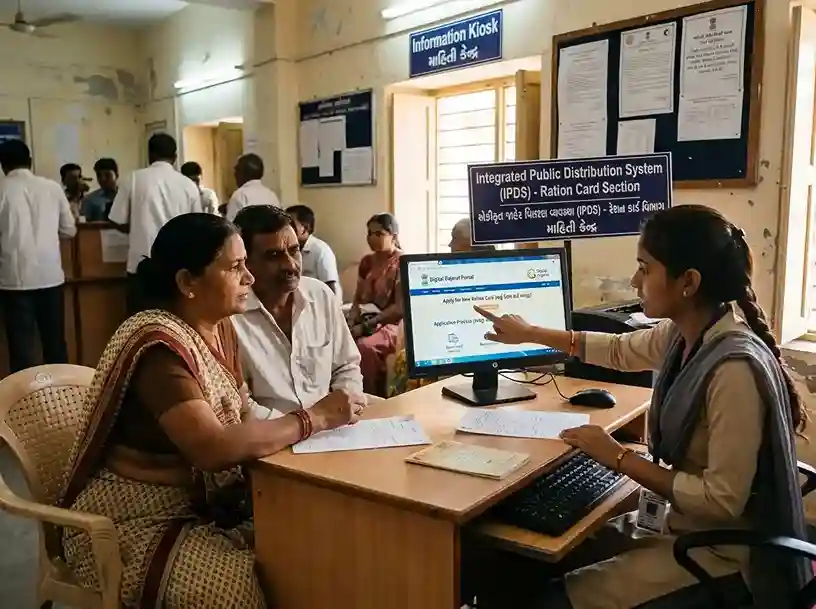
Gujarat offers two official routes to apply online. The primary route is through the Digital Gujarat portal. The IPDS portal is used for checking your beneficiary list and tracking status after submission.
Route 1 – Digital Gujarat Portal (Recommended)
-
1
Open the Digital Gujarat Portal
Go to digitalgujarat.gov.in. If you are a new user, click New Registration (Citizen) and create a free account using your mobile number and email. Existing users can log in directly.
-
2
Navigate to the Ration Card Service
After logging in, click the Revenue menu in the top navigation bar. Select More, then click Application for New Ration Card. You can also use the portal's search bar and type "Ration Card" to find it directly.
-
3
Choose "I am a Consumer" and Click Apply Online
On the next page, select I am a Consumer from the dropdown list. Then click Apply for a New Ration Card. You will be taken to the login confirmation screen. Click Continue to Service.
-
4
Fill in Your Profile and Applicant Details
Enter your personal details — full name as per Aadhaar, mobile number, address, and district. Then go to the Ration Card Applicant Details page and add all family members one by one. Include their Aadhaar numbers, date of birth, relationship to head of family, and gender.
-
5
Select Card Category and Enter Income Details
Choose your card type: APL, BPL, PHH, or AAY. Enter annual family income as per your income certificate. The system may verify this automatically against government records. Be accurate — any mismatch causes delays or rejection.
-
6
Upload Required Documents
Upload each document in the format specified (PDF or JPG, under 200 KB). Documents to upload: Aadhaar of all members, residence proof, income certificate, photograph, and bank passbook. Any situation-specific documents (surrender certificate, marriage certificate) go here too.
-
7
Submit and Save Your Reference Number
Review all details before clicking Submit. After successful submission, you will see an Application Reference Number on screen. Save or screenshot this number. You need it to track your application status. You should also receive an SMS confirmation on your registered mobile number.
Route 2 – Offline Application at Mamlatdar Office
If you face issues with the online portal, you can apply offline. Visit your nearest Mamlatdar office or e-Gram Seva Kendra (Common Service Centre). Ask for the ration card application form, fill it with accurate information, attach all required documents, and submit it to the officer. You will get an acknowledgement receipt with a reference number.
How to Track Your Ration Card Application Status in Gujarat
After submitting your application, you can track its status in two ways. Both are free and available 24/7.
Method 1 – Track via IPDS Gujarat Portal
-
1
Visit the IPDS Gujarat portal
Go to ipds.gujarat.gov.in. This is the official Integrated Public Distribution System portal managed by the Food & Civil Supplies Department, Gujarat.
-
2
Click "Know Your Entitlement"
On the homepage, look for the તમને મળવાપાત્ર જથ્થો જાણો link (Know Your Entitlement) under the Links section. Click it. The direct link is
ipds.gujarat.gov.in/Register/frm_KnowYourEntitlement.aspx. -
3
Enter your ration card number and captcha
Type your ration card number (if already issued) or use your application reference number. Enter the captcha and click View. Your entitlement details — card type, grains allocated, and FPS details — will appear on screen.
-
4
Check the beneficiary list by area
If your card has been approved, you can also find your name in the district-wise NFSA beneficiary list. Visit
ipds.gujarat.gov.in/Register/frm_RationCardAbstract.aspx, select the month and year, choose your district and taluka, and search for your card number in the list.
Method 2 – Track via Digital Gujarat Dashboard
Log in to your account at digitalgujarat.gov.in. Go to Track Application Status in the menu. Enter your reference number or search by service type. Your application's current stage — submitted, under review, verified, approved, or rejected — will show on screen.
Check Your Entitlement with the My Ration App
Gujarat also has the My Ration App (available on Google Play). After login with your ration card number, you can view card type, member details, monthly grain entitlement, transaction history, and FPS location — all in one place. This app also lets you track the last six months of grain lifting records from your Fair Price Shop.
What You Get With Your Gujarat Ration Card
A Gujarat ration card is not just for food. It gives your family multiple benefits across food security, identity proof, and government welfare access.
Food Grain Benefits Under PMGKAY (2024–2028)
Under the Pradhan Mantri Garib Kalyan Anna Yojana (PMGKAY), the central government extended free food grains for all NFSA beneficiaries until December 2028. This means PHH and AAY card holders in Gujarat pay nothing for their monthly grain allocation.
- PHH cardholders: 5 kg of wheat or rice per person per month — completely free.
- AAY cardholders: 35 kg per family per month — completely free.
- All NFSA families in Gujarat also receive 1 kg of chickpeas per card at ₹30/kg and 1 kg of salt per card at ₹1/kg through state top-up benefits.
Additional Benefits of Holding a Gujarat Ration Card
- Identity and address proof: The ration card is accepted as a valid identity and address document across many government services.
- LPG subsidy access: Supports eligibility for Pradhan Mantri Ujjwala Yojana (PMUY) connection and cooking gas subsidies.
- Government welfare schemes: Many state welfare programmes, scholarships, and housing schemes require you to hold a valid ration card. See our Gujarat welfare schemes guide for more.
- One Nation One Ration Card (ONORC): Migrant workers can collect their grain at any Fair Price Shop in India, not just in Gujarat. This is useful if you move to another state for work.
- Fair Price Shop access: You can buy subsidised food items — rice, wheat, and pulses — from your assigned FPS every month. Use the Know Your FPS tool to find your nearest shop.
One Nation One Ration Card – Gujarat Migrants Can Collect Anywhere
If someone in your family works in another state, they do not lose their food benefit. The ONORC scheme lets them collect their share of grain from any Fair Price Shop in the country. They need their ration card number and Aadhaar-based biometric authentication at the FPS machine.
This is especially useful for construction workers, daily wage labourers, and seasonal migrants from rural Gujarat who travel to other states for work. The Mera Ration 2.0 app (available on Google Play) helps migrants find the nearest FPS wherever they are and check their entitlement balance before heading to the shop.
Common Issues and How to Fix Them
Application Rejected
Rejection is usually because of one of these reasons:
- Name mismatch between Aadhaar and the application form.
- Missing or expired income certificate.
- Another ration card already exists in the family's name.
- Wrong card category selected relative to declared income.
- Blurry or corrupt document scans.
Log in to your Digital Gujarat dashboard to read the rejection reason. Fix the specific issue and reapply. If the rejection seems incorrect, file a grievance at digitalgujarat.gov.in/Grievance.
Name Not on FPS Beneficiary List
If your card shows as approved but your name is not on your Fair Price Shop list, visit your Mamlatdar office with a printed copy of your approval. They can update the FPS records. This process takes 7–10 working days.
Aadhaar Biometric Failure at FPS
Some people — especially elderly individuals, farmers, and manual labourers — face fingerprint authentication failure at the FPS biometric machine. In such cases, request OTP-based authentication at the FPS, or contact your district Food Supply Officer for alternative authentication methods.
Ration Card Needs Correction
If the name, address, or member details on your issued card are wrong, apply for correction at your local Mamlatdar office or through the Digital Gujarat portal under Ration Card Update Service. See our ration card update guide for detailed steps.
Offline Application – Mamlatdar Office and e-Gram Centre
Not everyone has internet access. Gujarat allows walk-in applications at:
- Mamlatdar office of your taluka — the primary offline authority for ration card services.
- e-Gram Seva Kendra — located in village panchayat buildings. Staff there can help you fill and submit the application on the portal.
- Jan Seva Kendra (Common Service Centre) — urban equivalent of e-Gram centres, often found near government offices.
Carry original documents and self-attested photocopies. The officer will verify details and give you an acknowledgement receipt with a reference number to track your application.
After Approval – Download and Use Your Ration Card
Once your application is approved, you have two options to access your ration card:
Download via DigiLocker
Log in to digilocker.gov.in. Search for Food and Civil Supplies Department, Gujarat. Select Ration Card and enter your card details. Your digitally signed ration card will appear in the Issued Documents section. Download it as a PDF — this is legally valid across all government services.
Collect Physical Card from FPS or Mamlatdar
In some talukas, a physical copy is still issued. Your assigned Fair Price Shop or local Mamlatdar office notifies you once the card is printed. Carry your acknowledgement receipt when you go to collect it.