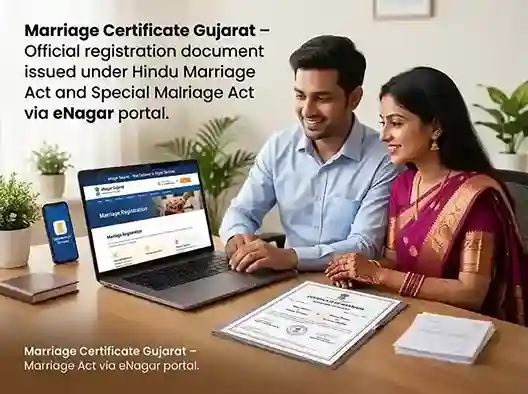
Why You Need This
The marriage certificate is required for passport (spouse visa), name change, joint bank account, spousal insurance, government welfare schemes, and legal proof of marriage. Registered marriages under the Hindu Marriage Act or Special Marriage Act have equal legal standing.
How to Apply | Step-by-Step
- 1
Log in to the Official Portal
Visit enagar.gujarat.gov.in and log in. New users: register first (5 minutes, free).
- 2
Select the service
Go to Citizen Services → select the relevant category → click Apply for the Marriage Certificate Gujarat 2026.
- 3
Fill in the form and upload documents
Complete all fields accurately. Upload required documents in PDF or JPG format, each under 200 KB.
- 4
Submit and track
Submit and note your Application Reference Number. Log in to check status. Once approved, download your digitally signed certificate.
Common Issues & Solutions
If your application is rejected or stuck: (1) Check the rejection reason on your dashboard, (2) Correct the issue | wrong document, expired certificate, or name mismatch, (3) Reapply. For unresolved issues, call 1800-233-5500 or submit a grievance at digitalgujarat.gov.in/Grievance.
What Is a Marriage Certificate?
A marriage certificate is an official government document that legally recognises and records a marriage between two individuals. In Gujarat, it is issued by the Sub-Registrar of Marriages (for Hindu Marriage Act registrations) or the Marriage Officer (for Special Marriage Act registrations). The certificate carries the seal of the registering authority and is admissible as proof of marriage in all courts, government offices, banks, embassies, and other legal proceedings throughout India and abroad.
Under the Gujarat Compulsory Registration of Marriages Act, 2006, registration of all marriages solemnised in Gujarat is mandatory, regardless of the religion of the parties. This applies to Hindus, Muslims, Christians, Parsis, Sikhs, Jains, Buddhists, and any other community. Failure to register within the prescribed time period may attract a late fee, but the marriage remains valid | registration is only about creating an official legal record.
The two central laws under which marriages are registered in Gujarat are the Hindu Marriage Act, 1955 (for Hindus, Sikhs, Jains, and Buddhists) and the Special Marriage Act, 1954 (for inter-religion marriages, civil marriages, or any couple who prefers a secular registration process). Both types of certificates carry identical legal weight.
Eligibility Criteria for Marriage Registration in Gujarat
Before applying for a marriage certificate in Gujarat, both parties must satisfy the following eligibility conditions:
- Minimum Age: The groom must be at least 21 years old and the bride must be at least 18 years old at the time of marriage.
- Mental Capacity: Both parties must be of sound mind and capable of giving free and informed consent to the marriage.
- Marital Status: Neither party should have a living spouse at the time of the marriage. In case of a previous marriage, a divorce decree or death certificate of the former spouse must be produced.
- Prohibited Relationships: The parties should not fall within the degrees of prohibited relationship as defined under the applicable Act, unless the custom of their community permits such a marriage.
- Citizenship: Both parties should ideally be Indian citizens. If one party is a foreign national, a No Objection Certificate (NOC) from the relevant embassy or consulate is required.
- Solemnisation: The marriage must have been formally solemnised | either in a religious ceremony (for Hindu Marriage Act) or through the court/marriage officer (for Special Marriage Act) | before the registration application is made.
Documents Required for Marriage Certificate in Gujarat
Gathering the correct documents before you apply is the most important step. Incomplete documentation is the number-one reason applications are rejected or delayed. All documents must be self-attested or attested by a Gazetted Officer or Notary Public.
Documents Required from Both Bride and Groom
Aadhaar Card
Primary identity proof for both bride and groom. Mandatory for eNagar online application.
Age Proof
Birth certificate, school leaving certificate (SSC marksheet), passport, or any government-issued document showing date of birth.
Address Proof
Voter ID card, ration card, electricity bill, bank statement, or rent agreement (for rented accommodation).
Passport-Size Photographs
Recent passport-size photographs of both bride and groom (typically 2 each). Joint photograph of the couple together.
Marriage Invitation Card
Wedding invitation card confirming the date and venue of the marriage ceremony.
Marriage Photograph
Photographs of the marriage ceremony showing the couple during the ceremony (especially the religious rituals or wedding scene).
Priest / Pandit Certificate
For Hindu marriages: a certificate from the priest or the religious institution where the marriage was solemnised, confirming the ceremony took place.
Affidavit
A joint affidavit (on stamp paper) stating the date of marriage, place, and confirming that both parties are legally free to marry.
Divorce / Death Certificate (if applicable)
If either party was previously married: a certified copy of the divorce decree or death certificate of the former spouse.
Documents Required from Witnesses
At least two witnesses are mandatory for marriage registration in Gujarat. Each witness must provide:
- Aadhaar Card or any government-issued photo identity proof
- Address proof
- Passport-size photograph
- Contact details (mobile number and email)
Additional Documents for NRI / Foreign National Marriages
If one or both parties are Non-Resident Indians (NRIs) or foreign nationals, the following additional documents are required:
- Copy of passport (all pages including visa stamps)
- Valid visa / OCI card / PIO card
- Current address proof in the country of residence
- Employer's ID proof (if applicable)
- Residence proof of two NRI witnesses (if NRI witnesses are being used)
- Residence proof of two local witnesses from India
- No Objection Certificate (NOC) from the concerned country's Indian Embassy or High Commission
- Marital status affidavit authenticated by the Indian Embassy
Marriage Certificate Fees in Gujarat
The fee structure for marriage registration in Gujarat is determined by the Gujarat Compulsory Registration of Marriages Act and is based on when the memorandum of marriage is submitted relative to the date of marriage. Late submissions attract higher fees to encourage timely registration.
| Submission Timeline | Fee (Memorandum) | Hindu Marriage Act Fee | Special Marriage Act Fee |
|---|---|---|---|
| Within 30 days of marriage | ₹5 | ₹100 (application) | ₹150 (application) |
| 30 days to 3 months after marriage | ₹15 | ₹100 + late surcharge | ₹150 + late surcharge |
| After 3 months from marriage | ₹25 | ₹100 + higher surcharge | ₹150 + higher surcharge |
| Affidavit & notary charges (approx.) | — | ₹200–₹400 additional (stamp paper) | |
| Total estimated cost | — | ₹300–₹500 | ₹400–₹600 |
How to Apply for Marriage Certificate Offline in Gujarat
While online application through the eNagar portal is convenient for document submission and appointment booking, the physical presence of both the bride, groom, and witnesses at the Sub-Registrar's office is mandatory in all cases. Here is the complete offline process:
- 1
Identify the Correct Registrar's Office
Visit the Sub-Registrar of Marriages office in the area where the marriage was solemnised, or where either the bride or groom is a permanent resident. In Gujarat, this is typically the office of the Civil Registrar under the local Municipal Corporation (for urban areas) or the Mamlatdar's office (for rural/taluka areas).
- 2
Collect and Fill the Application Form
Obtain the marriage registration application form (Form A for Hindu Marriage Act; Form III for Special Marriage Act) from the registrar's office or download it from the eNagar portal. Fill in all details accurately | names, date of birth, date of marriage, place of marriage, fathers' names, and witness details.
- 3
Attach All Required Documents
Attach self-attested copies of all documents listed above. Originals must be brought for verification on the day of submission. Ensure photographs are recent and of the prescribed size.
- 4
Submit the Form and Pay the Fee
Submit the completed form along with all attachments to the registrar's office. Pay the applicable registration fee via challan or cash at the designated counter. Obtain a receipt | this contains your application number for future tracking.
- 5
Document Verification by Registrar
The Sub-Registrar will review all submitted documents. If any document is found missing, deficient, or unclear, you will be notified to resubmit within a specified period. All originals will be cross-verified at this stage.
- 6
Attend with Both Spouses and Witnesses
On the scheduled date (which the registrar will communicate), both the bride and groom must be physically present at the office along with all two witnesses. All parties must carry their original identity documents.
- 7
Collect the Marriage Certificate
Once the registration is complete and approved, the marriage certificate will be issued | either on the same day or within 7–30 working days depending on the registrar's workload. You can also download a digitally signed copy from the eNagar portal once it is processed.
How to Download Marriage Certificate Online in Gujarat
Once your marriage registration is approved, you can download your digitally signed marriage certificate directly from the eNagar portal without visiting any office. Here is how:
- 1
Visit the eNagar Portal
Go to enagar.gujarat.gov.in/DIGIGOV/ and log in with your registered username and password.
- 2
Navigate to Certificate Download
From the dashboard, go to Marriage Registration → Download Certificate. Alternatively, use the Certificate Verification menu on the homepage.
- 3
Enter Application Details
Enter your application reference number, registration number, and date of marriage as prompted. Select your Municipal Corporation (ULB Name) from the dropdown list.
- 4
Verify and Download
Enter the CAPTCHA and click Verify. If the application is approved, the digitally signed marriage certificate PDF will appear. Click Download and save it | this is the official document.
How to Verify a Marriage Certificate Online in Gujarat
To check or verify a marriage certificate issued in Gujarat | for example, to confirm its authenticity before submitting it to a bank, embassy, or court | follow these steps on the eNagar portal:
- Visit enagar.gujarat.gov.in and click on Certificate Verification from the main menu (no login required for verification).
- Select your ULB Name (Municipal Corporation | e.g., Ahmedabad, Surat, Vadodara, Rajkot).
- Select Application Name: Marriage Certificate.
- Enter the Register Date, Register Number, and Date of Marriage.
- Complete the CAPTCHA and click Verify.
- The marriage certificate details will appear on your screen, confirming the record is genuine and registered in the official system.
Special Marriage Act Registration in Gujarat | Complete Process
The Special Marriage Act, 1954 allows any two adults to marry regardless of their religion, caste, or community. It is commonly used for inter-faith marriages, court marriages, and by couples who prefer a civil registration process over a religious ceremony. The process in Gujarat is as follows:
Step 1: Notice of Intended Marriage
Both parties must give a written notice of intended marriage to the Marriage Officer of the district where at least one of them has resided for at least 30 days immediately before the notice. This notice is filed in a prescribed form along with documents and the applicable fee.
Step 2: 30-Day Notice Period
The Marriage Officer publishes the notice in the office notice board for 30 days. During this period, any person may raise an objection to the marriage if they believe it violates any provision of the Act (e.g., one party is already married, or the parties are within prohibited degrees of relationship).
Step 3: Objection Handling (if any)
If an objection is raised, the Marriage Officer investigates the matter, which can extend the process by 30 days or more. If no objection is raised | or if the objection is dismissed | the marriage may proceed.
Step 4: Solemnisation and Declaration
On the scheduled date after the 30-day notice period, both parties and three witnesses appear before the Marriage Officer. Each party signs a declaration stating they are legally free to marry. The Marriage Officer then solemnises the marriage in the presence of the witnesses.
Step 5: Issuance of Marriage Certificate
The Marriage Officer enters the marriage in the Marriage Certificate Book and issues the certificate immediately. This certificate under the Special Marriage Act is identical in legal effect to a certificate under the Hindu Marriage Act.
Court Marriage in Gujarat | What You Need to Know
The term "court marriage" in India generally refers to marriage registration under the Special Marriage Act, 1954 before a Marriage Officer (who is typically a government official, not a judge). It does not literally take place in a courtroom. Court marriage is ideal for:
- Inter-religion couples (Hindu–Muslim, Hindu–Christian, Hindu–Parsi, etc.)
- Couples who want a purely civil, secular marriage without religious ceremony
- NRI couples or those with a foreign national partner
- Second marriages after divorce or death of a spouse
The entire process | notice, 30-day waiting period, declaration, and certificate issuance | takes place at the Marriage Officer's office (typically the Sub-Divisional Magistrate's office in Gujarat). The Marriage Officer's office in major Gujarat cities like Ahmedabad, Surat, Vadodara, and Rajkot can be located through the eNagar portal or the District Collector's office website.
For Muslim marriages specifically, Nikah is performed as the religious ceremony and the Nikah-Nama serves as the marriage record. However, Muslim couples can additionally register their marriage under the Special Marriage Act for added legal protection and wider acceptance of their certificate.
Sub-Registrar Offices for Marriage Certificate in Gujarat | Major Cities
Marriage registration in Gujarat is handled by the Sub-Registrar of Marriages or the Marriage Officer designated under the respective Municipal Corporation or Taluka administration. Below are the key offices for major cities:
| City / District | Authority | Portal / Contact |
|---|---|---|
| Ahmedabad | Ahmedabad Municipal Corporation (AMC) | Civil Registration | enagar.gujarat.gov.in |
| Surat | Surat Municipal Corporation (SMC) | Birth-Death-Marriage Cell | enagar.gujarat.gov.in |
| Vadodara | Vadodara Municipal Corporation (VMC) | enagar.gujarat.gov.in |
| Rajkot | Rajkot Municipal Corporation (RMC) | enagar.gujarat.gov.in |
| Gandhinagar | Gandhinagar Municipal Corporation / Taluka Mamlatdar | enagar.gujarat.gov.in |
| Bhavnagar | Bhavnagar Municipal Corporation | enagar.gujarat.gov.in |
| Jamnagar | Jamnagar Municipal Corporation | enagar.gujarat.gov.in |
| Junagadh | Junagadh Municipal Corporation | enagar.gujarat.gov.in |
| Rural / Taluka areas | Mamlatdar Office (Taluka level) | Via District Collector website |
Uses and Importance of a Marriage Certificate in Gujarat
A marriage certificate in Gujarat is far more than a ceremonial keepsake. It is a critical legal document required across a wide range of official, financial, and personal purposes. Here is a comprehensive list of why you need it:
Legal and Government Purposes
- Passport Application: Required when applying for or renewing a passport as a married individual, and essential for a spouse visa application to travel abroad together.
- Name Change: To change the surname after marriage in Aadhaar, PAN card, passport, driving licence, bank accounts, and voter ID, the marriage certificate is the primary supporting document.
- Visa Applications: Indian embassies and foreign consulates require a certified marriage certificate when processing dependent or spouse visas.
- Legal Proof of Marriage: Admissible as conclusive proof of marriage in all courts and tribunals in India.
- Government Schemes: Required to claim benefits under government welfare schemes like Kuvarbai Nu Mameru, widow pension, family pension, and various state-level schemes.
Financial and Banking Purposes
- Joint Bank Account: Banks require a marriage certificate to open a joint account in the names of the couple.
- Life Insurance Nomination / Claim: Insurers require a marriage certificate to process a spouse's nomination or death benefit claim.
- Property Rights: To add a spouse's name to property records or to claim inheritance rights.
- Income Tax: For filing a joint return or claiming HRA exemption for a spouse.
- Bank Loan: As proof of marital status when applying for a home loan or personal loan as a couple.
- EPF / Gratuity / Pension Claims: Required when the spouse makes a claim on provident fund, gratuity, or pension after the employee's death.
Personal and Family Purposes
- Children's school admissions and birth certificate applications (proof of parents' marriage)
- Adoption procedures | Indian adoption agencies require a marriage certificate
- Court proceedings related to divorce, maintenance, or property disputes
- Medical power of attorney or next-of-kin authorisation in hospitals
How to Change Name After Marriage in Gujarat Using the Marriage Certificate
One of the most common uses of the marriage certificate is for changing a spouse's (typically the bride's) name in official records. The process in Gujarat is as follows:
Change Name in Aadhaar Card
Visit the nearest Aadhaar Seva Kendra or use the UIDAI self-service portal (ssup.uidai.gov.in). Submit the marriage certificate as name-change proof along with the online request. The updated Aadhaar card is dispatched within 90 days.
Change Name in PAN Card
Apply on the NSDL or UTIITSL portal for a PAN name change. Upload a scanned copy of the marriage certificate as supporting proof. The revised PAN card is issued within 15–20 working days.
Change Name in Passport
Apply for a fresh passport (change in personal particulars) at the Passport Seva Kendra or via the Passport Seva online portal. Submit the marriage certificate as proof of name change. A new passport with the updated name is issued within 3–4 weeks (Tatkal: 1–3 working days at extra cost).
Change Name in Bank Account
Visit your bank branch with the original marriage certificate and a self-attested photocopy. Fill in the name-change request form. The bank updates the account name, and a revised passbook or debit card is issued within 7–15 days.
Change Name in Voter ID
Apply online at voters.eci.gov.in (Form 8 for address/name correction) or at the nearest BLO (Booth Level Officer) office. Upload the marriage certificate as proof of name change.
Marriage Certificate Correction Online in Gujarat
If there is an error in your issued marriage certificate | for example, a spelling mistake in a name, wrong date of birth, or incorrect date of marriage | you can apply for a correction through the eNagar portal. Here is the process:
- Log in to enagar.gujarat.gov.in with your credentials.
- Navigate to Marriage Registration → Apply for Correction.
- Select the certificate and specify the field(s) to be corrected.
- Upload supporting documents that prove the correct information (e.g., Aadhaar showing the correct name, birth certificate showing the correct DOB).
- Pay the correction fee (nominal amount as applicable).
- The correction request is reviewed by the Sub-Registrar and the corrected certificate is issued within 7–15 working days.
Marriage Certificate for NRIs and Foreign National Spouses in Gujarat
Many Gujarat marriages involve Non-Resident Indians (NRIs) | Gujarati-origin individuals living abroad | marrying either locally in Gujarat or registering a marriage that took place abroad. Here is what you need to know:
Registering a Marriage Solemnised in Gujarat When One Party is an NRI
The process is the same as for resident Indians, with the following additions:
- Passport copies of the NRI party (all pages including valid visa/OCI/PIO stamps)
- Current address proof in the country of residence
- NOC from the Indian Embassy/High Commission in the country of residence (if the NRI is a foreign national or has foreign citizenship)
- All documents must be apostilled or notarised as per the requirements of the Indian authority
Getting the Gujarat Marriage Certificate Apostilled for Use Abroad
If you need to use the Gujarat marriage certificate in a foreign country | for a visa, property transaction, or legal proceeding abroad | you will need to get it apostilled. The process in Gujarat is:
- Get the marriage certificate notarised by a Notary Public in Gujarat
- Get it attested by the Home Department, Government of Gujarat (or through the District Collector's office)
- Submit to the Ministry of External Affairs (MEA) for apostille via the online portal (apostille.mea.gov.in) or through a registered outsourcing centre
- The apostilled certificate is then accepted in all countries that are signatories to the Hague Convention
How to Check Marriage Certificate Application Status in Gujarat
After submitting your application | either online or offline | you can track its progress without visiting the office:
- Online (eNagar Portal): Log in to enagar.gujarat.gov.in → Go to Application Status → Enter your Application Reference Number → The current status (Submitted / Under Review / Approved / Rejected) is displayed with remarks.
- SMS: The system automatically sends SMS updates to your registered mobile number at each processing stage.
- Email: Status updates are also sent to the registered email address.
- Helpline: Call 1800-233-5500 (Toll-Free, Mon–Fri, 10 AM – 5 PM) and quote your Application Reference Number to get a status update from the helpdesk.
- Grievance Portal: If the application has been stuck for more than the promised processing time, submit a grievance at digitalgujarat.gov.in/Grievance or email ulbhelpdesk-enagar@gujarat.gov.in.
Expert Tips to Get Your Marriage Certificate Faster in Gujarat
Based on common applicant experiences and the eNagar system, here are practical tips to avoid delays and get your marriage certificate processed as quickly as possible:
- Apply within 30 days: Registering within 30 days of the marriage ceremony minimises fees and reduces the risk of complications. Documents are fresher, witnesses are easier to gather, and the process goes more smoothly.
- Double-check name spellings: The single most common cause of rejection is a name mismatch between the application form and supporting documents. Ensure the names are spelled exactly as they appear on Aadhaar cards.
- File size compliance: The eNagar portal requires documents to be in PDF or JPG format, each under 200 KB. Use an online PDF compressor or image resizer before uploading to avoid upload errors.
- Use a valid mobile number: OTPs and status SMS alerts are sent to the registered number. Ensure it is active and accessible during the application process.
- Book an appointment online: The eNagar portal allows appointment scheduling. Book your appointment in advance to avoid long wait times at the Sub-Registrar's office on the day of physical verification.
- Bring originals AND copies: On the day of the appointment, bring both original documents and self-attested photocopies. The originals are returned after verification; the copies are retained by the office.
- Witness availability: Confirm your witnesses' availability well in advance. Both witnesses must be physically present at the Sub-Registrar's office on the appointment day | without valid witnesses, registration cannot proceed.
- Follow up proactively: If you don't receive an SMS update within 10 working days of submission, log in to the portal and check your application status. Contact the helpline early to resolve any issues.
Related Guides
Frequently Asked Questions
The main documents required for both bride and groom are: Aadhaar card (identity proof), age proof (birth certificate, school leaving certificate, or passport), address proof (voter ID, ration card, utility bill, or bank statement), passport-size photographs (recent), joint photograph of the couple at the ceremony, marriage invitation card, marriage ceremony photographs, priest/pandit certificate (for Hindu marriages), an affidavit on stamp paper, and divorce/death certificate of former spouse if applicable. Additionally, both witnesses must provide their Aadhaar, address proof, and a photograph. For NRI parties, passport copies and a No Objection Certificate (NOC) from the Indian Embassy are also required.
If the memorandum of marriage is submitted within 30 days of the marriage, the fee is ₹5. For submissions between 30 days and 3 months, the fee is ₹15. After 3 months, the fee is ₹25. The Hindu Marriage Act application fee is ₹100 and the Special Marriage Act fee is ₹150, paid to the district cashier or online. Including affidavit and notary charges (stamp paper), the total cost typically ranges from ₹300 to ₹600 depending on the Act and timing of registration.
Yes. Under the Gujarat Compulsory Registration of Marriages Act, 2006, registration of all marriages solemnised in Gujarat is mandatory, irrespective of the religion of the parties. This applies to all communities including Hindus, Muslims, Christians, Parsis, and others. While an unregistered marriage is not invalid in itself, the law requires registration and delays attract increased fees. Registration provides critical legal protection to both spouses, especially the wife.
The processing time for a marriage certificate in Gujarat is generally 7 to 15 working days after successful submission and verification of all documents. In some registrar offices with higher application volumes, it may take up to 30 days. If there are discrepancies in documents or additional verification is needed, further delays may occur. Once approved, the digitally signed certificate can be downloaded immediately from the eNagar portal.
Yes, you can register a marriage at any time | there is no statute of limitations for marriage registration in Gujarat, even for marriages that occurred many years ago. However, late registration attracts higher fees (₹15 for 30 days–3 months; ₹25 after 3 months). For very old marriages, you may need to provide additional documentary evidence such as an affidavit, old photographs, or supporting statements from witnesses who were present. The Sub-Registrar has discretion to accept or seek additional proof for late registrations.
A minimum of 2 witnesses is required for marriage registration in Gujarat under both the Hindu Marriage Act and the Special Marriage Act. For Special Marriage Act court marriages, the law specifies 3 witnesses. All witnesses must be adults (18 years or older), must have been present at the marriage ceremony (for Hindu Marriage Act), and must appear in person at the Sub-Registrar's office on the day of registration with their original identity documents.
To download your marriage certificate online: (1) Log in to enagar.gujarat.gov.in. (2) Go to Marriage Registration → Download Certificate. (3) Enter your application reference number, registration number, and date of marriage. (4) Select your ULB (Municipal Corporation). (5) Enter the CAPTCHA and click Verify. (6) Download the digitally signed PDF. This PDF with QR code is the official certificate | you do not need to visit the office to collect a physical copy for most purposes.
Yes. Go to enagar.gujarat.gov.in → Certificate Verification (no login needed). Select your ULB Name (Municipal Corporation), Application Name (Marriage Certificate), and enter the Register Date, Register Number, and Date of Marriage. After entering the CAPTCHA and clicking Verify, the certificate details will be displayed on screen, confirming whether the record is genuine and officially registered.
Log in to the eNagar portal, navigate to Marriage Registration → Apply for Correction, select the certificate, specify the field(s) to correct, and upload supporting documents (e.g., Aadhaar showing the correct name, or birth certificate for the correct DOB). Pay the correction fee. Minor corrections are processed within 7–15 working days. For major corrections involving party name changes or date of marriage, an affidavit and in-person visit to the Sub-Registrar's office may be required.
The key practical difference is the 30-day notice/waiting period under the Special Marriage Act, which is not required under the Hindu Marriage Act.
Yes. "Court marriage" in Gujarat refers to marriage under the Special Marriage Act, 1954, conducted before a Marriage Officer (usually a government official). After the 30-day notice period, solemnisation, and declaration, the Marriage Officer issues a certificate immediately. This certificate is legally equivalent to any other marriage certificate and is accepted by banks, embassies, and government authorities throughout India and abroad.
If a marriage was solemnised abroad, it is generally not registered in Gujarat. However, an NRI can register their foreign marriage in Gujarat for domestic legal purposes by approaching the Sub-Registrar with proof of the marriage (foreign marriage certificate, apostilled and translated if in a foreign language), along with standard identity and address documents. The Sub-Registrar will enter it in the register and issue a Gujarat marriage certificate upon verification. This is particularly useful for property inheritance, PAN card name change, and other domestic legal matters.
For marriage certificate queries related to the eNagar portal: Helpline: 1800-233-5500 (Toll-Free, Monday–Friday, 10:00 AM – 5:00 PM). Email: ulbhelpdesk-enagar@gujarat.gov.in. For grievances: submit at digitalgujarat.gov.in/Grievance. The SMS update system will proactively notify you at each stage of your application | check your registered mobile for status updates before calling the helpline.