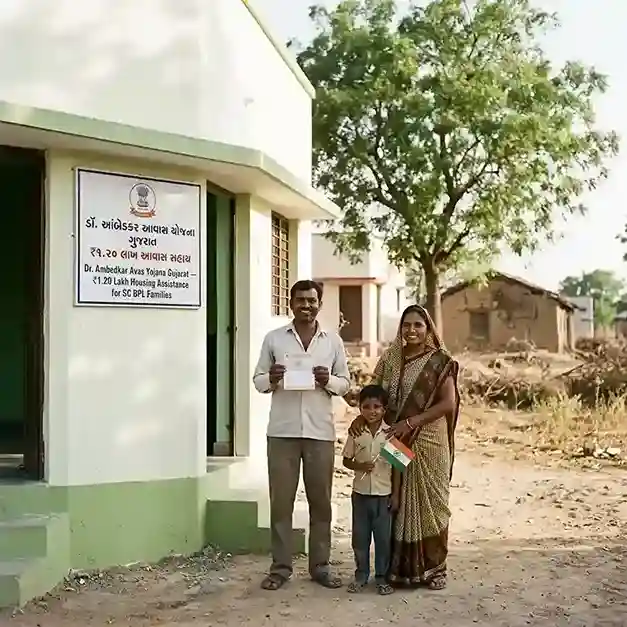
What Is the Dr. Ambedkar Avas Yojana?
Dr. Ambedkar Avas Yojana | also written as Ambedkar Awas Yojana or Ambedkar Aavas Yojana | is a Gujarat state government housing assistance scheme. It was launched in 1999 by the Director of Scheduled Caste Welfare, under the Department of Social Justice and Empowerment, Government of Gujarat.
The scheme targets Scheduled Caste, Re-scheduled Caste, and Tapriwas families who live below the poverty line and do not have a proper home. It gives ₹1,20,000 to eligible families to build a new house, fix an old uninhabitable home, or build on an open plot they already own.
The money is not given as a lump sum. It comes in three stages | each tied to progress at the construction site. This ensures the money actually gets used for housing.
The scheme operates separately in urban and rural Gujarat. In cities, the District Deputy Director of SC Welfare handles it. In villages, the District Social Welfare Officer manages the process.
The scheme is locally known as "Babasaheb Ambedkar Avas Yojana" or "Makan Sahay Yojana" in some districts. All names refer to the same scheme with the same benefits and the same application process.
Who Is Eligible?
You must meet all of the following conditions at the same time. Missing even one makes you ineligible.
| Criteria | Requirement |
|---|---|
| Category | Scheduled Caste (SC), Re-scheduled Caste, or Tapriwas caste in Gujarat |
| BPL status | Family must be listed in the Below Poverty Line (BPL) list |
| Income | Rural | Annual family income ≤ ₹1,20,000 from all sources |
| Income | Urban | Annual family income ≤ ₹1,50,000 from all sources |
| Residency | Must be a permanent resident of Gujarat |
| Age | Minimum 21 years |
| Plot / Land | Must own a plot of at least 50 sq yards (rural) or 35 sq yards (urban) |
| Previous housing scheme | Neither the applicant nor any family member should have received benefits under any other government housing scheme |
| Housing condition | Must be homeless, living in a kutcha/mud/grass house, or own only an open plot |
| Bank account | Active bank account in applicant's name, linked to Aadhaar |
Who Cannot Apply?
Even if you belong to the SC or Tapriwas community, you are not eligible if any of the following apply.
- You or any family member already received benefit under Pradhan Mantri Awas Yojana (PMAY), Indira Awas Yojana (IAY), or any other central or state housing scheme
- Your annual family income is above ₹1,20,000 (rural) or ₹1,50,000 (urban)
- You are below 21 years of age
- You are not a permanent resident of Gujarat
- You do not own any plot or land to build on
- Your plot is smaller than the minimum required size | 50 sq yards (rural) or 35 sq yards (urban)
- Your family already has a pucca (concrete/brick) house in good condition
Financial Assistance | 3 Installments Explained
The total assistance under this scheme is ₹1,20,000. This amount is released in three installments. Each installment is linked to a specific stage of construction. No stage can be skipped.
All three payments go directly to your Aadhaar-linked bank account via DBT | Direct Benefit Transfer. No cash is handled. No middlemen are involved. If your Aadhaar is not linked to your bank account, the payment will fail. Fix this at your bank branch before applying.
What If ₹1.20 Lakh Is Not Enough?
The scheme provides ₹1,20,000. This is not a full construction budget | it is a subsidy. If your total construction cost is higher, you must arrange the remaining funds yourself. The construction must still be completed within 2 years of the first installment, regardless of additional costs.
| Area Type | Maximum Allowed Construction Cost |
|---|---|
| Urban areas | ₹10,00,000 |
| Rural areas | ₹7,00,000 |
Additional Benefits | MGNREGA and Swachh Bharat
The scheme does not end at ₹1,20,000. Eligible beneficiaries can get two more forms of support on top of the housing grant.
MGNREGA | 90 Days of Unskilled Employment
Rural beneficiaries under this housing scheme can also access the Mahatma Gandhi National Rural Employment Guarantee Act. MGNREGA gives up to 90 days of unskilled employment specifically for house construction work.
This helps families who need labour income during the building process. The MGNREGA wages go to the family's job card account. It is separate from the ₹1,20,000 housing grant. Families do not have to choose one over the other | they can use both.
Swachh Bharat Mission | ₹12,000 for Toilet
The third installment of the housing grant (₹20,000) is released only after the toilet is built. But eligible families can also receive an additional ₹12,000 under the Swachh Bharat Mission specifically for toilet construction | on top of the scheme's own final installment.
This is a separate central government benefit. The family must apply for it separately through the Gram Panchayat or Urban Local Body. The house being built under this scheme qualifies as a new construction, which makes it eligible for the Swachh Bharat Mission toilet subsidy.
Special Rule | Building on the First Floor
This is one of the least understood provisions of the scheme. Many families miss it.
An SC beneficiary can receive assistance to build on the first floor of a family home | not just on open ground. This applies when an adult son or adult brother wants to build their own unit above the existing ground floor home of the family.
Three conditions must be met:
- The ground floor must already be registered in a family member's name (parent, sibling, or other family member)
- The ground floor owner must give written consent for the first floor construction
- The applicant building on the first floor must meet all other eligibility criteria independently
This provision is particularly useful in urban areas where open land is expensive or unavailable. A son living with his parents in a single-storey house can use this scheme to build his own separate unit above it.
Documents Required for Ambedkar Avas Yojana Gujarat
Keep all documents ready before you start the online form. Uploading them in one go prevents application failure and delays.
| Document | Purpose | Notes |
|---|---|---|
| Aadhaar Card | Identity and DBT payment linkage | Name on Aadhaar must match bank account exactly |
| Caste / Sub-Caste Certificate | Proves SC, Re-scheduled, or Tapriwas category | Issued by Mamlatdar. Must be valid |
| BPL Card or BPL List Entry | Confirms Below Poverty Line status | Family must appear in official BPL list |
| Annual Income Certificate | Confirms income is within the limit | Current financial year only. Issued by Mamlatdar |
| Proof of Residence | Confirms Gujarat permanent residency | Any one: electricity bill, voter card, ration card, lease, or licence |
| Plot / Land Documents | Proves plot ownership | 7/12 Satbara extract or property deed. Must show plot size ≥ 50 sq yards (rural) / 35 sq yards (urban) |
| Bank Passbook | For DBT payment | Account must be in applicant's name. Aadhaar must be seeded to the account |
| Ration Card | Supports BPL and residence proof | Helps verify family composition |
| Passport-size Photograph | Application identity | Recent, clear, white background |
| Self-declaration affidavit | Declares no previous housing scheme benefit | On ₹10 stamp paper, notarised |
For First-Floor Construction Applicants | Additional Documents
- Ground floor property registration documents in family member's name
- Written consent letter from the ground floor owner | signed and notarised
- Aadhaar card of the consenting ground floor owner
How to Apply Online | Step by Step
Applications go through the official e-Samaj Kalyan portal. Use Google Chrome or Mozilla Firefox. The process takes about 25–30 minutes if all documents are ready.
-
1Open the e-Samaj Kalyan portal
Go to esamajkalyan.gujarat.gov.in. This is the only official application portal. Do not use third-party websites.
-
2Register as a new user
Under the "Citizen Login" tab, click "Please Register Here." Enter your full name (as per Aadhaar), gender, date of birth, Aadhaar card number, email ID, and caste. Click Register.
-
3Log in with your new credentials
After registration is confirmed, log in with your user ID and password. If you already have an account from a previous application, skip registration and log in directly.
-
4Update your profile
Click "User Profile." Fill all mandatory information | personal details, address, caste, income, and bank account details. Click Update. This must be done before you can apply for any scheme on the portal.
-
5Go to Director Scheduled Caste Welfare
From the home page, click on the "Director Scheduled Caste Welfare" section. This opens the list of SC welfare schemes available on the portal.
-
6Select Dr. Ambedkar Avas Yojana
Find "Dr. Ambedkar Avas Yojana" from the scheme list. The scheme code is DAAY. Click Apply or the scheme name to open the application form.
-
7Fill the application form
Enter all personal details, family income from all sources, property details, and housing condition. Answer every field accurately. Do not leave fields blank unless they are optional.
-
8Upload all required documents
Upload each document in the correct field | JPG or PDF, under 200KB each. Verify that names match across all documents before uploading. A name mismatch between Aadhaar and caste certificate is a common rejection reason.
-
9Review and submit
Go through all entries one more time. Check that the bank account number and IFSC are correct. Submit the form. Print the filled application. Save your application number.
How to Apply Offline
Not everyone has reliable internet access. You can also apply through offline channels.
Through the District Office
For rural areas, go to the District Social Welfare Officer office in your district. For urban areas, go to the District Deputy Director, Scheduled Caste Welfare Office. Both offices accept paper applications and can assist with form-filling.
Through Jan Seva Kendra (JSK)
Jan Seva Kendras are government service centres available at taluka and district levels across Gujarat. They offer free help with e-Samaj Kalyan portal registration, form-filling, and document uploads. Bring all original documents and two sets of photocopies. Ask for a receipt after submission.
Ambedkar Avas Yojana Form PDF | Download and Offline Use
Many people search for a downloadable PDF form for this scheme. The official position is that applications are now fully online through the e-Samaj Kalyan portal. There is no single official paper form that replaces the online application process.
However, some district offices provide a physical form for applicants who come in person. These forms contain the same fields as the online application. If you need a physical form, visit your nearest District Social Welfare Officer office or Jan Seva Kendra and request one.
Third-party websites circulate unofficial PDF forms for this scheme. Many are outdated. Using an unofficial form does not guarantee your application will be accepted. Always confirm with your local district office what they require.
How to Check Application Status
After submitting your application, you can track its progress online without visiting any office.
-
1Open esamajkalyan.gujarat.gov.in
Go to the official portal. You do not need to log in to check status.
-
2Find "Your Application Status" on the homepage
Scroll down on the home page. Look for the "Your Application Status" button. Click it.
-
3Enter your application number and date of birth
Enter the application number you saved after submission. Enter the applicant's date of birth. Click Search.
-
4Read the status message
The result shows your current status | submitted, under review, sanctioned, or rejected. If rejected, the reason is shown. Correct the issue and reapply if the reason is fixable.
You can also check status by logging in to your account on the portal and going to the "My Applications" or "Application Status" section in the dashboard.
Construction Rules | What You Must Follow
Receiving the money is only the beginning. The scheme has strict construction rules. Violating them can cancel the remaining installments.
- You must complete construction within 2 years of receiving the first installment
- The house must include a toilet | the third installment is only released after the toilet is built
- Construction must follow the cost ceiling: ₹7,00,000 (rural) or ₹10,00,000 (urban)
- You must put up a plaque on the completed house reading "State Government's Ambedkar Avas Yojana"
- The house must be built on the plot you declared in the application
- You must not sell or transfer the property during the construction period
What Happens If You Cannot Complete Within 2 Years?
If construction stalls due to genuine reasons | medical emergency, natural disaster, or financial hardship | contact your District Social Welfare Officer as early as possible. In some cases, extensions can be granted with proper documentation. Do not wait until the deadline has passed.
Construction Inspection
A government inspector verifies construction progress before each installment is released. For the second installment, the inspector confirms the building has reached lintel level. For the third installment, they confirm full completion including the toilet. Be prepared for these inspections. Do not ask for the second installment without genuine lintel-level progress.
Who Implements This Scheme?
The scheme is run by the Department of Social Justice and Empowerment, Government of Gujarat, through its Scheduled Caste Welfare wing.
Ready to Apply for Ambedkar Avas Yojana?
The entire application is online. It takes about 25–30 minutes if your documents are ready. Go to the official e-Samaj Kalyan portal now.
Apply at esamajkalyan.gujarat.gov.inFrequently Asked Questions
Sources and References
- Department of Social Justice and Empowerment, Government of Gujarat | esamajkalyan.gujarat.gov.in
- Director of Scheduled Caste Welfare, Gujarat | Scheme Guidelines (DAAY), Page 88 and Page 461
- Project Sarthi | Dr. Ambedkar Awas Yojana scheme details (projectsarthi.com/schemes/daay)
- Public Services Map India | Dr. Ambedkar Awas Yojana scheme record
- Mahatma Gandhi NREGA | Ministry of Rural Development, Government of India
- Swachh Bharat Mission (Gramin) | Ministry of Jal Shakti, Government of India
Last reviewed: June 2026. This is an independent informational guide. Always verify current scheme details at esamajkalyan.gujarat.gov.in or with your District Social Welfare Officer before applying.