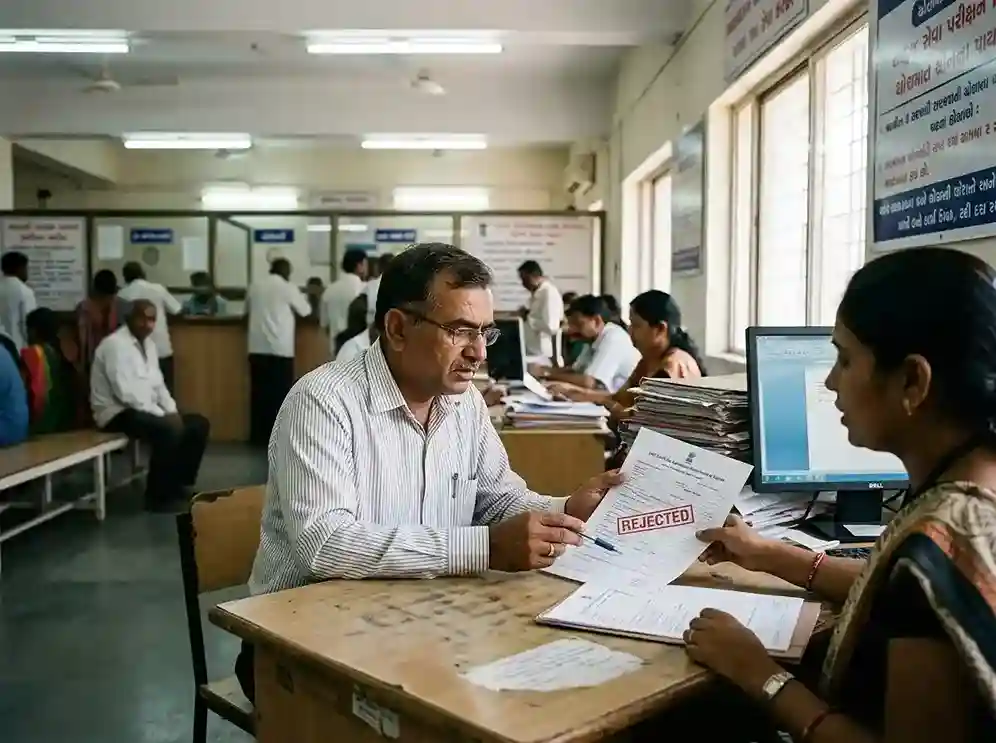
What the EWS Certificate Is and Who Needs It
The EWS certificate | formally called the Income and Assets Certificate for Economically Weaker Sections | gives General category applicants access to a 10% reservation in government jobs and educational institutions.
The 103rd Constitutional Amendment, passed in January 2019, created this reservation. Gujarat was the first state to implement it, on January 14, 2019, just two days after presidential approval.
You need this certificate for central and state government job applications under the EWS quota. You also need it for admission to central universities, IITs, IIMs, NITs, and Gujarat state colleges under the 10% EWS seats. If you apply for the EBC/EWS scholarship on the Digital Gujarat portal, this certificate is the primary eligibility document.
The Mamlatdar office issues the certificate in Gujarat. It is valid for one financial year. You need a fresh certificate every year.
EWS Eligibility in Gujarat | Quick Recap
The rejection almost always connects back to one or more of these eligibility conditions. All of them must be true at the same time. Failing even one disqualifies you.
| Criterion | Limit | Note |
|---|---|---|
| Category | General (unreserved) only | SC, ST, OBC, SEBC are not eligible |
| Annual family income | Less than ₹8 lakh | All sources combined | salary, agriculture, business, rent |
| Agricultural land | Less than 5 acres | Total for entire family unit |
| Residential flat (urban) | Less than 1,000 sq ft | Total built-up area |
| Residential plot (notified municipality) | Less than 100 sq yards | Applies in areas like AMC, Surat Municipal Corporation |
| Residential plot (non-notified area) | Less than 200–240 sq yards | Rural areas and panchayat zones |
| Gujarat residency | Family settled before April 1, 1978 | Gujarat-specific rule for state EWS quota |
The income limit includes all earning family members | both parents, earning siblings under 18, and any other dependents who receive income. It is gross income, not take-home pay. Even if taxes reduce your actual salary below ₹8 lakh, the gross figure applies.
Top 10 Reasons EWS Certificates Are Rejected in Gujarat
Every rejection on the Digital Gujarat portal has a reason code. Here are the ten most common ones, what they mean, and exactly how to fix each one.
-
Annual family income exceeds ₹8 lakh
The income certificate or documents submitted show combined family income above the ₹8 lakh ceiling. This is the most common rejection reason. Many families miss income from agricultural land, rental property, or secondary earners.
Fix: Review your income certificate carefully. Add up all income sources. If you genuinely fall below ₹8 lakh and the certificate is wrong, get a corrected certificate from the Mamlatdar with accurate figures. If income is above ₹8 lakh, you are ineligible this year.
-
Agricultural land exceeds 5 acres
Your family collectively owns 5 or more acres of agricultural land. The limit applies to all land owned by parents, spouse, and children combined | not just your personal share.
Fix: Check the exact acreage in your 7/12 Satbara record (Utara). If the combined family land is under 5 acres, provide a clear land record showing this. If it is over 5 acres, you are not eligible for EWS.
-
Residential flat or house is 1,000 sq ft or larger
The family owns a flat or house in an urban area with a built-up area of 1,000 sq ft or more. Many families in Ahmedabad and Surat own flats in this range without realising it disqualifies them.
Fix: Get a certified floor plan or property deed from your municipal authority showing the exact built-up area. If it is below 1,000 sq ft, submit this as supporting evidence. If the property is larger, you are ineligible.
-
Residential plot in notified municipality exceeds 100 sq yards
You own a plot within an AMC, Surat Municipal Corporation, Vadodara Municipal Corporation, or other notified municipality area that is 100 sq yards or more.
Fix: Check your property documents for the exact plot size in sq yards. Submit a certified measurement from the municipality if you believe the area is below the limit. A 10-cent plot is approximately 484 sq yards | well above the limit.
-
Applicant belongs to SC, ST, OBC, or SEBC category
EWS is strictly for General category persons who do not belong to any reserved category. The portal checks your caste certificate. If your records show SC, ST, OBC, or SEBC, the EWS application is automatically rejected.
Fix: You cannot apply for EWS if you belong to a reserved category. Instead, apply for the relevant scholarship or benefit under your own category | SC, ST, SEBC, or OBC | through the Digital Gujarat portal.
-
Family not settled in Gujarat before April 1, 1978
Gujarat has a unique rule. For state-level EWS reservation benefits | in state jobs and state colleges | your family must have been permanently settled in Gujarat on or before April 1, 1978. The Gujarat High Court upheld this rule in December 2025. Families from other states who migrated after 1978 cannot claim state EWS quota even if they have lived in Gujarat for decades.
Fix: Gather documents proving pre-1978 residency | old ration cards, voter rolls, school records, land records, or district gazette entries. If you cannot establish pre-1978 residency, you may apply for the Central EWS certificate but cannot use it for Gujarat state-level reservation posts.
-
Name mismatch across documents
Your name is spelled differently on your Aadhaar card, income certificate, caste affidavit, or bank account. Even a one-letter difference | "Patel" vs "Patell," or "Mehta" vs "Mehata" | triggers a rejection flag.
Fix: Identify which document has the wrong spelling. Update your bank records at the branch with an Aadhaar card. Update Aadhaar at a UIDAI centre with supporting documents. An affidavit on stamp paper declaring both names are yours can help during the interim. Make sure all documents match before reapplying.
-
Income certificate is expired or wrong financial year
The income certificate submitted was issued in a previous financial year. The EWS certificate requires an income certificate for the current financial year. An FY 2023–24 certificate submitted for an FY 2025–26 application is automatically invalid.
Fix: Apply for a fresh income certificate at the Mamlatdar office or through the Digital Gujarat portal. Always check the financial year on the certificate before submitting. Processing takes 7–14 working days, so apply early.
-
Income certificate issued by wrong authority
Only a Mamlatdar or Taluka Development Officer (TDO) can issue a valid income certificate in Gujarat. Certificates signed by a sarpanch, company HR, chartered accountant, or any unofficial person are rejected outright.
Fix: Get your income certificate from your area's Mamlatdar office or apply online through the Digital Gujarat portal. Do not accept certificates from any other source, however convenient.
-
Self-declaration affidavit missing or not on stamp paper
The EWS application requires a self-declaration stating you belong to the General category and your family assets are within limits. This must be on ₹10 or ₹20 stamp paper. Uploading a plain paper declaration or a scanned photo instead of the affidavit causes rejection.
Fix: Draft the self-declaration in the prescribed format. Get it notarised on stamp paper. Scan clearly at 200 DPI. Upload as a PDF file under 200KB. Do not photograph it in dim light | the notary stamp must be readable.
Land Ownership Edge Cases | The Tricky Rules
Land ownership is where most genuinely eligible families run into problems. The rules look simple on paper. In practice, they create real confusion.
Edge Case 1: Multiple Small Plots Adding Up to 5 Acres
A family owns one plot of 2 acres in one village and another 3-acre plot in a different taluka. Individually, neither plot crosses the limit. Together, they equal exactly 5 acres. The rule says the total must be less than 5 acres. Exactly 5 acres is not less than 5 | it is equal to 5. The application fails.
What to do: Add up all agricultural land across all locations and all family members. If the total is 5 acres or more, you are ineligible. If it is 4.9 acres or less, make sure your 7/12 records show this clearly and attach all of them.
Edge Case 2: Inherited Undivided Property
Your grandfather owns 10 acres. The property has not been legally partitioned. Your father's 25% share is 2.5 acres | below the limit. But the Mamlatdar may count the full 10 acres as family property if partition is not legally completed.
What to do: Complete the legal partition before applying. Get a registered partition deed. Once the deed is registered, the 7/12 records will show only your family's share, not the entire ancestral holding.
Edge Case 3: Agricultural Land in Another State
You own 3 acres in Gujarat but your parents own 4 acres of farmland in Rajasthan. Both parcels belong to the same family unit. The 5-acre limit applies to all agricultural land | regardless of which state it is in.
What to do: Add up all agricultural land owned by the family from all states. If total is below 5 acres, attach land records from all states as supporting evidence.
Edge Case 4: Residential Plot in a Village Inside Municipal Limits
You own a plot that was originally in a village area but the land now falls within the expanded AMC or municipal corporation boundary. Before the boundary expansion, the 200–240 sq yards limit applied. Now the 100 sq yards (notified municipality) limit applies. Many families are rejected because their plot was legal before the municipal limits expanded.
What to do: Check the current municipal classification of your land from the local municipality. If your plot is inside municipal limits, the 100 sq yard limit applies. If outside, the non-notified limit applies. Get a written certificate from the municipality confirming the classification.
Edge Case 5: Agricultural Land Used for Residential Purpose (Bastu Land)
In Gujarat, "bastu" land refers to a residential plot in a village, sometimes classified differently from urban residential plots. An 11-decimal bastu plot is approximately 532 sq yards | well above the residential plot limit. Even if the Mamlatdar classified it as agricultural in old records, if the land is used for a house, it counts as residential property.
What to do: Check the exact classification in your 7/12 and 8A records. If bastu land is counted as residential, ensure the built-up area of your house on it is below 1,000 sq ft. The plot size and the house size are measured separately under different limits.
Gujarat's 1978 Residency Rule | What It Means for You
This rule is unique to Gujarat and causes significant confusion, especially for families who migrated from other states.
In January 2019, Deputy Chief Minister Nitin Patel announced that families must have been permanently settled in Gujarat on or before April 1, 1978 to qualify for the state's EWS reservation in government jobs and state educational institutions.
In December 2025, the Gujarat High Court upheld this rule. A petitioner had cleared the GPSC preliminary examination but was declared ineligible because she could not prove pre-1978 residency. The court noted that she had herself acknowledged this issue and had chosen to use a Central EWS certificate instead of a Gujarat-specific one. The court held the Central certificate was not valid for Gujarat state-level EWS posts.
What Counts as Proof of Pre-1978 Residency
These documents can establish that your family was in Gujarat before April 1, 1978:
- Old ration card issued before April 1978 with a Gujarat address
- Voter list entries from 1977 or earlier showing family name and Gujarat address
- Land records (7/12, 8A) showing ownership before 1978
- School leaving certificate of a family member from a Gujarat school attended before 1978
- Municipal tax receipts or utility records from before 1978
- Birth certificate of a family member born in Gujarat before 1978
If Your Family Cannot Prove Pre-1978 Residency
You can still get a Central EWS certificate. This is issued under the central government format and works for central government jobs | Union PSC, SSC, Railways, UPSC, central bank recruitment | and admissions in centrally funded institutions like IITs, IIMs, central universities, and NITs.
It does not work for Gujarat state government jobs or Gujarat state university admissions under the state EWS quota.
EWS Certificate vs NCL Certificate | Key Differences
These two certificates confuse a lot of students and families. They share an ₹8 lakh income ceiling, but they serve completely different purposes and different people.
| Feature | EWS Certificate | NCL Certificate |
|---|---|---|
| Full name | Income and Assets Certificate for Economically Weaker Sections | Non-Creamy Layer Certificate |
| Who applies | General category persons only | OBC / SEBC persons only |
| Purpose | 10% EWS reservation in jobs and education | Proves you are not in creamy layer; required to claim OBC/SEBC reservation |
| Income limit | Family income below ₹8 lakh | Family income below ₹8 lakh |
| Asset limits | Yes | land, flat, plot limits apply | No | asset limits do not apply to NCL |
| Residency rule | Yes | pre-1978 for Gujarat state EWS | No | standard domicile certificate sufficient |
| Issuing authority | Mamlatdar | Mamlatdar |
| Validity | One financial year | One year (OBC/SEBC category certificate: 3 years) |
| Constitutional basis | 103rd Amendment (2019) | Mandal Commission (1990) / Article 16(4) |
| Can SC/ST use it? | No | No |
| Used for scholarship | EBC/EWS scholarship on Digital Gujarat | OBC Post-Matric, SEBC scholarships on Digital Gujarat |
The most common mistake: A General category student with income below ₹8 lakh applies for an NCL certificate. This is wrong. NCL is only for OBC/SEBC. The correct certificate for a General category student is EWS.
The reverse mistake: An OBC student applies for EWS thinking the income limit is the same. This is also wrong. OBC students need NCL | not EWS. Applying for EWS as an OBC student will be rejected because you do not belong to the General category.
OBC/SEBC + income below ₹8 lakh = apply for NCL certificate.
SC/ST = neither EWS nor NCL. Apply under your own reservation category.
How to Appeal an EWS Certificate Rejection
Not every rejection means you are actually ineligible. Documents can have errors. Verification officers can make mistakes. If you believe the rejection is wrong, here is how to fight it.
Step 1 | Identify the exact rejection reason
Log in to the Digital Gujarat portal. Go to "My Services" or "Service Requests." Find your EWS certificate application. The rejection reason is listed in the Status column or in the application detail view. Read it carefully. Take a screenshot.
Step 2 | Decide if you can fix and reapply, or if you need to formally appeal
If the rejection is for a correctable error | expired certificate, name mismatch, wrong file format | correct it and reapply directly online. No formal appeal is needed. If the rejection says you are ineligible for a reason you believe is wrong | for example, the verification officer incorrectly calculated income or misread your land records | you need a formal appeal.
Step 3 | Write a formal appeal letter
Address the letter to the Mamlatdar or District Collector of your area. Include:
- Your name, address, and application reference number
- The date of rejection and the reason stated
- Why you believe the rejection is incorrect, with specific facts
- A list of supporting documents you are attaching
- Your signature and date
Step 4 | Submit the appeal in person
Take the appeal letter and all original documents to the Mamlatdar office. Ask for a written acknowledgement with a stamp and date. This is your proof of appeal submission.
Step 5 | File an RTI if you are not getting a response
Under the Right to Information Act, you can file an RTI application to the Tehsildar asking for the verification report used in rejecting your application. This forces the authority to explain their decision in writing. You can use this written explanation to prepare a better appeal or take legal advice.
Step 6 | Approach the District Grievance Cell if needed
If the Mamlatdar office does not respond within 15 working days of your appeal, escalate to the District Collector's Grievance Cell. You can also submit a grievance online at digitalgujarat.gov.in/Grievance with your application ID and screenshots of the rejection.
How to Reapply Online | Step by Step
Once you have corrected the problem that caused the rejection, reapplying online is straightforward. The process is the same as the first application.
-
1Open digitalgujarat.gov.in
Use Google Chrome. Clear your browser cache first. Log in with your registered mobile number or email and password.
-
2Go to Revenue Services
Click "Services" on the top navigation. Select "Revenue." Look for "Income and Assets Certificate for EWS" or search for "EWS" in the service search bar.
-
3Start a fresh application
Do not try to edit your rejected application. Start a new one. Click "Apply Online" and begin the form from scratch.
-
4Fill in all details accurately
Enter income from all sources for all family members. Enter property details from official documents. Do not estimate | use the figures in your 7/12, property deed, and income certificate exactly.
-
5Upload all corrected documents
Each file must be JPG or PDF, under 200KB, and clearly readable. Make sure all names match exactly across every document. See the checklist in the next section.
-
6Submit and save the reference number
Review everything. Submit the application. Save the new reference number. Track progress under "My Services" on your dashboard. Processing takes 7–14 working days.
You can also reapply offline at your nearest Jan Seva Kendra or Mamlatdar office. Bring all original documents and two sets of photocopies. Ask for a receipt with a stamp and date after submission.
Documents Checklist for a Successful Application
Having the right documents ready before you start prevents rejection. Go through this list before submitting your reapplication.
Mandatory Documents
| Document | Issuing Authority | Common Error |
|---|---|---|
| Income Certificate (current financial year) | Mamlatdar only | Using previous year's certificate |
| Caste / Category Affidavit (declaring General category) | Notary / Mamlatdar | Plain paper affidavit, no stamp |
| Aadhaar Card (applicant) | UIDAI | Name mismatch with bank or certificates |
| Aadhaar Cards (parents) | UIDAI | Missing | applicant uploads only own Aadhaar |
| 7/12 Satbara Records (all agricultural land) | Revenue Department | Missing parcels in other talukas or states |
| Property documents (house / flat) | Municipality / Sub-Registrar | Old deed without current area measurement |
| Proof of Gujarat residency before 1978 | Old ration card / voter list | No old documents retained |
| Self-declaration affidavit (EWS eligibility) | Notary on stamp paper | Uploaded as plain text scan |
| PAN card of all earning family members | Income Tax Department | Missing PAN for second earner |
| Bank passbook (applicant) | Bank | Account name differs from Aadhaar name |
Before You Upload | Final Check
- Income certificate is for the current financial year (FY 2026–27)
- All names match exactly across Aadhaar, bank account, income certificate, and affidavit
- All agricultural land across all locations included in 7/12 records
- Self-declaration is on stamp paper with notary signature and seal
- All files are JPG or PDF format, under 200KB each
- Each document is clearly readable | no blurry photographs
- Income certificate is from Mamlatdar only | not CA, HR, or sarpanch
- Pre-1978 residency proof is attached if applying for Gujarat state EWS quota
Ready to Apply or Reapply?
The EWS certificate application is on the Digital Gujarat portal. Gather your documents first, then apply. It takes under 30 minutes if everything is ready.
Apply on Digital Gujarat PortalFrequently Asked Questions
Sources and References
- Department of Personnel and Training (DoPT), Government of India | EWS Reservation Order, 2019
- 103rd Constitutional Amendment Act, 2019
- Gujarat Government Resolution, January 25, 2019 | EWS pre-1978 residency rule
- Gujarat High Court | Rutbi Bhansali vs GPSC, December 2025
- Digital Gujarat Official Portal | digitalgujarat.gov.in
- UIDAI Aadhaar Services | uidai.gov.in
- Gujarat Revenue Department | 7/12 and Land Records
Last reviewed: June 2026. This is an independent informational guide. Always verify current rules on official government portals before applying.