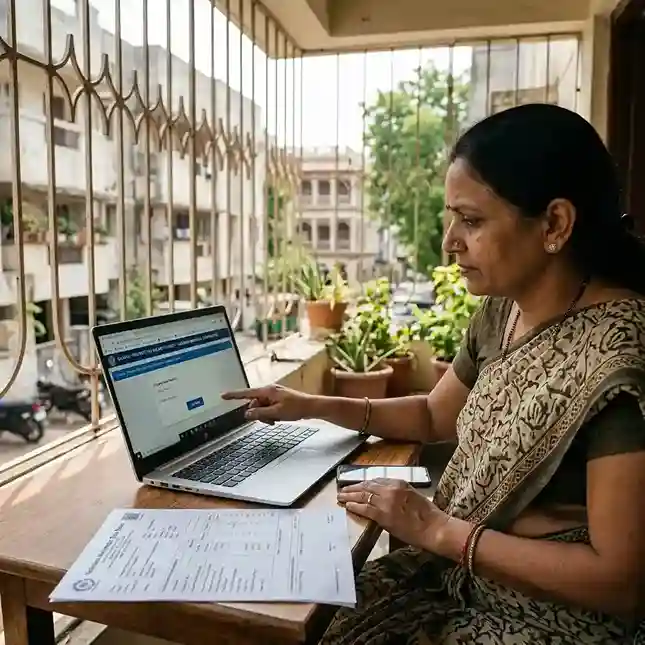
Property Tax in Gujarat | How It Works
In Gujarat, property tax is a mandatory annual levy on all buildings and land. It funds local services | roads, drainage, street lights, garbage collection, and civic maintenance. The authority collecting the tax depends on where your property sits.
If your property is inside a municipal corporation area | Ahmedabad, Surat, Vadodara, Rajkot, Bhavnagar, or Gandhinagar | the municipal corporation collects it. If you live in a town with a Nagarpalika, the Nagarpalika collects it. If you live in a village, the Gram Panchayat collects what is locally called Ghar Vero (house tax).
Gujarat has two billing cycles each year. The first half bill covers April to September. You must pay it before 31 March. The second half covers October to March. You must pay that before 15 October. Missing these dates triggers a penalty.
The base for calculating the tax is either the Annual Rental Value (ARV) or the Net Annual Value (NAV) of the property. Each local body sets its own rates, zone factors, and multipliers. The resulting tax figure is then topped up with education cess, fire tax, drainage tax, and solid waste management charges.
All Portals | City by City
Each city and local body has a specific portal or process. Use the correct one for your location to avoid confusion and failed payments.
How to Pay via eNagar Gujarat Portal
The eNagar Gujarat portal at enagar.gujarat.gov.in is the central payment platform for Nagarpalikas, smaller town municipalities, and some municipal corporations in Gujarat. It covers Gandhinagar, Himatnagar, Palanpur, Patan, Anand, Anjar, and over 170 other urban local bodies.
-
1Go to enagar.gujarat.gov.in
Open the official eNagar Gujarat portal. Use Google Chrome or Firefox. Clear cache if the page loads slowly.
-
2Click Quick Pay
On the homepage, click the "Quick Pay" option. Then select "Property Tax Payment" from the list of services.
-
3Select your ULB name
Choose your Nagarpalika, municipality, or municipal corporation from the dropdown list. This is called the Urban Local Body (ULB) selection.
-
4Enter your property details
Enter your tenement number, zone, ward, and old tenement number (if applicable). These details are on your last property tax bill. Enter the captcha code shown and click Search.
-
5Check dues and click Pay
The next screen shows your property details and the amount due. Check that the details match your property. Click the Pay button.
-
6Choose payment method
Select debit card, credit card, net banking, or UPI. Enter your payment details and confirm the transaction.
-
7Download your receipt
After payment completes, the receipt appears on screen. Download and save it immediately. To get it later, go to the eNagar homepage and click "Payment Receipt." Enter your payment reference number.
Ahmedabad AMC Property Tax Online
Ahmedabad property owners pay through the AMC portal at ahmedabadcity.gov.in. The AMC also has a separate eGovAMC platform for property tax management.
After registration on the AMC portal, you can link all your property tax numbers and professional tax numbers in a single account. This makes it easier to manage multiple properties from one login.
AMC Property Tax | Key Facts
- Tax calculated on Annual Rental Value (ARV) basis
- Residential tax rate is approximately 10%–20% of ARV depending on zone and property type
- Education cess is 25% of the base tax, levied under the Gujarat Education Cess Act 1962
- Fire tax, drainage tax, and solid waste management charges are added separately
- AMC accepts payment online, at AMC offices, and through authorised collection centres
- Tax bills are generated twice a year | April and October
Surat SMC Property Tax Online
Surat property owners pay at suratmunicipal.gov.in. SMC uses a 13–14 digit tenement number unique to each property. You can find this on your previous tax bill or at the SMC office.
The SMC portal has a built-in property tax calculator. You can estimate your annual dues before payment. SMC also offers an online grievance system if you disagree with the assessed amount. Surat residents can pay online or at authorised Easy Bill Pay counters across the city.
Surat Property Tax | Zone Rates
Surat is divided into zones. The tax rate per square foot varies by zone and property use (residential or commercial). Commercial properties attract a higher rate than residential properties. New constructions use the current year's rate. Older buildings may get an age factor concession in the ARV calculation.
Vadodara VMC Property Tax Online
Vadodara property owners pay at vmc.gov.in. VMC uses a Self-Assessment Scheme (SAS) where property owners assess their own property tax based on official guidelines and pay accordingly.
The VMC SAS system works by having the owner calculate tax using the area, usage, building type, zone, and age of the property. The calculation follows a standardised formula. VMC verifies the self-assessment periodically. If the declared value is too low, VMC can revise the assessment and recover the difference.
Vadodara property owners can pay online via the VMC portal, or offline at VMC wards and collection centres. For Anand city (Anand Nagarpalika), the eNagar Gujarat portal handles payments, not VMC.
Rajkot RMC Property Tax Online
Rajkot property owners pay at rmc.gov.in or rmcegov.gov.in. The Rajkot Municipal Corporation uses a SAS-based system similar to Vadodara.
RMC offers a 6% early payment rebate | the highest among Gujarat's major municipal corporations. Pay your first half-year bill before 31 March to get this discount automatically applied.
RMC's tax calculation uses a base rate of ₹3 per sq ft per month, adjusted by zone factor (0.80x to 1.45x), usage factor, building type, occupancy status, and age depreciation (up to 48% for very old buildings). The base 20% tax rate applies to the adjusted annual value. Education cess (4%), fire tax (6%), drainage tax (4%), and solid waste management tax (3%) are then added.
Bhavnagar BMC Property Tax Online
Bhavnagar property owners pay at bmcgujarat.com or through services.bmcgujarat.com. BMC Gujarat should not be confused with Brihanmumbai Municipal Corporation | in Gujarat context, BMC stands for Bhavnagar Municipal Corporation.
BMC also has a dedicated Android mobile application named "Bhavnagar Municipal Corporation." Download it from the Play Store to pay property tax, check dues, and download receipts from your phone. The BMC EDP (Electronic Data Processing) department handles all technical queries for online payments.
Gandhinagar GMC Property Tax Online
Gandhinagar property owners can pay at gandhinagarmunicipal.com or through the eNagar Gujarat portal at enagar.gujarat.gov.in. Gandhinagar is listed as an eligible ULB on the eNagar Quick Pay system.
The GMC portal also allows you to check your property card, verify assessment history, and file objections online. Gandhinagar being the state capital has well-maintained digital records for most properties.
Gram Panchayat Property Tax | Ghar Vero Online in Gujarat
In villages across Gujarat, Gram Panchayats collect a property tax called Ghar Vero (house tax). Traditionally collected in person at the Panchayat office, this is now available online through the digital Gram Panchayat system.
How to Pay Ghar Vero Online
-
1Visit the Gujarat Panchayat portal
Go to the official Gujarat Gram Panchayat website or the eGram Swaraj portal for rural property tax payments.
-
2Select district, taluka, and Gram Panchayat
Choose your district from the list, then your taluka, and finally your specific Gram Panchayat by name.
-
3Enter your property details
Enter your property ID or survey number. The portal displays your property owner name and all registered property details for verification.
-
4Select financial year and check dues
Choose the financial year or years you want to pay for. The portal shows the total amount due including any pending years and accumulated dues.
-
5Pay and download receipt
Pay via UPI, debit card, credit card, or net banking. Download and save your digital receipt after the transaction confirms.
Gram Panchayat Tax Rate
Gram Panchayat property tax rates in Gujarat typically range from 0.5% to 2% of the Annual Rental Value (ARV) of the property. The formula is:
The Gram Panchayat itself sets the rate each year through a formal resolution. Rates can differ from one panchayat to the next. Contact your Gram Panchayat sarpanch or secretary to confirm the exact current rate for your village.
Property Tax Rates in Gujarat
There is no single rate across all of Gujarat. Each local body sets its own rates, and rates can differ by property zone, usage type, and building age.
| Local Body | Base Tax Approach | Additional Levies | Early Payment Rebate |
|---|---|---|---|
| AMC (Ahmedabad) | ARV × 10%–20% | Education cess (25% of base), fire tax, drainage | Check AMC portal |
| SMC (Surat) | ARV × zone rate | Education cess, fire tax, solid waste | Check SMC portal |
| VMC (Vadodara) | SAS self-assessment on ARV | Education cess, fire tax | Check VMC portal |
| RMC (Rajkot) | ₹3/sq ft/month × factors × 20% | Education cess (4%), fire (6%), drainage (4%), SWM (3%) | 6% for early payment |
| BMC (Bhavnagar) | ARV-based | Education cess, other levies | Check BMC portal |
| GMC (Gandhinagar) | ARV-based | Education cess and local levies | Check GMC portal |
| Nagarpalika (eNagar) | ARV-based as per local rules | Education cess applies | Varies |
| Gram Panchayat (Ghar Vero) | 0.5%–2% of ARV | Usually no additional cess | Usually not offered |
How to Calculate Property Tax | ARV Formula
Most Gujarat municipal corporations use the Annual Rental Value (ARV) method. The formula is standardised but the input factors vary by city.
Factor Definitions
| Factor | What It Means | Typical Range |
|---|---|---|
| Usage Factor | Residential, commercial, industrial, or open land | 0.22x (open land) to 2.60x (commercial) |
| Building Type Factor | RCC pucca, semi-pucca, kutcha | 0.8x to 1.2x typically |
| Occupancy Factor | Self-occupied, rented, or vacant | 1.00x (self), 1.22x (rented), 0.60x (vacant) |
| Age Factor | Depreciation for older buildings | Up to 48% depreciation for very old structures |
| Zone Factor | Location within the city | core, peripheral, etc. | 0.80x to 1.45x |
Online calculators for AMC (Ahmedabad), SMC (Surat), VMC (Vadodara), and RMC (Rajkot) are available on their respective portals. Use the official calculator for your city to get an accurate estimate before paying.
Education Cess on Property Tax in Gujarat
Education cess is a surcharge added on top of your base property tax. It has been levied in Gujarat under the Gujarat Education Cess Act, 1962.
In most Gujarat municipalities and Nagarpalikas, the education cess is 25% of the base property tax. This means for every ₹100 of base tax, you pay ₹25 extra as education cess. So your total including cess would be ₹125.
In Rajkot Municipal Corporation, the education cess is 4% of the annual value | charged separately from the base rate. In other cities it is typically calculated as a percentage of the base tax. The amount collected goes into the State Education Cess Fund under the Gujarat Education Cess Act for primary education development.
The cess appears as a separate line item on your tax bill. You cannot opt out of it. It is a mandatory component of the total property tax liability.
Exemptions | Defence Personnel, Women, and Other Categories
Several categories of property owners in Gujarat may qualify for full or partial exemption from property tax. The rules vary by local body.
Defence Personnel Exemption
The Gujarat Municipalities Act provides for property tax exemptions and rebates for defence personnel. The specific exemption available to defence personnel | serving or retired | depends on which local body governs your property.
Generally, the exemption applies to one self-occupied residential property registered in the name of the serving or retired armed forces member. Properties used for commercial purposes or rented to others typically do not qualify for this exemption.
To claim the exemption, submit an application to your local municipal corporation or Nagarpalika along with your service documents or ex-serviceman certificate. The exemption is not automatically applied. You must apply for it every financial year or when your status changes.
Other Common Exemptions in Gujarat Municipalities
| Category | Typical Exemption | Condition |
|---|---|---|
| Places of worship | Full exemption | Not used for commercial purposes |
| Government buildings | Full or partial (varies) | Used for public administrative purpose |
| Schools and colleges | Concession or full exemption | Government-run or grant-in-aid institutions |
| Charitable institutions | Partial concession | Registered and non-commercial |
| Defence personnel | Full or 50% rebate | Self-occupied residential, one property only |
| Widows (some cities) | Concession (varies) | Self-occupied, income below threshold |
| Senior citizens (some cities) | Concession (varies) | Varies by municipal body resolution |
How to Download Property Tax Payment Receipt in Gujarat
Keep your receipt safe | it is proof of payment for any property transaction, loan application, or government verification.
Download Receipt from eNagar Gujarat
-
1Go to enagar.gujarat.gov.in
Open the official eNagar portal homepage.
-
2Click "Payment Receipt" on the homepage
The receipt download link appears on the eNagar homepage. Click it.
-
3Enter your payment reference number
Enter the transaction reference or application number from your payment confirmation. This was displayed when you completed payment and sent to your registered mobile or email.
-
4Download or print the receipt
The receipt opens as a PDF. Click Download or use your browser's print function to save it. This receipt is valid as official proof of payment.
Download Receipt from AMC Ahmedabad
Go to ahmedabadcity.gov.in. Navigate to the property tax section. Log in to your AMC account. Go to "View Payment History" or "Download Receipt." Select the financial year and property number. Download the PDF receipt.
Receipt for Gram Panchayat Ghar Vero
After payment on the Gujarat Panchayat portal, a digital receipt is generated immediately. Download and save it on the same screen. To retrieve it later, log in with your property ID and check your payment history in the portal's transaction section.
Penalty for Non-Payment of Property Tax in Gujarat
Gujarat municipalities take non-payment seriously. Missing the due date costs you more each day the payment remains pending.
| Charge | Rate | Notes |
|---|---|---|
| Late payment interest | 18% per annum | Charged on the outstanding tax amount from the due date |
| Notice fee | 0.50 paise per notice | Charged when a demand notice is issued for non-payment |
| Education cess on dues | 25% of base tax (included in total) | Accumulates with interest on unpaid amount |
Beyond financial penalties, persistent non-payment gives the municipality the legal authority to issue attachment notices on the property. This can block sale, mortgage, or transfer of the property. Courts can also be approached by the municipal body for recovery of dues in extreme cases.
Gujarat Property Tax Rules | Key Points
Property tax in Gujarat is governed by the Gujarat Municipalities Act, individual municipal corporation acts (like the Bombay Provincial Municipal Corporations Act, 1949, as adopted by Gujarat for its major cities), and the Gujarat Panchayats Act for rural areas.
Who Pays Property Tax?
The primary responsibility lies with the owner of the property. If the property is rented, the owner remains responsible for paying the tax | not the tenant | unless there is a specific written agreement transferring that responsibility, which must be registered with the local body.
New Constructions
When you complete a new construction, you must report it to your local municipal body within 90 days. The property is then assessed and added to the tax register. Failing to report a new construction and receiving demand later results in back-taxes being charged from the date of completion, plus interest.
Nagarpalika Property Tax Rules | Non-Payment Punishment
If a property owner in a Nagarpalika area does not pay within the stipulated time, the Nagarpalika can issue a distress warrant. The officer can attach movable property of the defaulter. In extreme cases, the Nagarpalika can apply to the civil court for recovery. The property itself can be legally encumbered, preventing sale or transfer.
Property Gift Tax in Gujarat
There is no separate property gift tax in Gujarat as such. When a property is gifted, stamp duty applies on the gift deed. The rate is the same as for a sale | currently a flat 4.9% for males and 4.9% for females in Gujarat (women get a concession of 1% in some transactions, bringing it to 3.9%). Registration charges are additional. After the gift deed is registered, the property tax liability shifts to the new owner (donee) from the next billing cycle.
Property Tax and Real Estate Transactions
When buying property in Gujarat, always verify that all property tax dues are cleared. The seller must provide a No-Due Certificate from the municipal body before registration. Without this, the buyer inherits pending tax liability.
For property purchase, stamp duty in Gujarat is currently 4.9% of the agreement value or guidance value, whichever is higher. Registration charges are 1% of the agreement value (maximum ₹30,000). These are one-time costs at purchase and are separate from the annual property tax.
7/12 Records and Property Ownership
For rural properties, the 7/12 (Satbara) extract is the primary proof of land ownership in Gujarat. It records the owner's name, survey number, and land use. Before paying Gram Panchayat tax, ensure your name appears correctly on the 7/12 record. To check your 7/12 online, visit our Gujarat Land Records 7/12 guide. For any land mutation or name update, read our Land Mutation Gujarat Online Apply guide.
Ready to Pay Your Gujarat Property Tax?
Use the right portal for your area. Pay before the due date to avoid penalties.
Frequently Asked Questions
Sources and References
- eNagar Gujarat Official Portal | enagar.gujarat.gov.in
- National Government Services Portal | services.india.gov.in (Gujarat property tax listing)
- AMC Ahmedabad | ahmedabadcity.gov.in
- SMC Surat | suratmunicipal.gov.in
- VMC Vadodara | vmc.gov.in
- RMC Rajkot | rmc.gov.in / rmcegov.gov.in
- BMC Bhavnagar | bmcgujarat.com
- Gujarat Education Cess Act, 1962 | Government of Gujarat Legislative Department
- Gujarat Municipalities Act | Urban Development and Urban Housing Department, GoG
- Rajkot Property Tax Calculator | tools.realestate (RMC self-assessment guidelines)
Last reviewed: June 2025. Information is subject to change. Always verify rates and deadlines on your specific local body's official portal before payment.