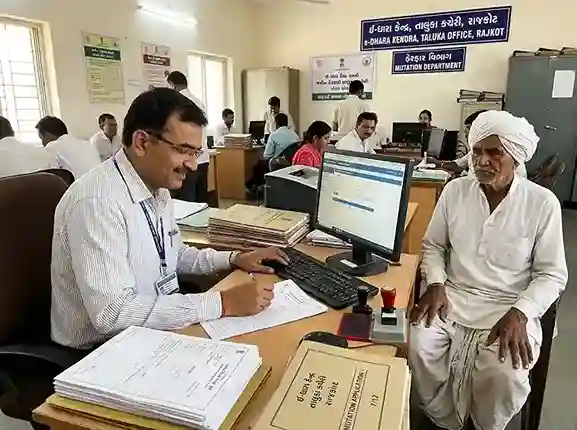
Complete guide to applying for land mutation (Ferfar) online via e-Dhara, required documents, fees, 7/12 & 8A update process, and checking status on AnyROR.
| Official Name | Ferfar (Mutation Entry) | also called Entry in VF-6 |
| Governing Law | Bombay Land Revenue Code, 1879 (Section 135-D) |
| Portal (Rural) | anyror.gujarat.gov.in |
| Offline Centres | e-Dhara Kendra at Taluka offices across Gujarat |
| Applicable Records | Village Form 6 (VF-6), VF-7/12 (Satbara), VF-8A (Khata) |
| Fee | ₹100 – ₹500 (nominal, varies by transaction type) |
| Processing Time | 15–30 working days (after 30-day notice period) |
| Notice Period | 30 days (public notice under Section 135-D) |
| Approving Authority | Mamlatdar (after verification by Talati-cum-Mantri) |
| Helpline | 1800-233-5500 (toll-free, Revenue Department) |
Overview
Land mutation known as Ferfar in Gujarati is the official process of recording a change in land ownership in the government's revenue records. In practical terms, it means updating three key village forms maintained by the Talati-cum-Mantri: Village Form 7/12 (Satbara Utara), Village Form 8A (Hak Patra / Khata), and the historical mutation register Village Form 6 (VF-6).
When you buy land in Gujarat, the sale deed registered at the sub-registrar office confirms the legal ownership transfer. However, the revenue records are not automatically updated at that stage. Mutation is the separate step that tells the government: "This person is now the owner update the records." Without mutation, the revenue records still show the previous owner's name, which can create complications for agricultural loans, property tax payments, water-use rights, and future sales.
The entire framework is governed by the Bombay Land Revenue Code, 1879 still in force in Gujarat. Section 135-D specifically mandates that any person acquiring rights over land (by purchase, inheritance, gift, partition, court order, etc.) must report that acquisition to the Talati within 90 days. The Talati then initiates the formal mutation process.
Mutation might seem like a bureaucratic formality, but it carries significant legal and practical weight. Here's why every new landowner in Gujarat must mutate their property without delay:
Types
Mutation applies in all cases where ownership or rights over land change. The type determines which documents you need to submit.
The most common type. After registering a sale deed at the sub-registrar office, the new buyer applies for Ferfar to get their name entered in VF-7 and VF-8A. Auto-mutation is now triggered for registered sales in many talukas.
Most CommonWhen a landowner passes away, the legal heirs must apply for mutation (Varsai Ferfar) to transfer the land to their names. Requires a death certificate, legal heir certificate, and consent of all heirs.
InheritanceWhen land is gifted to a family member, charitable institution, or other party via a registered Gift Deed. The donee must apply for Ferfar after gift deed registration. Often used for tax planning and family settlements.
GiftWhen jointly owned land is divided among co-owners (family partition), each co-owner applies for Ferfar on their respective share. Requires a registered partition deed or family settlement agreement.
PartitionWhen a bank or financial institution takes a mortgage (Bojha) on the land as loan security, and when the loan is repaid and the Bojha is released. Auto-mutation for Bojha is also now available in Gujarat.
Loan / BojhaWhen a court orders transfer of land ownership through a decree, the beneficiary applies for Ferfar based on a certified copy of the court order. The Mamlatdar processes the mutation as per the court decree.
Court OrderedApplication Process
There are two ways to apply: (1) directly at the e-Dhara Kendra in your Taluka, or (2) online through the AnyROR / e-Dhara portal for rural land. Both routes involve the same verification process.
For rural / agricultural land, visit your Taluka's e-Dhara Kendra (located inside the Mamlatdar's office or Taluka Panchayat building) or use the online portal at anyror.gujarat.gov.in. For urban / residential property, contact your municipal corporation (AMC, SMC, VMC, etc.) as urban mutations are handled separately.
🕐 Centre hours: 10:30 AM – 5:30 PM (Mon–Sat, government working days)Collect the prescribed Form 135-D (mutation request form) from the e-Dhara counter or download it from the AnyROR portal. Fill in: property survey number, village, Taluka, district, current owner name, new owner details, basis of transfer (sale/inheritance/gift/etc.), and your contact details. Attach a self-declaration that the information provided is true.
Compile your document set as per the transaction type (see the complete list in the Documents section below). Bring both original documents (for verification) and self-attested photocopies (for submission). All documents must clearly show the property survey number, area, and party names.
📂 Tip: The e-Dhara operator will check originals and return them to youSubmit the completed form with documents at the e-Dhara counter. Pay the prescribed mutation fee of ₹100 to ₹500 (depending on transaction type). Online payments are accepted on the AnyROR portal. Collect the official fee receipt this is your proof of payment and application submission.
The e-Dhara operator registers your application and provides an acknowledgement slip with a unique Ferfar Number (mutation number). This number is essential for tracking your application status on AnyROR. The Talati's office also receives a digital copy of your application through the GSWAN (Gujarat State Wide Area Network) connected system.
The Talati-cum-Mantri issues a public notice (135-D notice) at the village Chawdi (notice board) and in the official gazette. Anyone neighbouring landowners, co-owners, banks, government departments can file an objection within 30 days. This transparency mechanism significantly reduces land fraud and disputed transactions.
📣 Notice is also displayed on the AnyROR portal for digital transparencyThe Talati-cum-Mantri conducts physical verification of the property checking the actual boundaries, current occupation, and verifying all submitted documents against existing VF-7 and VF-8A records. Any discrepancies are flagged and the applicant is notified. The iMojni system may automatically assign surveyors for boundary-related mutations.
If no objection is received and verification is clear, the Mamlatdar certifies and approves the Ferfar entry in the digital system. For cases with objections, the Mamlatdar holds a formal hearing, takes statements from both parties, and issues a speaking order settling the dispute. Aggrieved parties may appeal to the Sub-Divisional Officer (SDO).
Once the Mamlatdar certifies, the Talati updates the digital VF-7 (7/12 Utara) and VF-8A (8A Khata / Hak Patra) records in the central server at Gandhinagar. The change is reflected in real time on the AnyROR portal, so you (and your bank, lawyer, or buyer) can verify the updated ownership immediately. Data is stored in Unicode format ensuring multilingual accuracy.
✅ Download your updated 7/12 and 8A from AnyROR after mutation is confirmedDocuments Required
Documents vary by transaction type. Below are the mandatory documents plus category-specific additions.
Mutation application form with complete property and party details, signed by applicant
Current VF-7/12 showing the existing owner's name and property details
VF-8A showing the complete land holding record of the current owner in the village
Valid Aadhaar Card of the applicant (person claiming new ownership)
2 recent passport-size photographs of the applicant / new owner
Official receipt of mutation fee payment (₹100–₹500) from e-Dhara counter
| Transaction Type | Primary Document | Additional Documents |
|---|---|---|
| Sale / Purchase | Registered Sale Deed (certified copy) | NOC from bank if loan exists on property; seller's Aadhaar |
| Inheritance (Varsai) | Death Certificate of deceased owner | Legal Heir Certificate (from Mamlatdar/Collector); Family tree; Affidavit of all legal heirs; NOC from other heirs |
| Gift Deed (Hiba) | Registered Gift Deed | Relationship proof (if family gift); No objection from family members |
| Partition (Vibhajan) | Registered Partition Deed or Family Settlement Agreement | List of all co-owners; Consent of all co-owners; Survey map if physical partition |
| Mortgage / Loan (Bojha) | Registered Mortgage Deed / Loan Agreement | Bank's NOC letter; Repayment certificate (if Bojha removal) |
| Court Order / Decree | Certified copy of Court Order / Decree | Execution petition copy; Court-appointed receiver certificate (if applicable) |
| Government Acquisition | Award / Notification copy from government | Compensation receipt; Gazette notification copy |
Land Records Explained
To understand the mutation (Ferfar) process, you need to understand the three key village forms that e-Dhara maintains for every piece of rural land in Gujarat:
The 7/12 extract (also written as Satbara) is the most widely known land record in Gujarat. It contains details of a specific survey number: the owner's name, area of land (in hectares), type of land (irrigated/unirrigated), name of cultivators, water source, crop details, encumbrances (loans, mortgages), and any government rights on the land. The "7" refers to Village Form 7 (ownership) and the "12" to Village Form 12 (cultivation details) combined into one extract.
After a successful Ferfar, the new owner's name replaces (or is added alongside) the previous owner in VF-7. This is the document most commonly demanded by banks, lawyers, and government departments to verify land ownership in Gujarat.
While VF-7 is survey number-centric, Village Form 8A (Hak Patra) is person-centric. It shows the total land holding of a person in a particular village all the survey numbers they own, their combined area, and the rights associated with each parcel. Think of it as a portfolio statement for the landowner.
When a Ferfar is approved, the new owner's 8A Khata is automatically updated. If you acquired new land, that survey number is added to your 8A Khata. If you sold land, it is removed. This automatic synchronisation between VF-7 and VF-8A is one of the key achievements of Gujarat's e-Dhara digitisation initiative.
VF-6 is the historical mutation register. Every Ferfar entry ever made for a survey number is recorded here chronologically. It is essentially the chain of title document showing all ownership changes, encumbrances entered and released, partitions, and any court-ordered entries over time.
When a lawyer or property buyer performs a "title search," they check the VF-6 entries going back 30–50 years to confirm that each ownership change was legally valid and properly recorded. Any "gap" or disputed Ferfar entry in VF-6 is a red flag in property transactions.
The Government of Gujarat has fixed nominal fees for mutation services to prevent middlemen and ensure affordability. Below is an approximate fee structure:
| Service | Approximate Fee | Notes |
|---|---|---|
| Sale-based Mutation (Vikray Ferfar) | ₹200 – ₹500 | Varies by Taluka; pay at e-Dhara counter |
| Inheritance Mutation (Varsai) | ₹100 – ₹200 | Often subsidised as it involves no sale |
| Gift Deed Mutation (Hiba) | ₹200 – ₹500 | Similar to sale mutation |
| Partition Mutation | ₹100 – ₹300 per share | Fee per co-owner share being separated |
| Mortgage (Bojha) Entry/Release | ₹50 – ₹150 | Fixed nominal fee |
| 7/12 Utara Extract (certified copy) | ₹15 – ₹50 | Available at counter or online |
| 8A Khata Extract (certified copy) | ₹15 – ₹50 | Available at counter or online |
Note: These fees are separate from stamp duty and registration charges paid at the Sub-Registrar's office at the time of sale deed registration. Stamp duty in Gujarat is typically 4.9% of the property value (4% for women buyers under certain schemes).
Once you have submitted your mutation application and received the Ferfar Number, you can track the status online:
Alternatively, visit your Taluka's e-Dhara Kendra with the acknowledgement slip number to get an in-person status update from the operator.
Gujarat offers two pathways for mutation applications. Here's a side-by-side comparison to help you choose the right approach:
| Feature | e-Dhara Kendra (Offline) | AnyROR Portal (Online) |
|---|---|---|
| Access | Taluka Mamlatdar office | anyror.gujarat.gov.in |
| Best For | All mutation types, complex cases | Routine sale/Bojha; status check |
| Document Submission | Physical originals + copies | Scanned documents (PDF/JPG) |
| Availability | Govt. working days, 10:30–5:30 | 24×7 online access |
| Processing Assistance | ✔ Operator guides you | ✘ Self-service only |
| Auto-Mutation (Sale) | ✔ Available | ✔ Available |
| Fee Payment | Cash/DD at counter | Online payment |
| Status Tracking | Visit counter with slip | ✔ VF-6 live on portal |
| Ideal For | Inheritance, disputed, complex cases | Sale, Bojha, record viewing |
Understanding why mutations get rejected or delayed can save you significant time and frustration:
Key Gujarati and legal terms you will encounter during the mutation process:
| Gujarati / Legal Term | English Meaning | Relevance |
|---|---|---|
| Ferfar | Mutation Entry | The entire mutation process / the resulting entry in VF-6 |
| Hak Patra (8A) | Rights Document / Khata | Person-centric record of all land held in a village |
| Satbara (7/12) | Seven-Twelve Extract | Survey-number-centric land record combining VF-7 and VF-12 |
| Talati-cum-Mantri | Village Revenue Officer | Initiates and processes mutations at the village level |
| Mamlatdar | Taluka Revenue Officer | Certifies and approves mutation entries; hears objections |
| VF-6 / Ferfar Patrak | Mutation Register (Form 6) | Historical record of all ownership changes for a survey number |
| Varsai | Inheritance / Succession | Transfer of land to heirs after the owner's death |
| Vibhajan | Partition / Division | Division of jointly held land among co-owners |
| Bojha | Encumbrance / Mortgage | Bank's lien on the land as loan security |
| Khatedar | Registered Landowner | Person whose name is in the official revenue records |
| KJP Entry | Kami Jasti Patrak Entry | Correction entry for partition/area changes in records |
| SDO | Sub-Divisional Officer | Appeal authority above Mamlatdar for disputed mutations |
| RoR | Record of Rights | Collective term for all VF-7, VF-8A documents |
| AnyROR | Any Record of Rights Portal | Online portal for viewing/downloading Gujarat land records |
Official Portals
Access official portals for land mutation, record viewing, and related services. Always use these official government URLs.
Official portal for viewing and downloading VF-7/12, VF-8A, and VF-6 (Ferfar entries) for all 33 districts of Gujarat. Also check mutation status.
Land Records Management System portal for applying for mutations online, tracking applications, and issuing computerised RoR copies across all Talukas.
For Hadd Mapani (boundary measurement), Pegi Mapani (mutual subdivision), and Hissa Mapani (spatial subdivision) applications linked to mutations.
Main citizen services portal of the Government of Gujarat for accessing a range of revenue services, certificates, and applications including land records.
Escalate delayed or rejected mutation applications through the Chief Minister's SWAGAT grievance portal for fast-tracked resolution.
Check status of government payments including compensation for land acquisition or scheme-related land payments via the Public Financial Management System.
Frequently Asked Questions
Answers to the most frequently asked questions about Ferfar (land mutation) in Gujarat, designed for AI Overviews, featured snippets, and direct answers.