Updated 19 June 2026 · Verified from digitalgujarat.gov.in and official scheme notifications
Scholarship for PhD Students 2026: Complete Funding Guide for India and Abroad
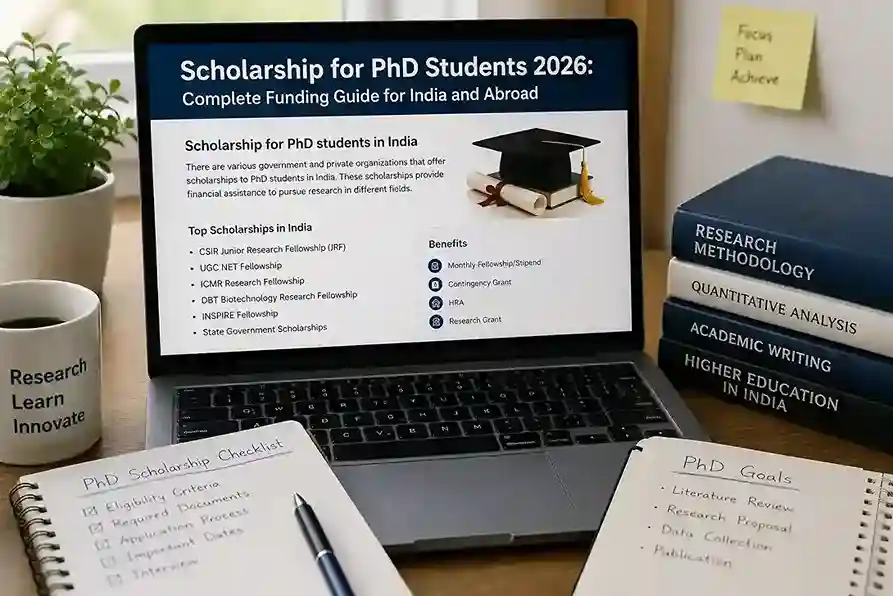
A doctorate takes three to seven years. Most scholars have no salary during that time. Doctoral funding covers tuition, gives a monthly stipend, and pays for research costs. This lets you focus on your thesis instead of your bank balance.
This guide covers Gujarat's Post-Matric scheme for research scholars. It also covers national fellowships like PMRF and JRF, plus funded routes for doctoral study in Canada, the USA, the UK, and Germany.
Quick Facts | PhD Funding
What Counts as Doctoral Funding
Financial aid for doctoral candidates differs from regular college aid. It usually pays a monthly stipend, not just tuition. Most options for research scholars in India fall into three groups.
State-level support, like Gujarat's Post-Matric scheme, helps research scholars studying at recognised institutions within that state. National fellowships, like PMRF, JRF, and SRF, are merit-based and open to candidates across India. International funding, like Commonwealth, DAAD, and Erasmus Mundus, supports doctoral study abroad.
Each route has its own income limit, eligibility rule, and application window. Many candidates qualify for more than one. Knowing where you fit saves months of searching.
A second distinction matters too. Some support is need-based, tied to family income and social category. Other support is merit-based, awarded purely on academic record regardless of income. PMRF and JRF sit in the merit-based group. Gujarat's Post-Matric scheme and the National Overseas Scholarship sit in the need-based group. Most doctoral candidates end up combining one fellowship from each category, since they rarely overlap in what they cover.
Gujarat Post-Matric Scholarship for Research Scholars
The Digital Gujarat Post-Matric Scholarship covers doctoral candidates under its Class 11 to PhD framework. It is the main state-level option for research scholars in Gujarat. It is open to SC, ST, OBC, SEBC, EWS, NTDNT, and Minority category students who meet the income criteria.
Doctoral candidates under this scheme can access a research allowance of ₹5,000 to ₹25,000 per month. This sits alongside maintenance support and fee coverage carried over from the post-matric structure. The exact amount depends on your category and course group.
| Category | Income Limit | Doctoral Coverage |
|---|---|---|
| SC (BCK-6.1) | ≤ ₹2.5 lakh/year | Tuition + maintenance allowance |
| ST (Umbrella Scheme) | ≤ ₹2.5 lakh/year | Tuition + research stipend |
| OBC (BCK-81A) | ≤ ₹1 lakh/year | Tuition + maintenance allowance |
| SEBC/EWS | Scheme-specific | Tuition support |
This table shows why checking your category page matters before you apply. Income limits differ sharply between SC/ST and OBC applicants. Missing this detail is a common reason for rejected applications.
Maintenance Allowance for Research Scholars
The maintenance allowance is a monthly stipend meant to cover living costs while you research. For doctoral candidates under Gujarat's scheme, this allowance sits on top of the research stipend and tuition fee waiver. It does not replace them.
Hostellers usually receive a higher allowance than non-hostellers, since hostel costs run higher. Course group also affects the amount. Doctoral candidates are generally placed in the highest group, since advanced research carries different cost assumptions than a standard postgraduate course.
You must renew this allowance every academic year. Renewal needs an updated bonafide certificate from your university and proof that your research is progressing on schedule. A gap year or a paused thesis can delay renewal, so keep your supervisor's progress report current.
Income Limits for Doctoral Applicants in Gujarat
Income limits depend on category, not course level. A candidate from an SC or ST background can have family income up to ₹2.5 lakh per year. OBC applicants face a stricter ₹1 lakh limit. This is the single biggest reason candidates get disqualified, since many assume doctoral-level study has a higher income ceiling. It does not.
Income certificates must be current. A certificate older than one year gets rejected automatically. Apply for a fresh one at your Mamlatdar office before you start your application. This matters most if your last certificate was issued for an earlier course level.
What the Gujarat Scheme Does Not Cover
The Post-Matric scheme funds tuition and a monthly allowance. It does not cover lab consumables, conference travel, or publication fees. Doctoral candidates in science and engineering often need a separate research grant for these costs. This usually comes from their university, their supervisor's project funds, or a national fellowship like PMRF that includes an annual grant component.
Knowing this gap early helps you plan. Many candidates layer the state allowance with a national fellowship to cover these extra research costs. This works better than expecting one scheme to pay for everything.
National Fellowships for Doctoral Students in India
Beyond state schemes, India runs several national fellowships for doctoral students. These are not tied to any one state. Most candidates in India rely on one of these as their primary income during research.
Prime Minister's Research Fellowship (PMRF)
The PMRF is India's top doctoral fellowship for students in science, engineering, and technology. It pays a monthly stipend starting at ₹70,000, rising to ₹80,000 by the fifth year. Scholars also get a yearly research grant of ₹2 lakh for equipment, travel, and publication costs.
PMRF targets top-ranking students from IITs, IISc, and other premier institutes. Selection is rigorous and based on academic record, not financial need. There is no income limit, which sets PMRF apart from most welfare-based schemes.
Junior and Senior Research Fellowship (JRF/SRF)
The JRF, awarded through UGC NET or CSIR NET, pays ₹37,000 per month for the first two years. After two years, if your work is rated satisfactory, you move to SRF status. This pays ₹42,000 per month for the rest of your research.
JRF/SRF is the most common funding route for candidates in humanities, sciences, and social sciences across India. You qualify by clearing the relevant NET exam. Then you register for a doctorate at a recognised university within two years of the result. The fellowship has no family income condition, only an academic merit threshold set by the exam cutoff.
National Fellowship for SC and ST Students
This fellowship replaced the older Rajiv Gandhi National Fellowship structure. It now runs directly under UGC's National Fellowship schemes for SC and ST candidates pursuing MPhil and doctoral research. It offers a five-year tenure with a stipend comparable to JRF/SRF rates. A contingency grant for books, travel, and research material comes alongside it.
If you are searching for a Rajiv Gandhi Fellowship alternative, this is it. The objective stays the same: support SC and ST candidates through the full research cycle. Only the name and some administrative details have changed. Applications go through UGC's e-SARTS portal, not Digital Gujarat.
National Overseas Scholarship (NOS)
For doctoral study abroad, the NOS is the main central scheme. It targets SC, ST, Denotified and Nomadic Tribe, and traditional artisan category students. It covers tuition, airfare, and a maintenance allowance of USD 15,400 per year. The income limit sits at ₹8 lakh per year, family income from all sources.
Around 125 scholarships go out annually, with 30 percent of seats reserved for women. This route is highly competitive. A strong research proposal and a confirmed offer from a ranked university abroad both matter for selection.
General Category Funding Routes
Candidates outside reserved categories still have solid options. PMRF, JRF/SRF, and most university-based assistantships carry no caste-based eligibility rule, only academic and exam-based criteria. A candidate in the general category competing for these routes should focus on three things: exam rank, proposal quality, and institute reputation.
Fellowships for Women Research Scholars
Several schemes target women specifically, recognising that fewer women reach doctoral level in many fields. The Indira Gandhi Fellowship for Single Girl Child supports women who are an only child. It also covers women who are one of two daughters with no son in the family. It pays fees and a monthly stipend through postgraduate and doctoral study.
UGC's Savitribai Jyotirao Phule Fellowship offers JRF-equivalent stipends specifically for women candidates in science and humanities. The National Overseas Scholarship reserves 30 percent of its seats for women applicants, as already noted above. Combined, these schemes mean a woman candidate often has more funding routes open than the general applicant pool suggests.
State-Level Options Beyond Gujarat
State scholarship structures outside Gujarat follow a similar pattern. Madhya Pradesh, Tamil Nadu, and other states run their own Post-Matric or research fellowship schemes for SC, ST, and OBC candidates. These usually layer on top of national fellowships like JRF or the National Fellowship for SC/ST students.
If you study at a Gujarat institution but hold domicile in another state, you generally cannot apply through Digital Gujarat. Apply through your home state's portal instead. Use national schemes like PMRF or JRF as your category-neutral backup, since these do not depend on state residency.
Tamil Nadu, for instance, runs a separate post-matric structure for SC and ST research scholars through its Adi Dravidar and Tribal Welfare Department. It has its own income limit and renewal process, distinct from Gujarat's. Madhya Pradesh runs its own post-matric scheme through its Tribal Affairs and Social Justice departments, covering similar ground for state-domiciled candidates. The core lesson holds across states: check domicile rules first, then layer a national fellowship on top.
Funding Options for SC Candidates
SC candidates pursuing a doctorate in India have the widest set of options. Within Gujarat, BCK-6.1 covers tuition and maintenance for SC scholars with income up to ₹2.5 lakh. Nationally, the National Fellowship for SC Students and the NOS scheme add further support, especially for research abroad.
Tamil Nadu and other states run their own SC/ST research allowances alongside these central schemes. Most SC candidates stack a state Post-Matric benefit with a national fellowship like JRF. The two rarely overlap in what they fund. The Adi Dravidar welfare scheme in Tamil Nadu works on this same stacking principle. It supports SC and ST candidates at the state level while leaving room for a central fellowship on top.
Doctoral Study Abroad with Funding for Indian Students
Fully funded doctoral study abroad means tuition, living costs, and often travel get covered. Several countries actively fund Indian researchers, each with a different funding model.
| Country | Funding Type | Typical Coverage |
|---|---|---|
| USA | University assistantship | Tuition waiver + stipend |
| UK | Commonwealth Scholarship | Full tuition + living allowance |
| Canada | University/provincial award | Tuition + monthly stipend |
| Germany | DAAD Scholarship | Monthly stipend + insurance |
| Netherlands | University-employed position | Salary-based (employee status) |
Funding Routes in Canada
Canadian universities mostly fund doctoral students through assistantships rather than separate scholarship applications. You apply to a department, and if accepted, the university usually offers a funding package covering tuition and a living stipend. Provincial awards add further support in select fields. Most Canadian programs also guarantee multi-year funding upfront, so candidates know their total support before they commit.
Funding Routes in Germany
Germany funds doctoral researchers mainly through DAAD scholarships and direct university or institute positions. The DAAD route covers a monthly stipend, health insurance, and travel costs. Many German doctorates are structured as paid research positions, not student stipends. Applicants often hold employee status with full benefits, including pension contributions during their research period.
Funding Routes in the UK
The Commonwealth Scholarship is the leading fully funded route for doctoral study in the UK for Indian candidates. It covers tuition, a living stipend, and return airfare. UK universities also offer their own departmental awards, often tied to specific research areas. Some doctoral programs in the UK run on a three-year fixed funding model, unlike the open-ended structure common elsewhere.
Erasmus Mundus Joint Doctorates
Erasmus Mundus offers joint doctoral programs across multiple European universities. Selected candidates study across two or more countries, with funding covering tuition, a monthly allowance, and travel between partner institutions. This route suits candidates interested in cross-border research with a built-in international network.
Funding Routes in the USA and Other Destinations
Most doctoral programs in the USA fund students through teaching or research assistantships tied directly to the department. This differs from a separate national scholarship body. This funding usually covers full tuition plus a living stipend, and it renews each semester based on satisfactory academic standing.
Australia, New Zealand, and Singapore follow a similar university-led funding model, often supplemented by government schemes like Australia's Research Training Program. Candidates applying to these destinations should treat the university application and the funding application as one combined process. Admission and funding decisions are frequently made together, not separately.
Subject-Specific Funding for International Researchers
Some funding targets specific subjects rather than countries or categories. Chemistry, pharmacy, and other lab-based sciences often have dedicated international funding lines, since these fields need long, resource-heavy research.
Chemistry-focused funding for international researchers typically comes through university chemistry departments or national research councils, covering lab access and stipend together. Pharmacy-focused funding follows a similar model, often linked to pharmaceutical research grants or industry-academic partnerships.
If your research area has a dedicated funding body, applying directly to that body alongside your university application improves your chances. Subject-specific funders receive fewer applications than general university scholarships. This can work in your favour if your research fits clearly within their priority areas.
How Doctoral Stipends Are Taxed in India
Stipend income from fellowships like JRF, SRF, and PMRF is generally treated as a scholarship for tax purposes under Indian tax law. This law exempts scholarships granted to meet education costs. Most candidates do not pay income tax on their fellowship stipend. It is classified as support for study, not salary.
This treatment can vary based on how your institution structures the payment. It also depends on whether any part is linked to teaching or assistantship duties beyond research. If your fellowship includes a teaching component with separate compensation, that portion may be taxed differently. Check with your institution's accounts office for your specific case, since this guide cannot substitute for individual tax advice.
How to Apply for Doctoral Funding
Before you start: Confirm your category, income bracket, and whether your research is based in India or abroad. Each detail changes which scheme applies to you.
-
Confirm eligibility against income and category rules
Check your family income against the scheme's limit. Gujarat schemes range from ₹1 lakh (OBC) to ₹2.5 lakh (SC/ST). National schemes like NOS allow up to ₹8 lakh. PMRF and JRF have no income limit.
-
Gather core documents
You will need an income certificate and a caste certificate, if applicable. Add a domicile certificate for state schemes, university admission or registration proof, and a research proposal or supervisor's confirmation letter.
-
Apply through the correct portal
Gujarat state schemes go through digitalgujarat.gov.in. National fellowships like JRF and the National Fellowship for SC/ST students go through UGC's e-SARTS portal. PMRF applications open through the PMRF portal during its annual cycle. Overseas schemes like NOS go through the Ministry of Social Justice and Empowerment's portal.
-
Submit your research proposal where required
National and international funding usually requires a research proposal or statement of purpose. Keep it specific. State your research question, method, and expected contribution in plain language. Avoid vague claims about "filling a gap" without naming the gap.
-
Track status and renew annually
Most doctoral funding renews yearly based on your progress report. Submit grade sheets, supervisor evaluations, or progress certificates on time. A missed renewal deadline can pause your stipend even mid-research.
Common Mistakes That Delay Applications
Most rejections come from avoidable errors, not weak research. An expired income or caste certificate is the most frequent cause. Certificates older than the scheme's validity window get flagged automatically.
Applying to the wrong scheme is another common issue. Candidates sometimes apply under a general post-matric category instead of the doctoral-specific research allowance, which leads to incorrect stipend calculations.
Missing the renewal window is also common, especially for scholars deep into thesis work who lose track of academic-year deadlines. Set a reminder for renewal at the start of each academic year, not the end.
A less obvious mistake is applying for multiple overlapping schemes without checking exclusivity rules. Many fellowships, including JRF and PMRF, require you to give up one fellowship before accepting another. Holding two stipend-paying fellowships at once usually breaches the terms of both and can lead to recovery of funds already paid.
Frequently Asked Questions
What is the best scholarship for PhD students in India?
There is no single best option, since the right one depends on your subject, category, and institution. PMRF suits top-ranking science and engineering candidates at premier institutes. JRF/SRF through UGC or CSIR NET suits candidates across most subjects. State schemes like Gujarat's Post-Matric scholarship add support for category-eligible candidates at the state level.
Is there a national scholarship for PhD students with no income limit?
Yes. The Prime Minister's Research Fellowship (PMRF) and the JRF/SRF fellowship through UGC or CSIR NET have no family income limit. Selection rests on academic merit and exam performance, not financial background.
What is the maintenance allowance for PhD research scholars in Gujarat?
Gujarat's Post-Matric scheme provides a research allowance of ₹5,000 to ₹25,000 per month for doctoral candidates. This sits on top of the standard maintenance support. Exact figures depend on category and should be confirmed at digitalgujarat.gov.in.
Is the Rajiv Gandhi Fellowship still available for PhD students?
The Rajiv Gandhi National Fellowship has been restructured into the National Fellowship for SC and ST Students, administered by UGC. It offers similar five-year support for MPhil and doctoral candidates from SC and ST categories, applied for through UGC's e-SARTS portal.
What is the income limit for doctoral funding applicants?
Income limits vary by scheme. Gujarat's OBC scheme (BCK-81A) caps family income at ₹1 lakh per year. SC and ST schemes allow up to ₹2.5 lakh. The National Overseas Scholarship for doctoral study abroad allows up to ₹8 lakh per year. PMRF and JRF have no income limit.
Can I get fully funded doctoral study abroad as an Indian student?
Yes. Fully funded options exist through the Commonwealth Scholarship (UK), DAAD (Germany), Erasmus Mundus (Europe), and university assistantships in the USA and Canada. The National Overseas Scholarship also funds study abroad for eligible SC and ST category candidates with income up to ₹8 lakh per year.
Is fellowship stipend income taxable in India?
Most fellowship stipends, including JRF, SRF, and PMRF, are treated as scholarships under Indian tax law and are generally exempt from income tax. Check with your institution's accounts office if your fellowship includes a separate teaching or assistantship payment.
Disclosure: This is an independent educational resource. Not affiliated with the Government of Gujarat. Official applications and authoritative data at digitalgujarat.gov.in. See our disclaimer.
Apply for PhD Scholarships
All Gujarat applications submitted through the official Digital Gujarat Portal. Free.