Patan Scholarship Gujarat 2026-27 | Full Eligibility & Apply Guide
Patan scholarship is the name students in Patan district use for the state scholarships open to them. There is no scheme called "Patan Scholarship." Students from Patan, Sidhpur, Radhanpur, Chanasma, Harij, Sami, Santalpur, Shankheshwar, and Saraswati taluka all apply through the same Digital Gujarat portal as the rest of the state. Once they submit a form, the local Mamlatdar office in their taluka checks the income and caste papers. This page explains who can apply, what papers you need, and where your taluka office is.
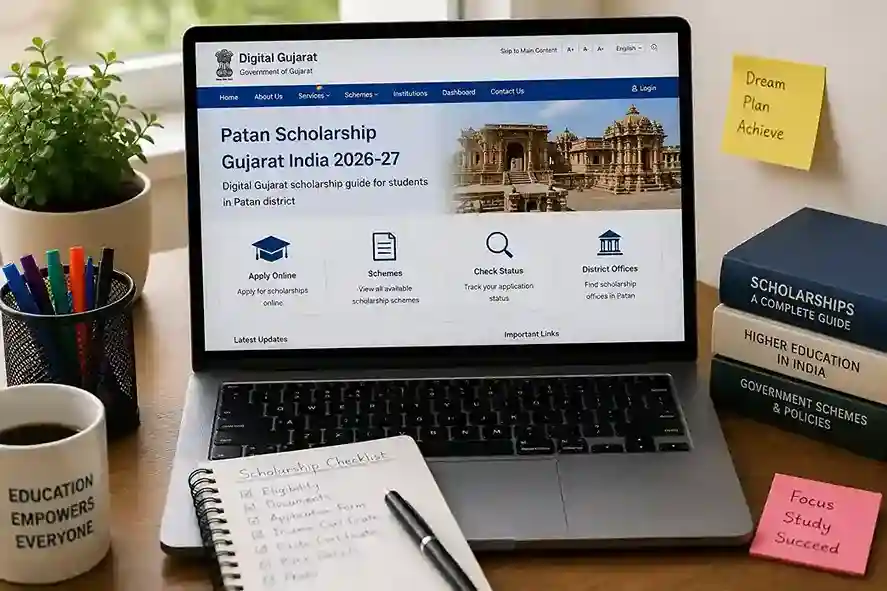
Patan scholarship guide for students across all 9 talukas of Patan district, Gujarat | Updated June 2026
What does "Patan scholarship" actually mean?
A short, honest answer before you read anything else.
Patan is a district in north Gujarat. It does not run its own scholarship scheme. Every scholarship a Patan student can get comes from the Government of Gujarat or the Government of India. These schemes work the same way for a student in Patan as they do for a student in Ahmedabad or Surat.
So when people search for "Patan scholarship," they usually want one of three things. They want to know which scholarships they can apply for as a Patan resident. They want to find the right office in their taluka for an income or caste certificate. Or they want help with the Digital Gujarat application form itself.
This guide covers all three. We explain eligibility in plain words. We list every taluka office in the district. We also walk through the application steps from start to finish.
Who can apply for scholarship in Patan district?
Most rules apply across the whole state. A few rules change based on your category.
Every applicant needs a Gujarat domicile. If your family has lived in Patan district for years, this is usually easy to prove with a ration card or an old address record. Beyond that, the rules split by category.
| Category | Who Qualifies | Typical Income Limit |
|---|---|---|
| SC (Scheduled Caste) | Students with a valid SC caste certificate | Varies by scheme; check the form |
| ST (Scheduled Tribe) | Students with a valid ST caste certificate | Varies by scheme; check the form |
| OBC / SEBC | Students with a Non-Creamy Layer certificate | Below ₹8 lakh a year, family |
| EWS (General) | Economically weaker general category students | Below ₹8 lakh a year, family |
| Minority | Muslim, Christian, Sikh, Buddhist, Parsi, Jain students | Varies by scheme; check the form |
| General (Merit-based) | Any student with strong Class 10 or 12 marks | Below ₹6 lakh a year, family |
Marks also matter. Pre-Matric students need regular school attendance. Post-Matric students usually need at least 50% marks in their last exam, though some schemes ask for more. A bright student from Sami or Harij taluka with good marks and a low family income has a strong chance across several schemes.
There is no separate "Patan quota." Your application competes on the same terms as any other Gujarati student. What changes by district is only the office where your papers get checked, not the scholarship rules themselves.
Scholarship schemes open to Patan students
These are the main schemes a student from Patan district can apply for, by education stage.
| Stage | Scheme | Amount (Approx.) |
|---|---|---|
| Class 1-8 | Pre-Matric Scholarship (SC/ST/OBC/Minority) | ₹940 to ₹4,000 a year |
| Class 9-12 | Post-SSC Scholarship | ₹2,000 to ₹10,000 a year |
| Class 11-12, 80%+ marks | MYSY Scholarship (all categories) | Up to ₹2,00,000 a year |
| UG / PG (SC) | Post-Matric Scholarship for SC | Tuition + hostel costs |
| UG / PG (ST) | Post-Matric Scholarship for ST | Tuition + hostel costs |
| UG / PG (OBC) | Post-Matric Scholarship for OBC | Up to ₹1,00,000 a year |
| UG / PG (EWS) | EBC / EWS Fee Exemption Scheme | Tuition fee waiver |
| Engineering / Medical / Diploma | Professional Course Scholarships | Tuition + book costs |
| PhD / Research | Research Fellowship Scheme | Monthly stipend |
If you scored 80% or above in Class 10 or 12, look closely at the MYSY Scholarship page. It is open to general category students too, not just reserved categories. Many Patan students miss this scheme simply because they assume merit scholarships only exist for top cities.
Documents you need from Patan district offices
Gather these before you start the online form. It saves time and avoids a rejected application.
Aadhaar Card
Link it to your bank account before applying. Payments fail without this link.
Income Certificate
Get this from your taluka Mamlatdar office. It is valid for one year.
Caste / Category Certificate
Needed for SC, ST, OBC, and SEBC applicants. Apply early; it can take a few weeks.
Domicile Certificate
Proves you live in Gujarat. Most Patan families already have old proof on hand.
Marksheet
Your last passed exam result. Keep a clear scan ready, under 200KB.
Bank Passbook
First page only, showing your name, account number, and IFSC code.
Most documents come from your taluka Mamlatdar office, not the district headquarters. A student from Radhanpur does not need to travel to Patan city for an income certificate. The Radhanpur office handles it directly.
All 9 talukas in Patan district and their offices
Find your taluka below to know where to get your income and caste papers.
Every Mamlatdar office in the district also runs a Jan Seva Kendra. Staff there can help you apply for certificates even if you are not confident using a computer. Bring your Aadhaar card and any old documents you have.
If you study at Hemchandracharya North Gujarat University in Patan city, your college office will also guide you through the verification step after you submit your online form.
How to apply for Patan scholarship, step by step
The same five steps work for every taluka in the district.
Register on the portal
Go to digitalgujarat.gov.in. Click New Registration. Enter your mobile number and set a password.
Fill your profile
Add your Aadhaar number, address in Patan district, category, and bank details.
Pick your scheme
Choose the scholarship that fits your class, category, and course.
Upload documents
Keep each file under 200KB. Use clear scans, not photos taken at an angle.
Submit and print
Submit online first. Then print the form and hand it to your school or college office.
How to check your scholarship status
Your application moves through a few stages before money reaches your bank account.
Log in to your Digital Gujarat account. Open the Scholarship Services tab. Your status will show as Pending, Under Review, Approved, Payment Processed, or Rejected.
A rejected status usually means a document issue, not a permanent block. Common reasons include an unclear scan, a mismatched name, or an income certificate that expired before submission. You can often fix these and reapply within the same window.
For payment tracking, use the PFMS website with your Aadhaar number. This shows whether your money has actually left the government account, separate from the status shown on Digital Gujarat.
Common mistakes Patan students make
Small errors cause most rejections. Here is what to watch for.
- Using an expired income certificate. These are valid for one year only. Get a fresh one each season.
- Skipping Aadhaar-bank linking. Without this, your DBT payment cannot go through, even after approval.
- Uploading large files. The portal rejects scans over 200KB. Compress them first.
- Forgetting to print and submit the hard copy. An online submission alone is not final at most colleges.
- Not renewing every year. Scholarships do not carry over automatically. Reapply each academic year.
- Waiting until the last week. Mamlatdar offices in smaller talukas get crowded near deadlines.